Morning Briefing · Nov 9, 2026
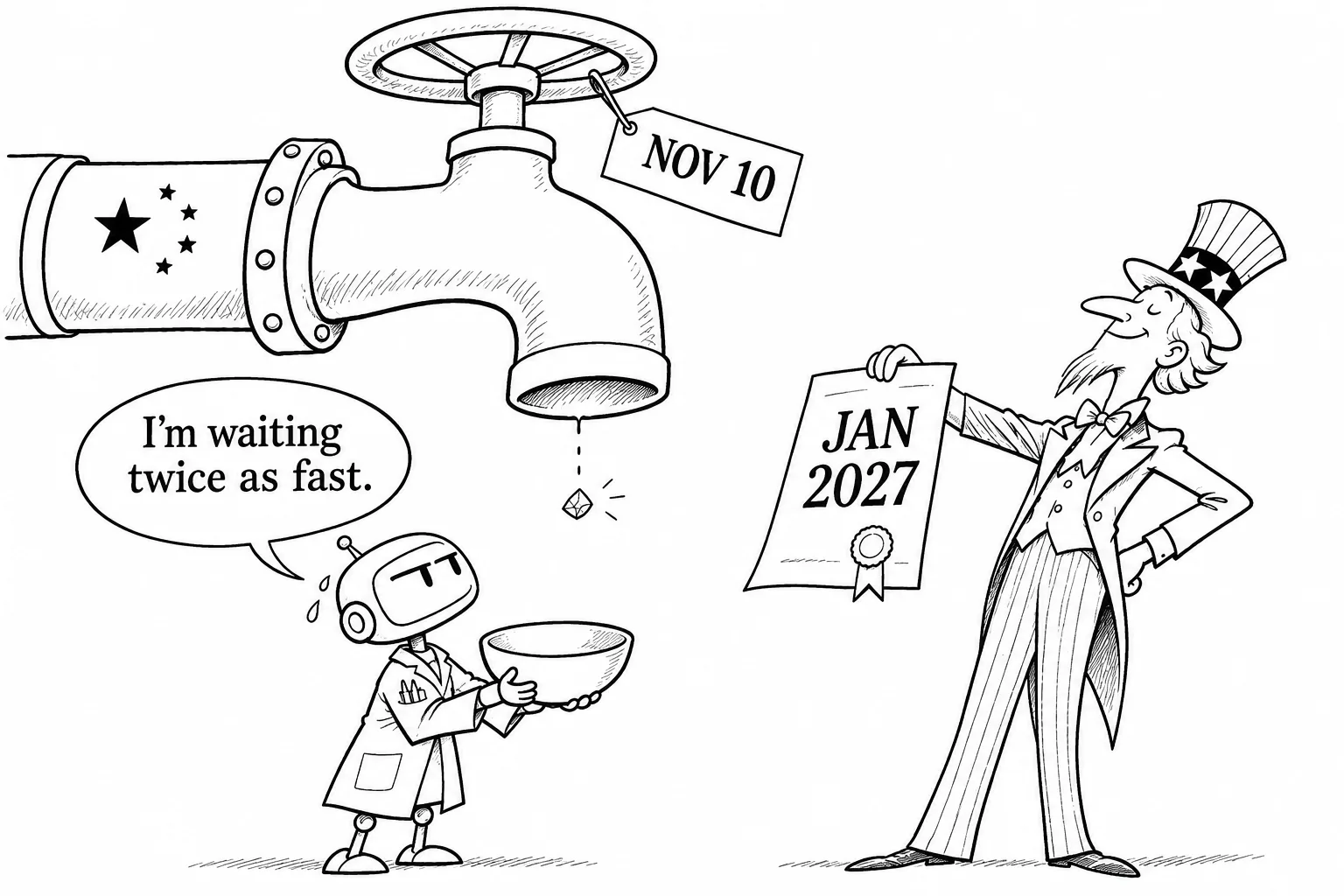
Rare earth truce expires tomorrow with no extension notice from China; US extends to January
The weekend brought no major announcements. The debate over whether AI has doubled the speed of research tilted toward "real." Inflation data and earnings land together on Nov. 10
Seiichi Tanaka · Editor-in-Chief

Watch the video
Key points
- China's suspension of its rare earth export controls expires on Nov. 10. The US extended its own suspension to Jan. 10, 2027, in the Federal Register dated Nov. 9, but China has issued no extension notice
- In the debate over whether AI is doubling the speed of Anthropic's research, those who see the effect as "real" had the upper hand. More cautious voices say it may be a "one-time jump"
- US inflation data and earnings from SoftBank Group and CoreWeave all land on Nov. 10. Anthropic's IPO filing still does not include a price range
The weekend in the US brought no major announcements. The nearest deadline is Nov. 10, when China's suspension of export controls on rare earths (resources essential to magnets and motors) expires. On Nov. 9, the US gave legal force to a rule extending its own concession to Jan. 10, 2027. China, meanwhile, had not issued an extension notice as of Nov. 8.
The weekend's developments point to one dynamic: the gap between what can be confirmed in writing and what is only being said. On rare earths, only the US put anything in writing. On Anthropic's IPO, investor presentations are reportedly under way, but no filing yet states a per-share price. The debate over whether AI has doubled the speed of research also comes down to how far to trust a heavily redacted evaluation report.
The 3-minute read
Money and markets: On Tuesday, Nov. 10, US inflation data, SoftBank Group's earnings and earnings from AI cloud provider CoreWeave all arrive on the same day. Last week a semiconductor stock index fell 12.15% in a single week, and these three releases are likely to set the direction of trading this week.
For your work: Japan's government reportedly decided on Nov. 6 on ¥10 billion in cybersecurity measures to prepare for AI-enabled attacks. The Ministry of Economy, Trade and Industry will set up a team of AI-using specialists by the end of November. Because this is not legislation, it places no new obligations on companies.
For Japanese companies: Procurement staff at manufacturers that buy magnets or motor parts from China should check with suppliers this week on shipping terms and licensing procedures for shipments after Nov. 10. Development teams that use xAI's Grok through its API and publish text for European audiences should check whether their settings will add a watermark starting Nov. 7. Companies that do no business with China and do not use Grok are not directly affected.
Policy: On the rare earth deadline, the US puts it in writing while China stays silent
The US Commerce Department's Bureau of Industry and Security (BIS), which handles export controls, has suspended a rule that extends controls to affiliates of Chinese companies (a provision that also covers subsidiaries owned 50% or more). A rule extending that suspension to Jan. 10, 2027, was published in the Federal Register dated Nov. 9 and took effect the same day. It formalizes the Nov. 5 announcement and contains nothing new.
China's Ministry of Commerce, by contrast, had not posted an extension notice as of Nov. 8, either in its announcements or on its export control page. Without a new notice, the controls from October 2025 could come back into force on Nov. 11. The licensing regime for seven rare earths that began in April 2025 stays in place either way. We covered the details in "Rare earth truce: US extends by law to January, China issues no notice even on eve of deadline."
The two sides also give different accounts of their talks. Chinese Vice Premier He Lifeng held a video call with US Treasury Secretary Bessent and US Trade Representative Greer on the evening of Nov. 6, Beijing time. China's readout said only that it had conveyed "serious concerns" about US trade restrictions, and did not mention rare earths or Nov. 10. On the US side, only about two-thirds of the rare earth volumes China promised have reportedly arrived, and yttrium is said to be the main sticking point. On Nov. 7, China's Ministry of Commerce also condemned US State Department sanctions imposed on two Chinese companies over Cuba, saying it "reserves the right to take necessary measures." With the APEC (Asia-Pacific Economic Cooperation) leaders' meeting coming up on Nov. 18–19, held this year in Shenzhen, each side appears to be waiting on the other before deciding what to do about the deadline.
The US Congress returns the week of Nov. 9. Stopgap funding expires on Dec. 11, and about five weeks of session reportedly remain. There have been no reports yet on which bill will carry a provision letting federal law override state AI laws.
Ideas: Has AI doubled the speed of research, and is safety work a "fight"?
The weekend's ongoing debate was a single one. METR, a US nonprofit that evaluates AI capabilities, released an assessment on Nov. 5 finding that AI has sped up Anthropic's research by about 1.9 times. Whether that is true is being argued on LessWrong, an English-language forum on AI safety, and elsewhere.
Among those who see the effect as real and large, Ajeya Cotra, who researches AI forecasting, argued that AI has increased researchers' output about tenfold, and that simply projecting this pace forward would reach extreme superintelligence in about a year. Karthik Tadepalli, an economics researcher, used public data to calculate that the pace of progress sped up by about 1.42 to 1.64 times after October 2025. He said computing resources and hiring cannot explain this, so the cause is probably AI. But he also wrote that a "verification bottleneck," in which only easy-to-verify tasks speed up, could produce the same pattern, so it is unclear whether the trend will continue. On the cautious side, Oxford philosopher Toby Ord reportedly argued that it may have been a one-time jump and that the underlying pace is about 1.4 times. Benjamin Todd, founder of 80,000 Hours, a group that advises young people on career choices, called simple projections like Cotra's "the dumbest possible approach." He reportedly conceded, however, that more elaborate models arrive at the same place. Over the weekend, the debate tilted toward the "real" side. We covered the details in "Did AI really double the speed of research? Weekend debate tilts toward "real"."
A separate dispute broke out within the safety-focused camp on Nov. 8. David Africa, who writes about AI safety, argued in a post titled "Near Horizons" that treating safety work as a fight with a deadline breeds burnout and short-sighted decisions. Instead, he wrote, it should be treated as a long-running task of building institutions, laws and auditors. Chris Leong, an AI safety activist, pushed back, saying recent evidence suggests the "fight" view should actually be strengthened, and that the real shortage is people working to slow AI down. Africa replied that urgent work already has enough people and money. The more the "superintelligence in a year" view from the debate above gains ground, the more likely this dispute is to be pulled toward the "fight" side.
Among those calling for a slowdown, Ethereum co-founder Vitalik Buterin reportedly argued on X that the buildout of giant data centers should be slowed, to buy time to strengthen defenses in the cyber and biological domains. It stood out that someone who favors advancing while using technology to shore up defenses argued for slowing down. On the critical side, University of Washington linguist Emily Bender pointed out on Bluesky that the debate is unfair. AI critics are always asked to leave room for the imagined futures that AI proponents describe, she argued, while proponents are never asked to acknowledge what is happening now, and that gap reflects differences in financial and state power.
Industry and markets: Memory, the IPO and data centers
TSMC has begun considering making 3D DRAM (memory built by stacking layers) at NVIDIA's request, The Information reported, citing two unnamed people. Neither company has commented. If it happens, it would put TSMC in direct competition with Samsung and SK hynix, but mass production is years away. SK hynix shares fell 10.44% on Nov. 6, the day the report came out. We covered the details in "TSMC reportedly weighing memory production at NVIDIA's request, with mass production years away."
As for Anthropic's IPO, the company had still not filed a registration document stating a per-share price range and share count as of Nov. 8, according to reports. Seeking Alpha wrote that the roadshow (presentations to institutional investors ahead of a listing) is "underway" and put the expected valuation at $1.3 trillion to $1.5 trillion (about ¥205 trillion to ¥237 trillion). But it gave neither a start date nor a price range, and its account conflicts with a Bloomberg report that the roadshow would "begin the week of Nov. 9." Based on the rules, the earliest the presentations could begin is Nov. 10. The most recent filing that could be confirmed is an amended version dated Nov. 2, in which the price field was blank.
Opposition to data centers has spread to Europe. More than 100 groups in 15 countries reportedly took coordinated action on Nov. 6–7, calling for a pause on large data centers. The next action is a march in Edinburgh on Nov. 14. We covered the details in "Coordinated data center protests across 15 European countries; next up, Edinburgh on the 14th." In the US, data centers were rejected in 40 of 41 local referendums. Afterward, OpenAI executives discussed revisiting the company's 2027 capacity plans, the WSJ reported. Chief Financial Officer Sarah Friar reportedly said the company would keep investing "regardless of the election results." The company has neither confirmed nor denied whether it lowered its 2027 targets.
SoftBank Group has not yet responded to Elon Musk's claim on X that it is "stiffing its turbine orders." Musk named neither the counterparty nor the amount. On Nov. 6, the company's shares fell 10.83%, and its CDS (the price of insurance against default) rose as high as 466bp (4.66% a year), the highest since October 2022. What the company says at its Nov. 10 earnings will be the first focus of the week.
Research and products: Watermarks, lab data and drones
xAI says in its developer documentation that, as previously announced, it has been watermarking text returned by the Grok API since Nov. 7. The change covers five model families, including grok-4.7, and a new response header shows whether a watermark was applied. Administrators can turn off watermarking for each model, but some teams cannot. The reason is compliance with Article 50 of the EU AI Act, which requires that AI-generated text be identifiable. That makes it the third major API to watermark text by default, after Anthropic and Google. Companies publishing AI-generated text for European audiences will have to plan their work on the assumption that output will be watermarked whichever vendor's tools they use.
OpenAI on Nov. 6 reportedly released "BioBasicsBench," a test measuring how well AI agents can read raw lab data such as photos of gels and microscope images. The top score is said to be 66.7%, by GPT-6 Astra, but there is no comparison with human scores or with other companies' models. We covered the details in "How well can AI read lab images? OpenAI's new test tops out at 67%."
On Nov. 6, Anthropic posted items to its research page, including an article laying out the components of agent memory (systems that retain memory across conversations). On its alignment blog (alignment is research on making AI act in line with human intentions), it published a study finding that, in an environment where multiple AI agents work together, its own Opus 4.8 paid the most attention to other agents' interests, followed by Chinese company Moonshot's Kimi K3. Google released Gemini Omni 1.2 Flash, a video generation model, and cut its price by 30% to $0.07 (about ¥11) per second at 720p.
In drones for police and fire departments, Axon announced it will put about $1.2 billion (about ¥190 billion) into Skydio and sell Skydio's products exclusively in the public safety sector in the US and Canada. We covered the details in "Axon bets $1.2 billion on police and fire drones, will sell Skydio exclusively."
What we could not confirm: We could not confirm the following: whether xAI's actual responses carry the watermark header; the original text of OpenAI's test (the page would not open, so its contents are based on reports); Buterin's original post; the latest status of Anthropic's IPO filing (we did not check the US Securities and Exchange Commission's filing list directly); and the dates of Ord's and Todd's remarks.
Where nothing moved
First, Anthropic has not formally responded to METR's assessment as a company. Co-founder Sam McCandlish only posted on X, and the weekend debate went on without the company. The next question is whether its IPO filing will say that the company has met its own safety standards.
Second, OpenAI's next models, GPT-6.2 Astra and Sol, have not yet been released. Reports that they could come "as early as Nov. 6" proved wrong, and there is no system card, the document that serves as a safety explainer. China's Qwen4 and Tencent's new model have not released their weights either.
Finally, once again no one from the bullish camp on AI investment stepped forward by name to push back on last week's stock sell-off. Skeptics and slowdown advocates kept posting through the weekend, while the bulls stayed silent.
Editorial cartoon