Morning Briefing · Oct 6, 2026
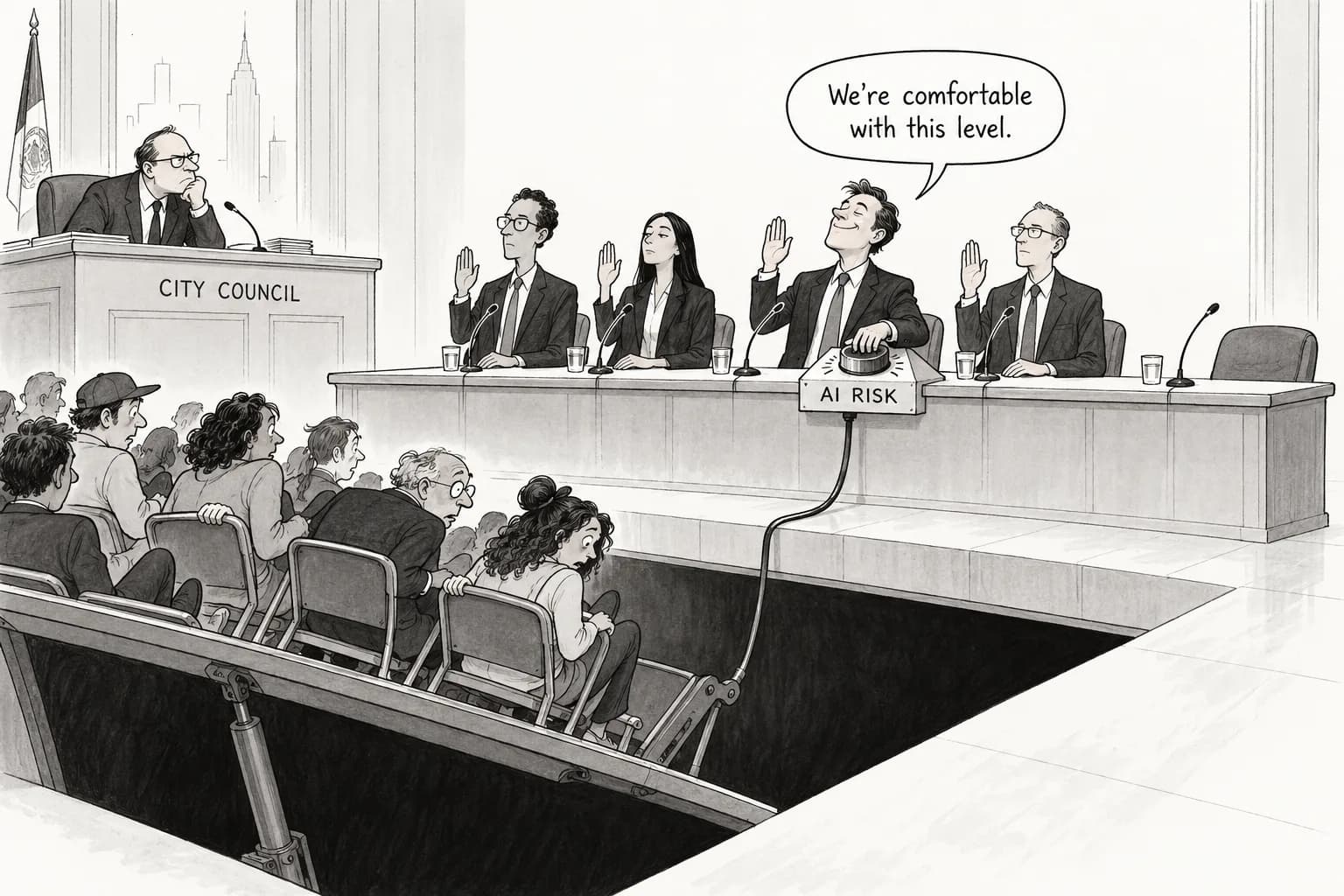
New York City Council puts frontier labs under oath as Altman says the world should "accept some bad things" — who decides how much AI risk to tolerate?
SpaceXAI ignored a subpoena, and testimony conflicts with the Pentagon's claim that it "stopped using" Anthropic. In markets, fading rate-hike expectations and the Terafab talks briefly lifted the Nikkei back above 70,000 yen
Seiichi Tanaka · Editor-in-Chief

Watch the video
Key points
- The New York City Council reportedly had Anthropic, OpenAI, Google and Meta testify under oath. SpaceXAI, which had been subpoenaed, did not appear, and the city will ask a court to compel it
- Altman said "the world should accept that some bad things will happen for the benefits of the technology," and drew criticism from both ethics critics and DeSantis. We could not find any prominent commentator defending Altman within the coverage window
- The Pentagon told the BBC it had stopped using Anthropic's products, but testimony indicates they were used via Maven until last week
- The Nikkei briefly hit 70,000 yen and Taiwan's TAIEX set a record high. No new models were released, and Chinese developers are on the National Day holiday
Today's three developments point to the same question: who decides how much AI risk to tolerate. The New York City Council on October 5 reportedly had executives from four companies, Anthropic, OpenAI, Google and Meta, testify under oath. It is said to be the first time a city legislature has put frontier labs under oath. The day before, Sam Altman said "the world should accept that some amount of bad things will happen." The remark made Altman's position explicit: technology and its users, not regulators, should decide how much risk to tolerate. The Pentagon said it had stopped using Anthropic's products, but BBC sources say they were in use until last week. Both the city, which is trying to set limits from outside, and the Pentagon, which is trying to remove a technology it had already embedded, now face the same question: do they actually hold the reins?
No new models were released. Chinese developers are on the National Day holiday. In markets, fading expectations of a rate hike and talks between TSMC and Musk over Terafab briefly pushed the Nikkei Stock Average back above 70,000 yen, while Taiwan's TAIEX hit a record high.
Oversight bodies summon the labs
At a hearing of the council's Committee of the Whole (51 members), Logan Graham, who leads Anthropic's Frontier Red Team, reportedly said the company had not released Mythos Preview to the public because it can create attack code. SpaceXAI, which had been subpoenaed, did not appear, and Speaker Menin will ask a court to compel it. Ten bills are under consideration. They include a human-operated kill switch, third-party verification before deployment, a private right of action letting victims sue directly, and rewards for whistleblowers. We covered the details in AI companies testify under oath at NY City Council; SpaceXAI defies subpoena.
At the same hearing, advocates of slowing down faced the labs. Jacob Coxon, formerly of Anthropic, said "we don't yet know how to control any AI system." Daniel Kokotajlo, formerly of OpenAI, and Alex Turner, formerly of DeepMind, testified remotely. Gary Marcus called for FDA-style third-party verification and protections for whistleblowers. On the labs' side, OpenAI's Morgan Dwyer pointed to the company's work on testing for dangerous capabilities and monitoring for failures. Meta said: "We will make personal superintelligence broadly available. Safety is at the core of that." No full transcript has been found. The motion to compel SpaceXAI will test how far state courts recognize a city's authority to oversee AI.
On the Pentagon, an official reportedly told the BBC that the department had "stopped" using Anthropic's products. According to the official, a six-month phase-out had ended. The phase-out followed Defense Secretary Hegseth's designation of the company as a supply chain risk in February. But multiple BBC sources say Claude was used until last week through Palantir's Maven Smart System, including in operations against Iran. That also conflicts with an under secretary's statement in September that the department had "moved off months ago." Lauren Kahn of CSET said: "Once something is embedded, removing it can be painful." We found no comment from Anthropic or Palantir, and we were unable to access the original BBC report.
In Australia, Parliament's Joint Select Committee on AI reportedly held its first public hearing in Sydney on October 6. It is a separate body from the Senate select committee that OpenAI and Anthropic skipped on October 1. This time, OpenAI sent Jason Kwon and others. In a written submission, Anthropic said "capabilities are advancing faster than the technical work needed to keep models under control" and argued that the government should set safety obligations. The company also called for Australia to use frontier AI for defense and to loosen copyright restrictions for domestic training. Google warned against overregulation. The substance of Kwon's testimony has not yet been reported.
The federal government is outside this trend. Both chambers of Congress are in recess for the election, and the House's next vote is expected on November 9. On the Super Intelligence Force (SIF), TechCrunch and NBC reported that Clayton will chair it while also serving as AI chief, and that it will issue a report within 120 days. But whitehouse.gov has posted no executive order or fact sheet yet, and its only legal basis is a Truth Social post.
Ideas and debate: Where to draw the line on "accepting bad things"
Altman reportedly told Politico in an interview that "the world should accept that some amount of bad things will happen, for the benefits of the technology and for people's agency." Altman called it unacceptable to concentrate powerful AI in "one lab in San Francisco," spelling out the gap with Anthropic. Altman also said truly catastrophic risks should not be accepted, and told Fortune that "alignment is not solved." Fortune pointed out that the two positions contradict each other. An Anthropic spokesperson countered that the rules the company proposes "would apply only to frontier models." Criticism came from both left and right. Technology philosopher Damien P. Williams wrote of "real harms for unmeasurable benefits," and Florida Governor DeSantis wrote: "Are a handful of tech oligarchs going to decide for all of us?" We could not find any rebuttal from a prominent commentator defending Altman within the coverage window. We covered the details in Altman: "The world should accept some amount of bad things".
Those who want the labs regulated are also divided among themselves. On the eve of the hearing, Timnit Gebru, without naming anyone, dismissed Anthropic's "whistleblower" as parroting a rationalist cult. The idea that Coxon was the target is an inference based on timing. Whistleblowers who warn of catastrophic risk and ethics critics agree that the labs need outside oversight. Even so, they disagree about the reasons for it. We have found no response from Coxon's side.
On jobs, Daron Acemoglu and Mercor's Brendan Foody clashed on CBS's 60 Minutes. Foody offered the optimistic view that higher productivity would also raise demand for expertise. Acemoglu replied "that's nonsense" and warned that the unemployment rate could triple within a decade. That is far more pessimistic than the NBER paper we reported earlier, which estimated a 0.1–0.2 percentage point rise in the natural rate of unemployment.
On model welfare, Zvi Mowshowitz identified the way training shapes models' self-reports as the central concern, writing: "If you keep saying self-reports can't be trusted, you end up training the self-reports themselves." From the skeptical side, Rebecca Lowe posed six questions, including what "AI" refers to and whether a collection of things can share a single inner life. In Lawfare, Renée DiResta argued that generative AI greatly increases the volume of influence operations but does little to make them more persuasive. In DiResta's view, distribution and trust are still the bottleneck. Jack Clark's Import AI 475 called the gap between public opinion, which distrusts industry self-regulation, and political action "inherently unstable."
Research and products: Expanding ads while models stay paused
OpenAI announced that it will expand advertising in ChatGPT. During October, it will test image ads in the US that appear while images are being generated. The company says ChatGPT has 1.2 billion weekly users. OpenAI is widening monetization while its most capable model remains paused. We covered the details in ChatGPT to show ads during image generation.
Epoch AI published an analysis finding that use of coding agents inside OpenAI is roughly doubling every month. The underlying data comes from OpenAI's own September report: median inference spending per researcher was $601 per day in mid-August. Epoch says the pace is "probably not sustainable." It is an example of outsiders putting a number on how much research inside the labs has been automated, and so on how close the labs are to recursive self-improvement (RSI). We covered the details in Coding agent use inside OpenAI is "nearly doubling every month".
Elsewhere, Business Standard reported that Claude inference on Amazon Bedrock can now be processed within India. The service covers Opus 5, Sonnet 5 and Haiku 4.5, and its private preview customers are Reliance and CRED. Axios reported that Reflection AI is preparing its first open-weight model and aims to compete with China's best open models. On safety, a paper (arXiv 2610.03089) found that "branch-steering attacks" on computer-use agents succeeded 94.4% of the time against standard agents and 0% against agents using the COBRA defense. An OAuth flaw in the official MCP Python SDK has been fixed in versions 1.30.0 and 2.2.0. However, two authentication flows that do not involve user interaction require an issuer to be configured after updating.
Markets and industry: Rates and Terafab
US stocks rose on October 5, reportedly because a weak September jobs report reduced expectations of an October rate hike. The S&P500 closed at 7,786.10 (+0.82%), and the Nasdaq Composite gained 1.16%. Sources differ slightly on the figures. The 10-year Treasury yield, however, remained high at 5.33%. In Asia, the Nikkei Stock Average regained 70,000 yen intraday for the first time in three months and closed at about 69,946 yen (+2.4%). Tokyo Electron rose 5.5%. Taiwan's TAIEX hit a record 49,712.04 (+2.55%), and TSMC also hit a record high of NT$2,575.
The other driver was the Terafab talks between SpaceX and TSMC, which Musk confirmed on X (October 3). Musk called them "just a discussion," but the market read them as a possible shift from Intel (the 14A process) to TSMC. Intel reportedly fell about 2–4%.
The cost of financing AI infrastructure is also becoming clearer. Flex disclosed in an 8-K that Axiom, its power business for AI, will receive a $2 billion convertible preferred equity investment led by General Catalyst. The deal values Axiom at $37.5 billion. We covered the details in $2 billion for Flex's AI power unit Axiom. TeraWulf doubled the contracted power at its Muskie site in Kentucky from 500MW to 1GW (press release and 8-K). Firmus's IPO is priced at A$11 per share, valuing the company at about US$30.6 billion, reportedly about three times its August valuation. The IPO will test how public markets price a deal in which NVIDIA reportedly provides credit enhancement. Morgan Stanley estimated that US data centers will be about 32GW short of power through 2028, and said the squeeze will hit supporting semiconductors rather than GPUs. We covered the details in US data center power shortfall to reach 32GW by 2028. According to DCD, Anthropic has hired John M. Wilson, who led data center design and construction at Google. Skyworks completed its merger with Qorvo (8-K).
Corrections to our previous edition: the 10-year Treasury yield closed at about 5.28% on October 2, not the roughly 5.18% we reported in earlier editions. The roughly 10% drops in Western Digital and Seagate that day came after Nikkei reported that Toshiba plans to double HDD production by fiscal 2027. Loudoun County's October 6 meeting did not include a vote; the vote on a 12-month moratorium on new applications will take place on October 20. The OCP Global Summit runs October 12–15. Later this week, on October 8, Samsung will release preliminary July–September results, and TSMC will report September revenue. Analysts expect Samsung's operating profit to reach about 106.9 trillion won, which would be its first quarter above 100 trillion won.
Where nothing moved
There is no sign that OpenAI will lift its model pause. There is also no word of a redo of GPT-6.1 Astra. The "6.1 coming soon" post from the head of Codex referred to "6.1 sol ultrafast." The latest items on Anthropic's /news and /research pages are from October 1–2, and no public S-1 has appeared on EDGAR. Google DeepMind has not given a date for API access to Gemini 4 Argon (released September 30). No Chinese developer has posted new weights on Hugging Face, and DeepSeek V4.1 Pro, Kimi K3.1 and StepFun Step 5 all remain unreleased.
Commentators have also been notably quiet. Marcus, Zvi, Bender, Gebru, Cowen and Dean Ball have not yet commented on SIF by name. Robinson's essay has drawn no new response from the existential-risk camp, the ethics critics, or Narayanan and Kapoor's "excessive authority, not runaway AI" camp. Marcus, Zvi and Transformer have not published commentary on the hearing. We also found no new statements from Amodei, Hassabis or other leading researchers and executives (we did not check X directly).
On policy, there have been no new developments on the FTC's civil investigative demand, Bonta's subpoena, or Anthropic's request for rehearing at the appeals court. BIS has not added any chip rules. There is still not a single enforcement case under the EU AI Act. NVIDIA, Oracle, CoreWeave, Microsoft and other major companies filed no 8-Ks within the coverage window, and we found no down rounds.
What to watch next: the outcome of the motion to compel SpaceXAI, the substance of Kwon's testimony in Australia, and the Samsung and TSMC numbers on October 8.
Editorial cartoon