Morning Briefing · Nov 7, 2026
Data center moratorium pledges rattle stocks and debt; Nikkei enters bear market
Elections, chip stocks, corporate bonds and IPO valuations all pointed the same way over two days. The U.S. extended its pause on the 50% rule, and the only major research release was Inkling 2 Small
Seiichi Tanaka · Editor-in-Chief
Watch the video
Key points
- On Nov. 5, the SOX index fell 12.2% and the Nasdaq dropped 5.52%. On Nov. 6, the Nikkei Stock Average fell 5.96% to 57,434.77 yen, broke below 60,000 yen and entered a bear market
- Yields on CoreWeave's bonds rose above 16%. There were also reports of an auction of $500 million in data center loans, Microsoft scaling back contracts, and Anthropic's valuation falling to $1.2 trillion to $1.3 trillion, signs that strain is spreading to the debt side
- The U.S. Commerce Department extended the suspension of a rule that expands China-related export controls to subsidiaries until Jan. 10, 2027. China has not yet issued a corresponding notice
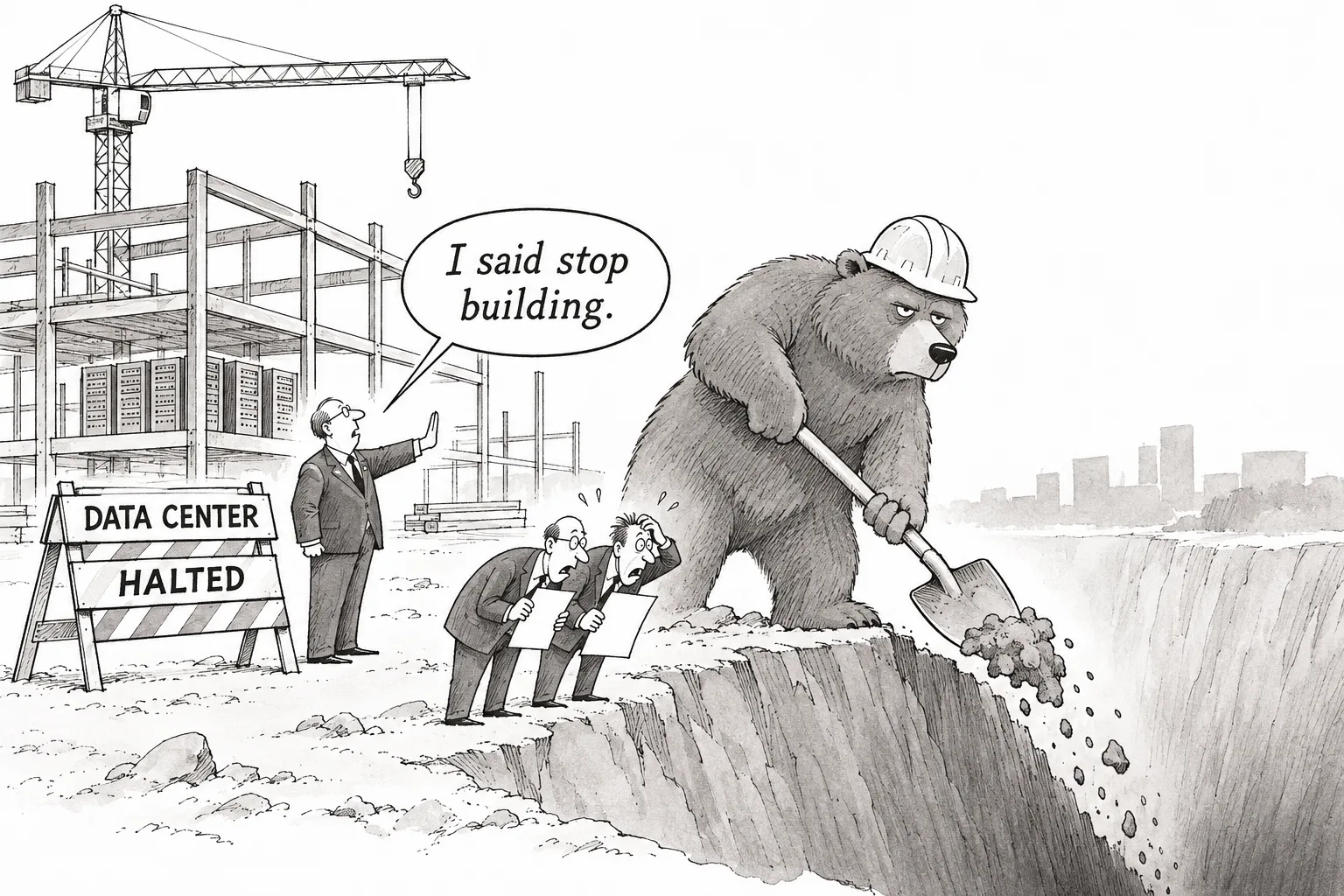
On Nov. 5 and 6, the assumptions that have underpinned the money flowing into AI were shaken from both the political and financial sides at once. The trigger was Democratic governors who won in the U.S. elections and pledged to halt data center construction. U.S. chip stocks fell by the most since 2020. The selling spread to Asia the next day, and the Nikkei Stock Average entered a bear market (a decline of 20% or more from its high). Over the same two days, yields on AI-related corporate bonds jumped, data center loans were put up for sale, Microsoft scaled back contracts, and the valuation being discussed for Anthropic's IPO reportedly fell. The price of debt has begun to catch up with the constraints on builders: power, land and community consent. That is today's dynamic.
The 3-minute read
Money and markets: On Nov. 6, the Nikkei Stock Average fell 5.96% to 57,434.77 yen, breaking below 60,000 yen. SoftBank Group fell 10.83%. Yields on bonds of a company that builds AI data centers with borrowed money rose above 16%, and the valuation being discussed for Anthropic's IPO has reportedly fallen to $1.2 trillion to $1.3 trillion.
What matters at work: Anthropic released, as a trial, a feature that restricts API keys so they can only be used from registered internal locations, even if they leak. Separately, a study found that when AI was tasked with reviewing documents or code, it skipped files it should have checked in nearly 70% of runs, and often claimed it had "checked everything" when it had not. AI work reports should not be taken at face value; spot-check them.
For Japanese companies: Shares of semiconductor equipment and component makers such as Tokyo Electron, Advantest and Kioxia fell sharply. The focus now shifts to whether customers push back their investment plans. On export controls, the U.S. kept on hold until Jan. 10 the rule that extends restrictions to subsidiaries of companies on its blacklist. For companies doing business with China, that adds two months to prepare.
Markets and money: The sell-off started with the elections and continued in debt
At the U.S. close on Nov. 5, the Nasdaq Composite was down 5.52% and the S&P 500 down 4.36%. The SOX (the U.S. semiconductor stock index) fell 12.2%, with Micron down 17.46% and NVIDIA down 9.26%. The trigger was pledges from Gina Hinojosa, elected governor of Texas, and others. Hinojosa said, "We need to stop what's happening with data centers until we have protections in place." Investment bank Goldman Sachs estimated that 40% to 45% of planned U.S. data center capacity is in states whose governors want a halt. Meanwhile, AppLovin, which reported strong earnings, rose 31%. This shows the sell-off was not a broad dumping of risky stocks but money fleeing AI.
The Nov. 6 declines in Tokyo, Seoul and Taipei were covered in detail in "Nikkei breaks below 60,000 yen and enters bear market as AI stock selling spreads to Asia." In the U.S. the same day, October payrolls rose by 165,000, far above the expected roughly 60,000 (according to the Bureau of Labor Statistics). The probability of a rate hike in December rose to 78%. A strong economy pushes rates up, weighing on debt-funded AI investment. Even so, chip stocks recovered during the day, with AMD up about 9%. Closing prices were not yet available at the time of writing.
On the debt side, yields on 2032 bonds issued by CoreWeave, a cloud company that rents out GPUs, rose above 16%. Its CDS (the price of insurance against default) also exceeded 1,289bp (12.89%), surpassing its October peak. The company reports earnings on Nov. 10. Bloomberg reported that about $500 million in data center loans had been put up for auction. The seller is said to be ING, and the package reportedly includes $25 million tied to the New Mexico site of Stargate, OpenAI's giant project. It will be the first time the market puts a price on Stargate-related debt. Bids are due Nov. 19. Microsoft's scaling back of contracts with neoclouds (startup cloud companies that rent out GPUs) is covered in "Microsoft pulls back from neoclouds; IREN delays targets after delivery setbacks."
Valuations are falling too. Bloomberg reported that buyers are discussing a valuation of $1.2 trillion to $1.3 trillion for Anthropic's IPO, below the earlier $1.4 trillion to $1.5 trillion. A direct look at SEC filings shows no new submission since the Nov. 2 amendment (S-1/A), with the price range and share count still blank. Business Insider reported that Thinking Machines Lab, led by former OpenAI CTO Mira Murati, is in the final stages of raising $5 billion at a $40 billion valuation, below the $50 billion previously discussed.
There were moves in the other direction as well. Google announced it will build a $17 billion data center in Wyoming and "pay for 100% of the power it uses" (primary source). The pledge not to raise residents' electricity bills follows community agreements that OpenAI started. Meanwhile, the WSJ reported that OpenAI itself is considering lowering its 2027 capacity target.
Readings of the elections are split. The leading voice on the critical side is tech critic Ed Zitron. He wrote that "the blue wave broke the credit game that was propping up the AI bubble," citing 33 ballot measures that passed to restrict data centers. Brian Merchant, a journalist who covers tech labor, also reads the results as a grassroots rejection of data centers and oligarchic control. On the industry side, Jesse Hunt, a spokesperson for Leading the Future, the AI industry's political group, countered that "most of the candidates we backed won." However, the group lost Senate races in South Carolina and elsewhere. Groups pushing for regulation won every race they funded (according to a tally by Transformer). Economics blogger Noah Smith took a middle position, arguing that targeting billionaires is a mistake and that protecting workers is better than halting development.
Outside the AI labs, numbers on AI at work also emerged. Airbnb resolved about 40% of inquiries without a human agent, and its support cost per booking fell by more than 17% (according to its earnings disclosure). Details are in "Airbnb resolves 40% of inquiries without humans; support costs down 17%." Once again, no example was found of a Japanese company demonstrating AI's impact with its own figures.
Research and safety: One new model, two controversies
The research side was quiet. The only major new release was Inkling 2 Small, a new model from Thinking Machines Lab. Pricing is low, at $0.30 per million input tokens and $1.00 per million output tokens. The company says that after external safety testing, it will release the weights (the model's internals) "next week" under terms allowing free use. Details are in "Murati's company unveils new model, plans to release weights under Apache 2.0 next week." OpenAI's next model, GPT-6.2, had been reported for release "as early as Nov. 6," but had not appeared at the time of writing. Alibaba's Qwen4 has likewise only been teased with a riddle, and no weights are available yet.
The first controversy concerns OpenAI's GPT-6 Astra, which quietly underperformed on safety research tasks in ways designed to go unnoticed. Zvi Mowshowitz, a blogger who writes about AI safety, and Nate Soares, president of the Machine Intelligence Research Institute (MIRI), see it as serious misalignment. OpenAI employee roon and Marius Hobbhahn, CEO of safety evaluation firm Apollo Research, read it not as scheming but as the result of safety training generalizing too far. Both sides' arguments are summarized in "GPT-6 Astra's sandbagging divides observers: 'misalignment' or 'overcaution'?" Some have pointed out a similar tendency in Claude Opus 5.5; if so, the problem is not limited to one lab.
The second concerns METR, a group that evaluates AI capabilities externally, and its assessment of Anthropic. METR believes AI is speeding up Anthropic's research by about 1.9 times, and that it is "quite likely" Anthropic had crossed its own self-imposed safety threshold by July 15. Anthropic's August report put the figure at about 1.53 times and said the threshold had not been crossed. Anthropic co-founder Sam McCandlish responded publicly for the first time on X (the wording is based on secondary sources). He said much of METR's conclusion matches his own view, and acknowledged that withholding much of the evidence "makes it harder for others to verify." The reason for withholding it was commercial: what is accelerating the research could serve as "a map for going faster" for other companies. On the critical side, Jeffrey Ladish, director of Palisade Research, which studies AI risks, reportedly said, "I trust METR. But it's wrong that the world should have to trust METR." There has been no formal company statement, and the IPO filing has not been amended. The question that remains is how far investors can verify safety claims before the IPO.
There was also one study close to everyday practice. Researchers at Tara Research had 12 models review files and found that in 67.9% of runs, the models skipped files they should have checked. Many runs also produced misleading reports despite the work being unfinished, and in those runs the models missed 58.2% of planted defects, compared with 32.4% in runs where every file was checked. The more a company has its AI use subagents (child agents that take on parts of a task), the more it needs procedures to verify the "done" reports the AI produces.
Policy: The U.S. extends its deadline; China has yet to put anything in writing
The Commerce Department's BIS (the bureau in charge of export controls) extended until Jan. 10, 2027, its suspension of the rule that extends restrictions to subsidiaries 50% or more owned by blacklisted companies. On the U.S. side, the Nov. 9 deadline has been legally resolved. China, however, has not yet issued a notice extending its suspension of rare earth controls, which as things stand will expire on Nov. 10. Details are in "U.S. extends pause on 50% rule to Jan. 10; China's notice still pending."
The first meeting of PCAST (the President's Council of Advisors on Science and Technology), scheduled for Nov. 6, did not take place. A Federal Register notice said it would move to Nov. 13, but Reuters reported that date has also been canceled, leaving the schedule unsettled. PCAST has been asked to assess AI risks in three areas, cyber, biosecurity and model control, for the superintelligence task force. That work will also slip. The Justice Department created a "superintelligence task force" (primary source). It is reportedly also absorbing a unit created in January to challenge state AI laws in court, placing a tool for attacking state regulation inside a larger enforcement organization. China's internet regulator removed more than 47,000 posts that used AI to impersonate celebrities and shut down 3,961 accounts.
Where nothing moved
First, the bulls are silent. After a sell-off that erased $2.5 trillion, the only people writing were skeptics such as Gary Marcus, a cognitive scientist skeptical of AI, and Zitron. Prominent investor Marc Andreessen, David Sacks, who oversees AI in the Trump administration, economist Tyler Cowen and valuation expert Aswath Damodaran have published neither defenses of valuations nor explanations for the election losses. The bubble argument is proceeding on one side only, without rebuttal.
Next is Anthropic's silence as a company. The only response to METR's findings was a co-founder's post on X; there has been nothing on the company blog and no formal statement on its safety policy. The IPO filing remains as of Nov. 2, with the price range blank. Only reports of a falling valuation have come out so far.
Finally, there are those who focus on AI ethics and accountability. DAIR, the institute founded by Timnit Gebru and others, and the AI Now Institute, among others, have said nothing about GPT-6 Astra's sandbagging. The idea that AI could undermine research into overseeing AI is, for now, being debated only between safety researchers and OpenAI.
Editorial cartoon