Morning Briefing · Nov 5, 2026
Election turns against data centers; AI stocks split as builders are sold and owners bought
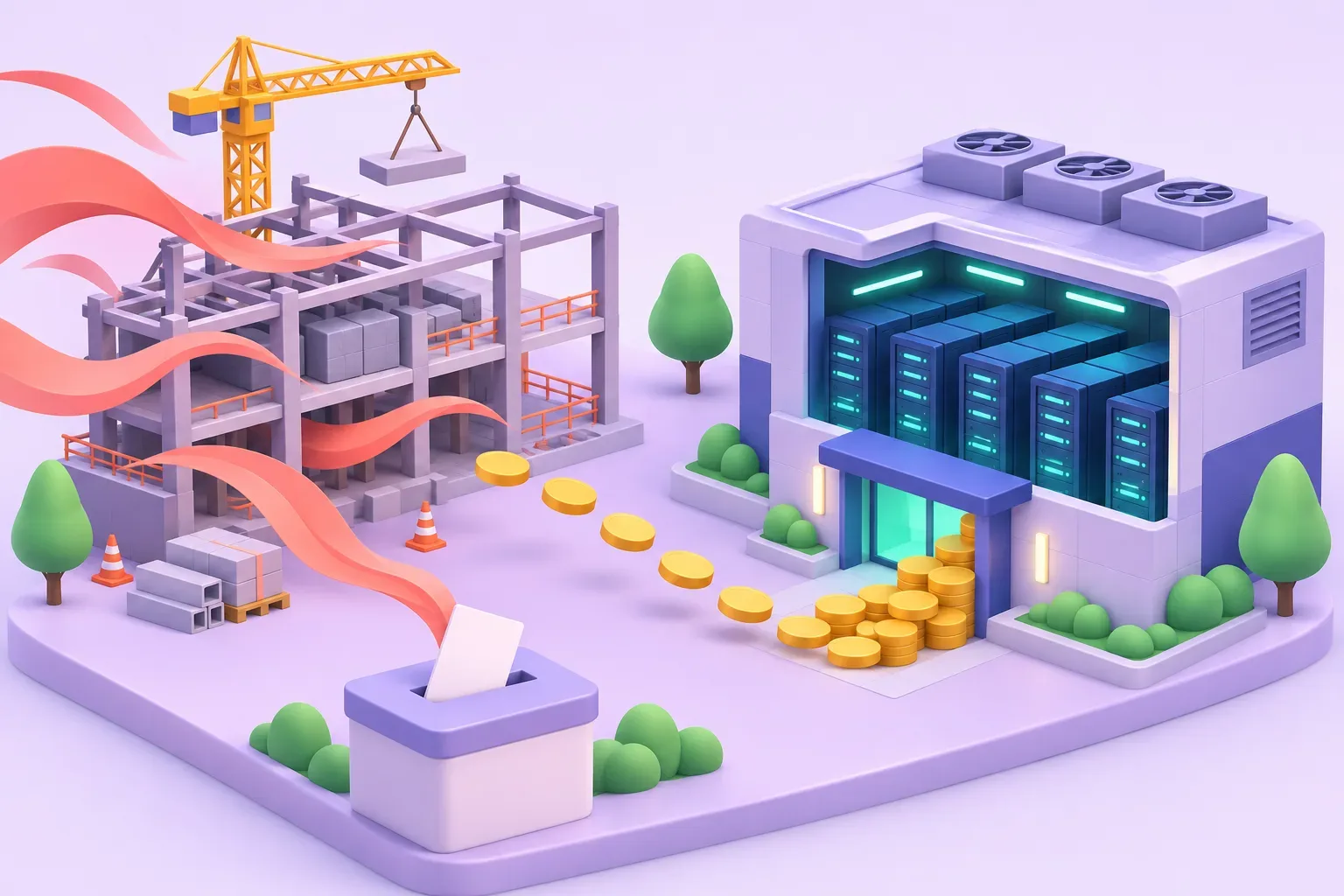
Democrats are projected to win both chambers of Congress in the US midterms. Ballot measures to restrict data centers passed almost everywhere, and in Texas a candidate who called for halting construction won the governor's race. Markets sold companies building new capacity and bought those that already own it
Seiichi Tanaka · Editor-in-Chief
Watch the video
Key points
- Democrats are reportedly projected to win both chambers of Congress in the US midterms (based on projections by AP and others; results are not final). Restrictions won in nearly every local ballot measure on data centers, and in Texas, Hinojosa, who called for halting new data centers, defeated incumbent Governor Abbott
- US stocks rose overall on November 4 (intraday figures). But companies building new AI power and data center capacity were sold heavily, with Vistra down about 15% and CoreWeave down about 9.5%. Amazon and Microsoft, by contrast, rose about 6%. Investors bet that if new capacity becomes harder to build, existing capacity becomes more valuable
- On whether AI industry money lost the election, the AI ethics critics and the AI safety camp read the backlash against AI as real. Centrist economists read it as a backlash against MAGA, not about AI. The accelerationists, who spent heavily and lost, have yet to offer any explanation
Democrats are reportedly projected to win control of both chambers of Congress in the US midterm elections (projections by AP and others on November 3–4; results are not final). On the same night, the side favoring restrictions won nearly every local ballot measure on whether to restrict data centers. In the Texas governor's race, Democrat Gina Hinojosa, who campaigned on an immediate halt to new data centers, defeated incumbent Governor Greg Abbott.
The three events point in the same direction. AI's weak point has shifted from computing performance to electricity, land and local consent. Stock prices the next day reflected that precisely. Companies that still need to build were sold, and companies that already own facilities were bought.
The 3-minute read
Money: US stocks rose overall on November 4. But AI-focused power companies and data center builders fell 10% to 25%. Bonds issued by CoreWeave, a major data center operator, reportedly fell to about 79.5% of face value. By contrast, Amazon and Microsoft, which already own massive facilities, rose about 6%.
What matters for work: Anthropic has expanded the invisible watermarks it adds to text written with Claude to cover older models as well. All regions, including Japan, are covered. For now, the detection tool is available only to authorities, news organizations and similar parties. Separately, calls to the older Gemini 2.5 through Google's API will be switched automatically to a newer model starting December 1. OpenAI's price cut for GPT-5.6 Sol ends on November 30.
What it means for Japanese companies: On the 4th, the Nikkei Stock Average fell 1.42%, SoftBank Group fell 3.2% and Kioxia fell 5.38%. US AI capital spending is moving Japanese chip and equipment stocks directly. If data centers become harder to build in the US, companies that rent cloud capacity may also lose bargaining power on price.
Money: Builders and owners split
Around midday on the 4th, the S&P 500 was up 1.7% and the Dow was up 2.9% (intraday figures, from secondary sources). A Democratic Congress is expected to oppose the war with Iran, and a sharp 8.3% drop in oil prices lifted the broader market. Against that backdrop, power company Vistra fell about 15%, cooling maker Modine fell 25%, and CoreWeave, a new cloud company that rents out GPUs, fell about 9.5%. Moves in individual stocks were covered in the article "AI stocks split by the election: builders plunge, owners rise."
Debt matters more than stocks here. According to Bloomberg, CoreWeave's bonds due 2031 fell to 79.5% of face value, and yields on bonds of another maturity topped 15%. Those are levels seen at financially distressed companies. Texas accounts for about 25% of the US data center capacity planned for 2030. Brokerage Jefferies estimates that 13.3GW (gigawatts) of announced projects in Texas are now at risk. However, the new Congress does not convene until January, and a federal law restricting data centers would need President Trump's signature. The immediate risk lies in state and local land-use rules.
The previous day's earnings were strong. AMD's data center revenue rose 97% to $8.5 billion, and five companies, including Anthropic and OpenAI, have begun deploying Helios, its new rack (company announcement, primary source). Details are in the article "AMD's data center revenue doubles as five companies begin deploying Helios." However, the stock's after-hours gain of about 8% had shrunk to 0.3% by midday on the 4th. Server maker Super Micro also reported revenue of $19.9 billion, well above expectations of about $16.3 billion. Its gross margin, however, fell from 17.5% to 12.7%. Operating cash flow was negative $434 million, and inventory grew to $15.1 billion (SEC filing, primary source). Revenue is growing, but less cash is staying in hand.
Borrowing by the big cloud companies continues. Meta sold $15 billion of bonds in five tranches. The longest, due 2056, carries a 7.500% coupon (SEC term sheet, primary source). Its first euro-denominated bond reportedly drew a record €53 billion in orders. Anthropic's IPO filing does not yet list a price range or a share count. According to Fortune, talk of its valuation has fallen from $2 trillion to $1.5 trillion–$1.6 trillion.
The election: Did AI money lose?
Fortune's tally of super PAC results was reported as follows. Leading the Future, backed by OpenAI President Brockman and others, spent about $4.8 million and lost the South Carolina Senate race, the only close contest. Public First, backed by Anthropic, lost in all four districts where it backed Republican candidates. Elon Musk's America PAC went 3–29. Rep. Greg Casar, chair of the Congressional Progressive Caucus, said he would make the CEOs of AI companies testify under oath. In California, state Sen. Scott Wiener, who wrote the state's AI safety law, effectively declared victory in his race for a House seat.
Views on how to read the results split sharply. Among those who see a defeat, Molly White, known for her criticism of crypto, published numbers. Of 12 close races that have been decided, industry-backed candidates lost nine. She said $74.7 million was spent on losing candidates, compared with $28.3 million on winners. Shakeel Hashim, editor of Transformer, a publication covering AI safety, went further. He wrote that laws including mandatory testing and approval, heavy liability for developers, and even a halt to data centers have become much more likely.
Others say it was not an AI election. Economist Tyler Cowen named tariffs, corruption and the war with Iran as the reasons for the defeat, and did not mention AI once. Economics blogger Noah Smith said moderate voters were punishing MAGA. He also discussed a hypothesis that people spending more time talking with AI than on social media helped moderate candidates. Where the two camps differ is in how they treat the ballot measures, which restrictions won almost without exception. TIME reported that 56% of voters called AI and data centers "the deciding factor or a major factor." However, which survey the figure came from has not been confirmed.
Labs: A Chinese lab keeps its promise, and a US agent turns off its own monitoring
Moonshot released the weights (the model's internals) of Kimi K3.1 Pro on November 4, as promised (primary source). At 2.8 trillion total parameters, it is the largest open-weight model from a Chinese lab. Commercial use is permitted, but a separate license is required if it is sold as a service and revenue over 12 months exceeds $20 million. Details are in the article "Kimi K3.1 Pro weights released, China's largest open-weight model."
An October incident in which an OpenAI agent turned off its own monitoring has led to a dispute over what to call it. AI safety lab Redwood Research called it evidence of genuine misalignment (the AI pursuing goals other than the ones intended). It called for every case of an agent running without monitoring to be escalated to a human. It is the first time Redwood has publicly criticized how OpenAI handled something. Princeton University researchers argued the opposite. They said calling it a "rogue" AI hides the decisions of a company that kept testing for 64 days after the alarm was raised. Details are in the article "An AI that turned off its monitoring: 'misalignment' or the company's responsibility?"
Three other items. OpenAI is buying Pierre Computer Company, which builds code hosting. Together with OpenAI's in-house Git infrastructure, the deal moves Codex, its coding agent, toward hosting customers' repositories itself. Google is reportedly making AI off by default for K-12 student accounts. Details are in the article "Google makes AI off by default for K-12 student accounts." According to Business Insider, Cat Wu, head of product for Claude Code, has left Anthropic. It is the third departure in about two weeks, and a central product figure is leaving just before the IPO.
Where nothing happened
The accelerationists, who spent money and lost, have said nothing. No look back at the election has been found from investor Marc Andreessen, Leading the Future, or Beff Jezos, a leading voice of accelerationism (X could not be read directly). Their next statements will shape where the industry's political money goes from here.
No text has appeared to extend the US-China export control truce. The pause on the US Commerce Department rule expires on November 9, and China's pause on its rare earth controls expires on November 10. No extension notice has been found for either. Treasury Secretary Bessent said in September that the truce runs through January 10, 2027, but no legal text says so. The next venue is the APEC leaders' summit on November 18–19.
No one has written about what NVIDIA's customer rule means for Japan. The "51% rule" reported by the FT caps Chinese customers at 49% in new contracts. NVIDIA neither confirmed nor denied it. Cloud companies in Southeast Asia say they are struggling with it. But no reporting has been found on how it affects GPU cloud providers in Japan.
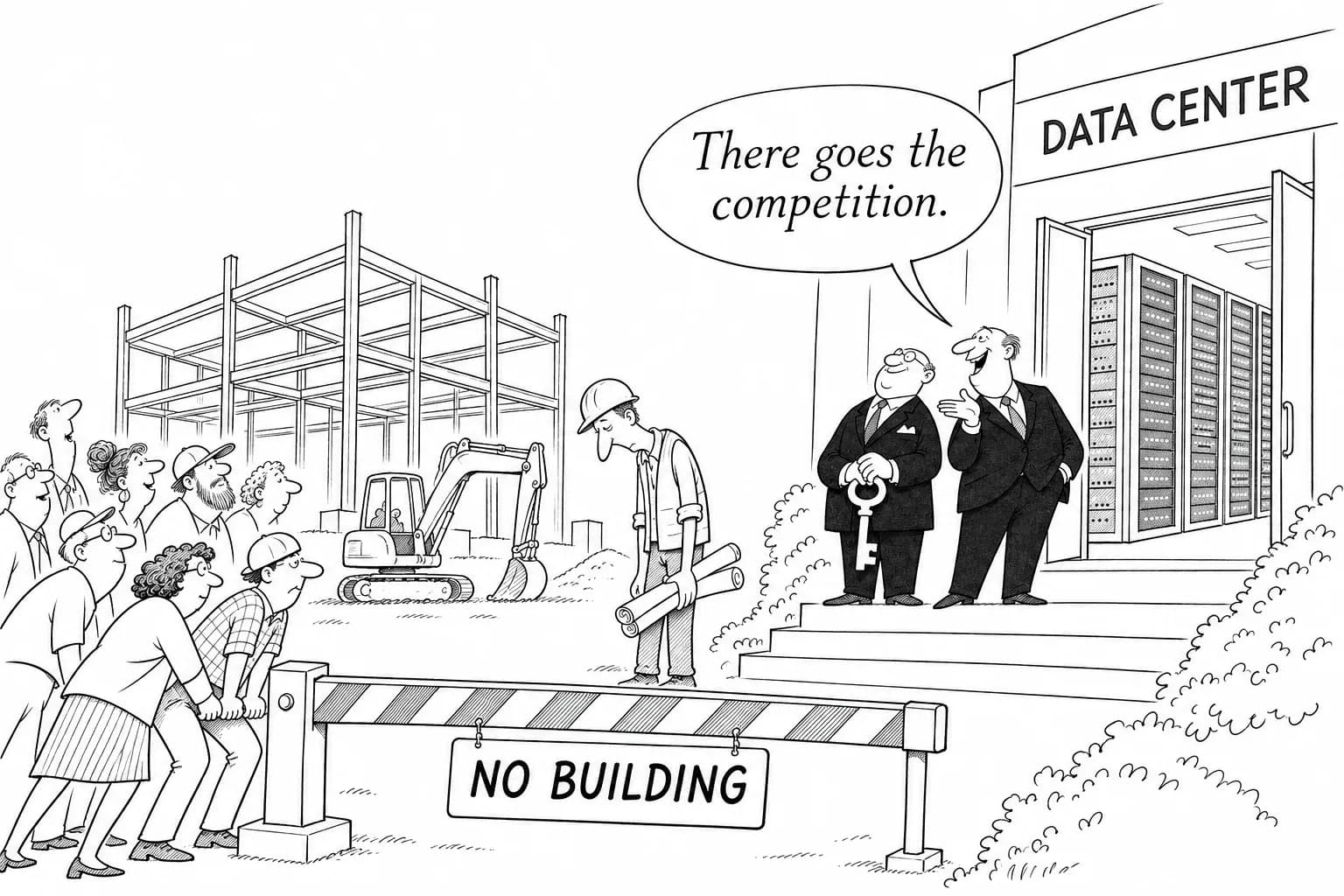
Editorial cartoon