Morning Briefing · Nov 4, 2026
AI debt push hits a third day as Meta reportedly taps bond market; Apple guides lower on memory costs
The cost of AI is starting to spread to bond investors and device makers. Lenders are becoming choosier about borrowers, and the KOSPI fell 3.59%. Results of the U.S. midterm elections are not yet in
Seiichi Tanaka · Editor-in-Chief
Watch the video
Key points
- Big Tech's push to raise money for AI infrastructure through debt continued for a third straight day. Meta's offering is reportedly more than $20 billion, at spreads well below Oracle's. Lenders are starting to choose their borrowers
- Apple guided its October–December gross margin to 45–46%, mainly because of rising memory prices, below the expected 46.3%. AI costs have now reached the profits of companies that make devices
- The FT reported that NVIDIA is asking partners to sell at least 51% of their capacity to customers outside China. Japanese GPU clouds were named among those affected
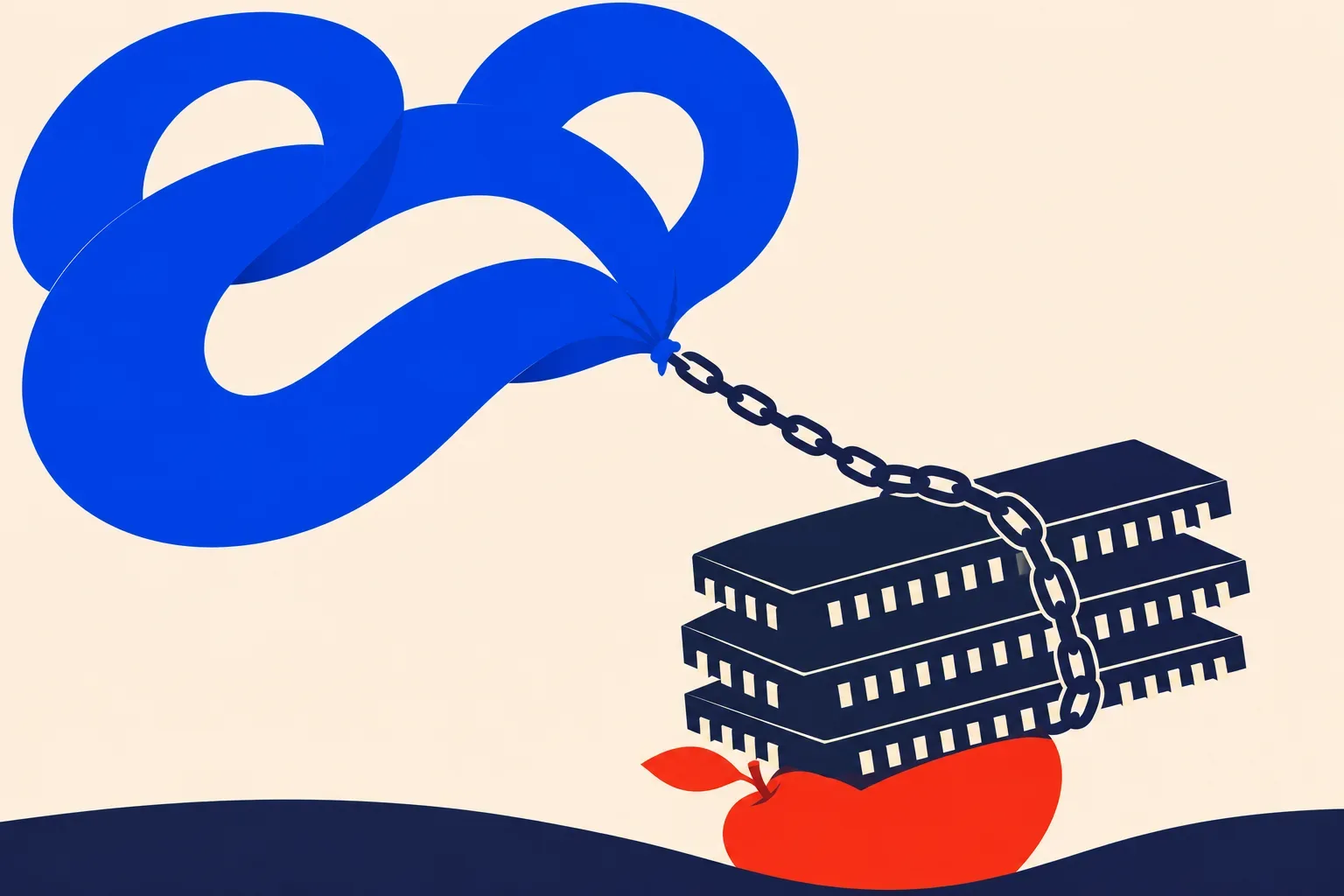
Big Tech's push to borrow money for AI infrastructure continued for a third straight day. Following Oracle's $20 billion and Alphabet's (Google's parent) €6 billion, Meta began selling more than $20 billion of bonds on Nov. 3, Bloomberg and others reported. On the same day, Apple guided its October–December profit margin below market expectations, mainly because of rising memory prices. The bill for the scramble for AI memory has now reached the profits of the company that makes the iPhone and Mac.
The two developments point to the same dynamic. AI companies can no longer cover the cost of AI on their own, and that cost is beginning to spread to the investors who buy their bonds and the device makers who buy components. South Korea's KOSPI index fell 3.59%, wiping out the previous day's gains. Results of the U.S. midterm elections had not come in as of this writing (around 2 p.m. ET on Nov. 3) and are not reflected here.
The 3-minute read
Big Tech keeps piling on debt for AI, but lenders are starting to pick and choose. Meta, with a profitable core business, looks set to borrow at low rates, while heavily indebted Oracle and newer cloud providers are paying high rates. In South Korea, Samsung and SK hynix fell 4–5%.
The most direct impact on businesses is rising memory prices. Apple expects memory shortages to constrain supply of the Mac and iPad, which could affect prices and delivery times for corporate PCs and devices. Separately, NVIDIA has reportedly asked cloud companies that rent out GPUs (the chips used for AI computing) to keep sales to Chinese customers below half.
Japanese companies that plan to replace PCs or devices before the end of the fiscal year would be wise to get quotes early. Japanese GPU clouds were also named among those subject to NVIDIA's request, so companies that use them could see changes in available capacity and pricing. The Tokyo market was closed on Nov. 3 for Culture Day, so the impact of South Korea's decline will show up in trading on Nov. 4.
Money and markets: Lenders start choosing their borrowers
According to reports, Meta is issuing about $15 billion of dollar-denominated bonds in five tranches with maturities of five to 30 years, and is issuing euro-denominated bonds for the first time. Orders reportedly peaked at about $58 billion, roughly four times the amount on offer. Initial price talk on the spread (the premium paid over U.S. Treasuries) was 1.30% for the five-year and 2.50% for the 30-year. Oracle is paying spreads of 2.40–3.35%, putting its coupons at 7.000–8.650%. Oracle has also sold 86.2 million shares at a discounted $116, and its credit default swaps (CDS), the price of insurance against default, have risen to about 2.92%. Bonds of newer cloud provider CoreWeave are reportedly trading at about 80% of face value, with yields reaching about 15.6%. The same "borrowing for AI" comes at very different prices depending on the borrower.
Stocks reflect the same view. In the U.S. on Nov. 2, the Nasdaq Composite closed down 1.07%, Oracle fell 8.8%, and Marvell, which agreed to buy Lumentum in an all-stock deal, dropped 12.7%. Investors shunned fundraising that dilutes shareholders. Chip stocks rebounded midday on Nov. 3, with NVIDIA up about 3% and its market value at about $5 trillion, though these are intraday figures, not closing prices.
Apple's July–September quarter results beat expectations, with revenue of $114.5 billion (+12%). But its October–December gross margin outlook of 45–46% fell short of the expected 46.3%. On the earnings call, CEO John Ternus reportedly called memory prices "unprecedented." For details, see our article "Apple's first earnings under Ternus are strong, but memory costs push year-end margin outlook below forecasts."
Data analytics company Palantir reported revenue of $2.313 billion (+96%), well above its own guidance (primary source: earnings release). However, the total value of newly signed contracts grew just 6% year over year, down from 49% in the previous quarter, and the stock was down about 2% midday on Nov. 3. Current revenue is strong, but growth in future bookings is slowing.
Ahead of Anthropic's IPO, both skeptics who say its disclosures fall short and bulls weighed in. On the skeptical side, tech industry critic Ed Zitron pointed out that compute costs are growing faster than revenue. Legal commentator Matt Scherer called the roughly $895.4 billion in compute commitments "effectively debt" and wrote that the IPO should be made to wait. On the bullish side, economics blogger Noah Smith said revenue per dollar of compute had tripled in a year and wrote that Claude itself is the moat. For details, see our article "Anthropic's pre-IPO disclosure debate: Is $895.4 billion in compute 'debt'?"
Research and safety: Tools for verification, and a debate over whether to stop
Anthropic's research team, working with the Swiss Federal Institute of Technology Lausanne (EPFL), MIT and others, released FlashProve, a system that uses cryptography to prove which model produced an answer without revealing the model's internals (primary source: research page). It could give outside evaluators and regulators a way to check that an approved model is actually being used. For details, see our article "Anthropic releases system to cryptographically prove which model was used while keeping weights hidden."
MIT researchers said they had GPT-6 Astra directly rewrite the internals of another, smaller model to meet a goal stated in natural language (researchers' blog; not peer-reviewed). On the small Qwen3.5, accuracy on a math test rose from 7.9% to 48.1%. On another small model, however, it rose by only about one point, and the authors themselves interpret the result as removing obstacles rather than adding new capabilities. Matthew Honnibal, creator of the natural language processing tool spaCy, objected to how the result was framed, while developer and blogger Simon Willison reproduced the model-reading part of the experiment locally. The work feeds the debate over whether AI can improve itself, but it remains a single, unreviewed result.
Employees at Google DeepMind in the U.K. are asking executives to drop a clause that permanently bars them from disparaging the company, even after they leave, the Washington Post reported. The employees reportedly argue that the clause keeps them from publicly warning about AI risks once they have left. Google said it had removed the post-employment portion for new hires. OpenAI ran into the same problem with a similar clause in 2024.
The debate over whether safety-focused companies should pause development on their own, even if no one else does, has entered a third round. Arguing against a pause was psychiatrist and blogger Scott Alexander, who replied in the comments on the discussion site LessWrong instead of publishing a new post. Alexander argued that pausing is right only if the chance that the pause spreads to other companies outweighs the chance that losing the lead causes safety research to fail. Alexander also sketched a scenario in which Anthropic pauses for just two months as a trial, China does not follow, and resuming only damages the company's reputation. In response, safety blogger Zvi Mowshowitz argued that if you won't ban building something that could kill everyone, you don't really believe in a ban. Geoffrey Irving, chief scientist at the UK's AI Security Institute (AISI), wrote that the right way for a single company to pause is not to dissolve itself. Instead, it should move people to safety and security work and resume if other companies do not follow. Irving's post was the most widely read in the debate. All of this is happening within the safety camp, and no one from the companies has responded.
Policy and geopolitics: Drawing lines on chips, and deadlines
NVIDIA is asking its data center and cloud customers to sell at least 51% of capacity under new contracts to customers outside China, the FT reported. The instruction was reportedly given verbally and will be checked through site visits and contract audits. NVIDIA has neither confirmed nor denied the report and has made no announcement. GPU clouds in Singapore, Malaysia and Japan were named among those affected. For details, see our article "NVIDIA asks partners to sell at least 51% of capacity outside China, FT reports."
In China, Premier Li Qiang spoke at the World Internet Conference Wuzhen Summit (primary source: text of the speech). Li said China opposes "overstretching the concept of national security and building a digital iron curtain," an implicit criticism of U.S. export controls. The speech repeated earlier positions, and no new bodies were announced.
Deadlines are approaching in the U.S.-China export control truce. The U.S. suspension of a rule that extends controls to subsidiaries of Chinese companies expires on Nov. 9, and China's suspension of rare earth export controls expires on Nov. 10. The U.S. Treasury secretary said in September that the truce would last until Jan. 10, 2027. But as of Nov. 3, no extension notice had appeared in the U.S. Federal Register, and no formal Chinese legal order could be found. Companies that source parts and materials from China should watch for developments next week.
In the election, attention turned to how money spent by AI industry political groups (super PACs) moved. Investigative outlet Bellingcat reported that more than $36 million had passed through shell companies in Delaware. For details, see our article "AI super PACs spent $79 million on Election Day, nearly half through shell companies." In defense, former Army Secretary Dan Driscoll has reportedly joined OpenAI as a senior adviser on national security.
Where nothing moved
No midterm results are in yet. Depending on the outcomes of elections for state commissioners who set electricity rates and local votes on data center construction, the answer to who pays for AI's electricity could shift. All six measures decided before Election Day went to the side seeking to restrict development.
In its IPO filing, Anthropic wrote that AI "may soon meet the threshold" for accelerating research, but it has not explained the sentence in detail. We also could not find any prominent safety commentator who had responded to it. The IPO debate has focused almost entirely on financial disclosure.
China's Moonshot AI had reportedly planned to release the weights of Kimi K3.1 Pro by Nov. 4, but they have not yet appeared where it publishes models. The same goes for Meituan's LongCat-2.5. No new versions of Chinese open models came out in the past two days.
Editorial cartoon