Morning Briefing · Nov 3, 2026
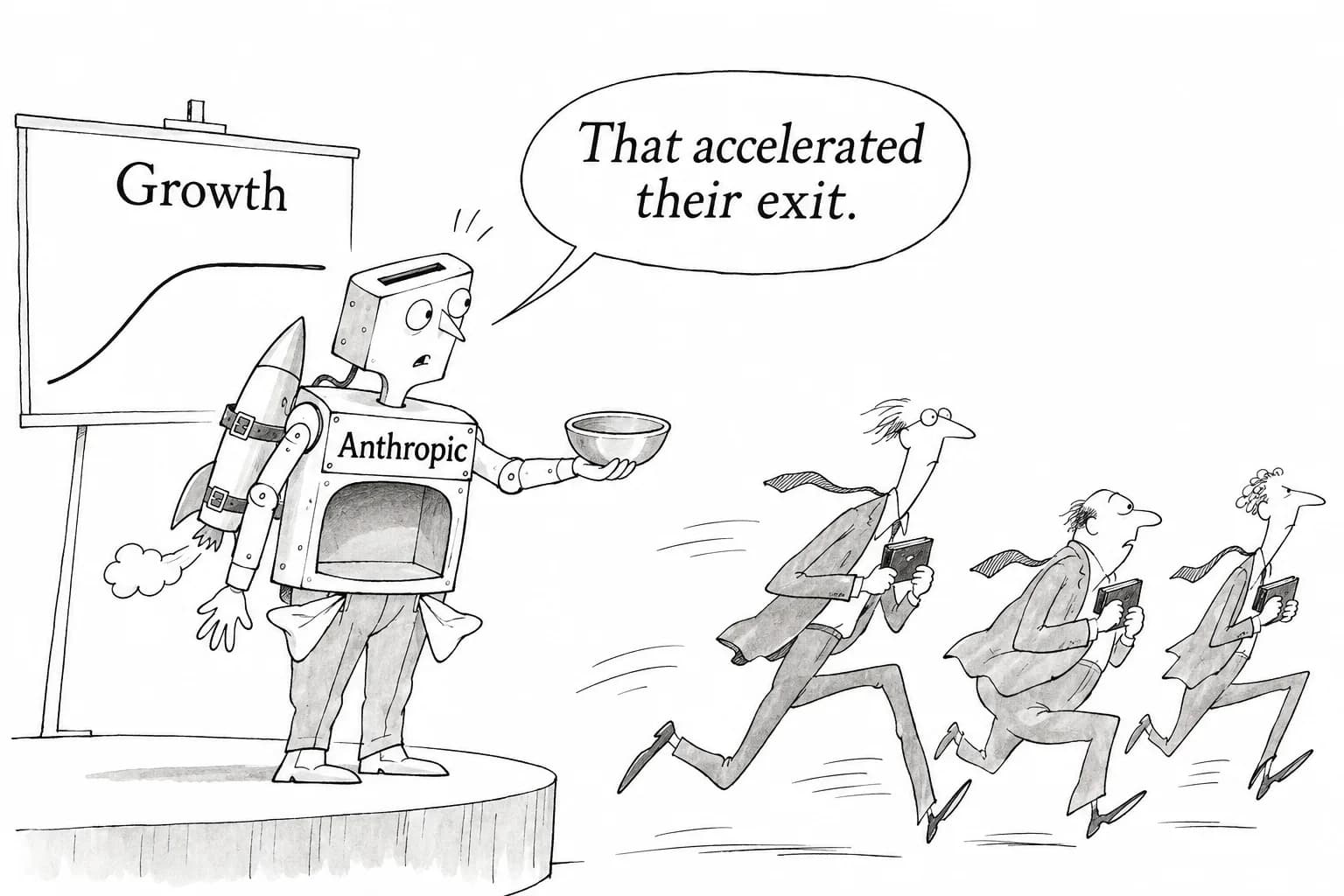
Anthropic's growth slows and it swings to an operating loss as investors sell AI fundraisers
The IPO filing also says a future model is close to the company's "dramatic acceleration of research" threshold. Oracle and Marvell fell even as oil prices dropped
Seiichi Tanaka · Editor-in-Chief

Watch the video
Key points
- Anthropic's July–September revenue was about $17 billion. Quarter-on-quarter growth reportedly fell from 144% to 47%, and the company posted an operating loss of $567 million
- In what is reportedly the first time in an IPO filing, a lab wrote that future models are close to its self-imposed threshold for a "dramatic acceleration of research by AI"
- Oracle (−6% to −7%) and Marvell (about −10%) fell even as falling oil prices lifted the broader market. Investors disliked their fundraising and the dilution of their shares
Anthropic, which is preparing to go public, filed an amended IPO registration statement on November 2. According to reports, revenue for the July–September quarter was about $17 billion, up 47% from the previous quarter. That is a sharp slowdown from 144% growth in the April–June quarter. Operating income under GAAP swung to a loss of $567 million. The filing also reportedly states that future models "could soon meet" one of the company's safety thresholds, a "dramatic acceleration of research by AI." On the same day, Oracle announced a $20 billion capital raise, Marvell agreed to an acquisition with an enterprise value of $115 billion and Alphabet issued €6 billion in bonds. A roughly 7% drop in oil prices supported stocks broadly, but the companies raising money were sold. AI revenue growth has started to slow, yet the money AI requires keeps growing. The market has begun to price in that gap. Apple and Palantir had not yet reported earnings when this was written.
The 3-minute read
Money: Major AI players kept raising huge sums through stock and debt. Investors disliked it. Oracle fell 6% to 7%, and Marvell fell about 10%. The price of Oracle's credit default swaps (CDS), which insure against default, has risen about 3.7-fold over the past year.
Work tools: Starting in December, OpenAI will reportedly combine the usage allowances for ChatGPT and its coding AI, Codex, into a single pool on paid plans, metered by usage. xAI has also tightened Grok's usage caps, citing costs. The era of unlimited AI tools appears to be ending.
For Japanese companies: Anthropic reportedly plans to sell up to ¥552.9 billion in new shares to Japanese investors, with Mizuho as lead manager. In Tokyo, memory maker Kioxia fell 15.8% on a weak outlook. That may signal that memory price increases are close to peaking, which could help steady prices for companies buying PCs and servers.
Money and markets: the companies raising cash were sold
The Anthropic figures come from CNBC and Fortune reports that cite the filing. The filing itself was too large for us to load. According to the reports, operating expenses rose from $10.6 billion to $17.5 billion, and price cuts cost about $600 million in revenue. The cumulative operating loss for January–September was $1.26 billion, which covers a different period from the $567 million loss for July–September. Commitments to pay for compute and other resources total about $895.4 billion and run through 2045. The price range and IPO date have not yet been disclosed. For details, see "Anthropic's amended S-1: close to research-acceleration threshold, growth slows to 47%."
Marvell signed a definitive agreement to acquire optical communications component maker Lumentum, according to a company announcement and an 8-K filing, the current report that public companies submit. It will pay entirely in its own stock, with no cash. The bet is that wiring inside data centers will shift from copper to optics. Even so, investors disliked the dilution and the size of the burden, and both companies' shares fell. For details, see "Marvell to acquire Lumentum in stock swap at $115 billion enterprise value."
In a prospectus filed with US securities regulators, Oracle said it would raise $10 billion in common stock and $10 billion in bonds. Its debt stood at $125.3 billion at the end of August, and its credit rating is BBB-, the lowest investment grade. Only days earlier, at an investor briefing, Oracle had described this as the "final funding" it would need through fiscal 2030, and it moved quickly to execute it. Bloomberg reported that Alphabet will also issue €6 billion in bonds. That is smaller than its €9 billion issue in May, but hyperscalers are still using debt to pay for AI infrastructure.
What supported the overall market had nothing to do with AI. Iran signaled willingness to negotiate with the United States, and Brent crude fell 7.7% to $104.66. The ISM index of US manufacturing activity came in at 55.5, beating expectations. The Dow rose as much as about 0.9%, but the Nasdaq turned slightly negative in the early afternoon. The economy was strong, but AI stocks alone lagged.
Commentators were divided on whether this signals a bubble, though they were not debating one another directly. Tech critic Ed Zitron wrote that "bubbles don't end in a day, they end through a series of events." He cited a report that software developer Replit had left Anthropic for OpenAI, which offered deeper discounts, and argued that such discounting cannot last. Economics blogger Noah Smith wrote that "Anthropic's moat is Claude." In his view, the company's defensive strength lies in the intelligence itself, and the idea that this will become a price war is wrong. Evan Conrad of SF Compute, a compute marketplace company, predicted that within six months only creditworthy companies will be able to obtain compute.
Research and safety: a lab says it is close to its own threshold
Anthropic has a self-imposed commitment, its Responsible Scaling Policy (RSP), to strengthen safety measures as capabilities increase. According to reports, the IPO filing says future models could soon meet one of its thresholds, a "dramatic acceleration of research by AI." No current model has been determined to meet it. The company is also reportedly considering adding human review to some research decisions. Internal use of Claude, valued at list prices, grew 250-fold between January and September. By September, Claude was writing more than 90% of new code. This is the first time a lab has written in a securities filing that it is close to the stage where AI accelerates AI research. The statement is a selling point for investors. It is also advance notice that the company's safety commitments are about to take effect.
There was also news on how capabilities are measured. Research firm SemiAnalysis released GDPx, a new benchmark that gives AI long tasks in 11 fields, including chip design and law. Even the top-ranked model, Opus 5.5, solved only 12.0%. For details, see "SemiAnalysis's new GDPx benchmark: even top-ranked Opus 5.5 scores just 12%." OpenAI also released LifeVal, which measures tasks such as childcare, household finances and government paperwork. GPT-6 Astra scored 80.6%. However, OpenAI has not published the tasks or the data and has not tested other companies' models. Outsiders cannot verify the results, so it remains an in-house yardstick.
Among safety-focused people, the debate over whether to stay inside the labs continued. Popular blogger Scott Alexander opposes the idea (SURA) that safety-minded employees should quit the labs and join movements to stop AI development. He argues it is better to pressure companies from within while building support in government. Mikhail Samin, who advocates stopping development, rebutted him directly. Samin argues that governments can halt development themselves and make other countries do the same. He says the political power of safety advocates inside the labs is "almost zero," and that resigning draws media attention. Alexander has not yet responded to Samin.
Policy and power: data centers on the ballot
OpenAI launched the "Grid Protectors Program," which cuts data center power use when the grid is under strain. The first site is in Georgia, where the utility can reportedly reduce load by up to 1,000MW. The announcement came the day before the election for the state's utility regulatory commission. For details, see "OpenAI to cut data center power by up to 1GW when the grid is strained." In the November 3 midterm elections, about 41 local ballot measures across 10 states reportedly ask voters whether to allow data centers. Frustration over electricity bills has begun to directly affect where AI infrastructure gets built. Axios reported that after the election, OpenAI will lobby Congress to impose mandatory safety limits on the most powerful AI.
Among US allies, South Korea will allocate 21.3 trillion won (about $16 billion) to AI in its 2027 budget, nearly double the 2026 figure. For details, see "South Korea's 2027 budget nearly doubles AI spending to 21.3 trillion won." In Taiwan, the Legislative Yuan reportedly held a hearing on a bill to punish smuggling AI chips to China. The proposal carries prison sentences of up to 10 years.
Where nothing happened
Anthropic co-founder Jack Clark published his newsletter the same day. He did not mention the IPO or the language about research acceleration. We also found no substantial response to that language from the safety community. A lab has written that it is close to a danger line it set for itself, but outside scrutiny has not yet begun.
Google DeepMind has still not released a model card, the document that describes a model's capabilities and risks, for its new model Gemini 4 Carbon. Nor has it published a report assessing the model against its safety framework. On the day Anthropic disclosed in a filing that it was nearing a threshold, its rival stayed silent.
The suspension of the "50% rule," which extends US export controls to affiliates of Chinese companies, ends on November 9. The Treasury Secretary has said it will be extended, but no formal notice has been issued. Without one, the rule takes effect again on November 10. Japanese companies with affiliates or business partners in China would then face more compliance checks.
Editorial cartoon