Morning Briefing · Nov 2, 2026
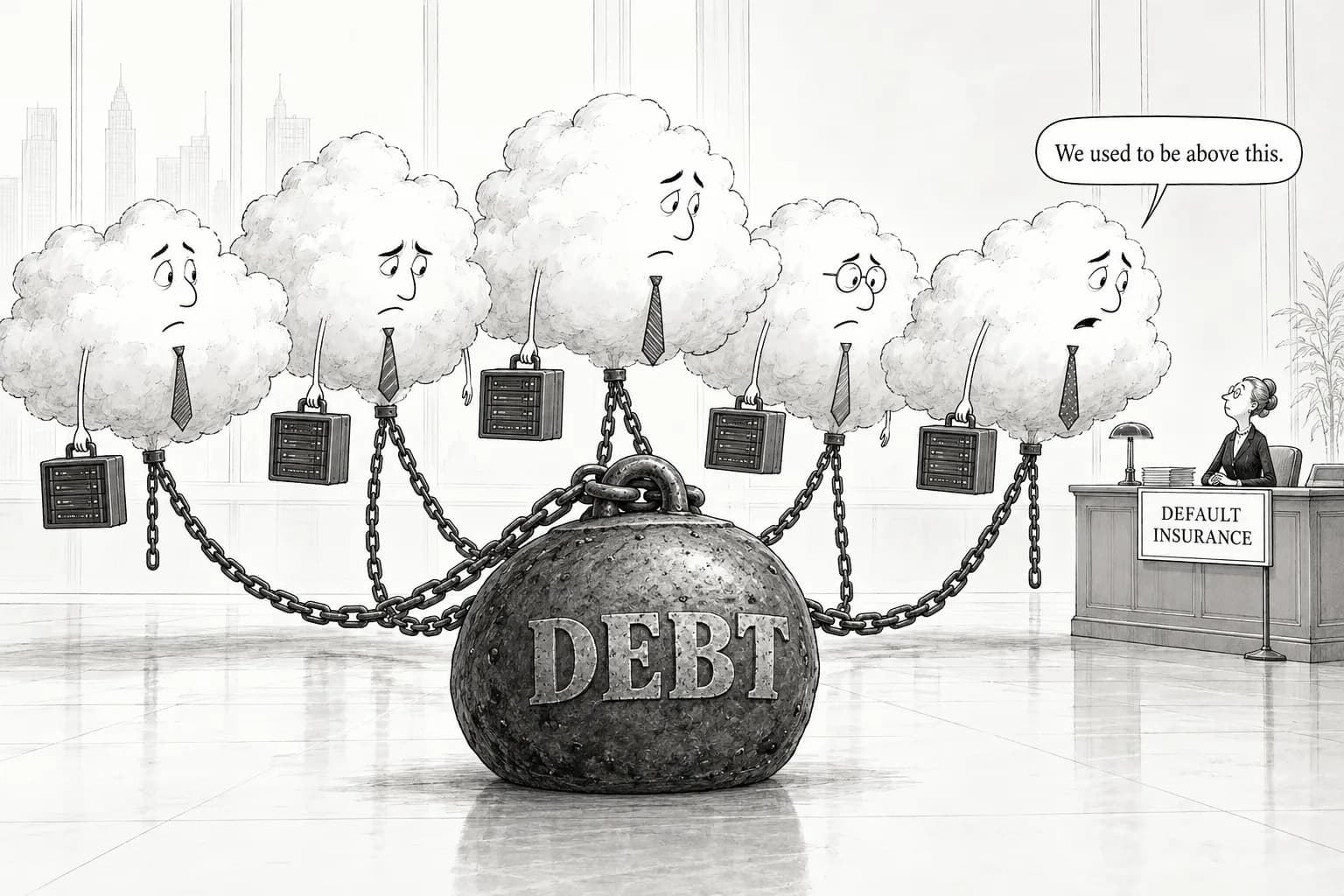
CDS on all five cloud giants hit highest since 2021 as debt worries reach top-rated borrowers
No major announcements over the weekend. South Korea's chip exports rose 259%, and demand remains strong. Inside the safety camp, a dispute over "don't stop alone"
Seiichi Tanaka · Editor-in-Chief
Watch the video
Key points
- WSJ report: CDS on Amazon, Alphabet, Microsoft, Meta and Oracle at their highest since 2021; Oracle's widened by more than 1 point in a month
- South Korea's October chip exports reached $56.44 billion (+259.4%), a gap between credit worries and strong demand for physical goods
- Scott Alexander argued that safety-focused companies stopping on their own would backfire; Kokotajlo and TsviBT pushed back
[Update, November 2, 2026, 5:55 JST] We made the following corrections. (1) An internal term, "during the window," appeared twice; we replaced it with plain wording. (2) We had written that Addy Osmani cited the terms of service, but he cited the usage policy; we corrected this and added his role.
It was a weekend, and the frontier labs released no models and posted no blog updates. The biggest story was about credit. The price of insurance against default (credit default swaps, or CDS) has reached its highest level since 2021 at all five companies: Amazon, Alphabet, Microsoft, Meta and Oracle, The Wall Street Journal reported (Nov. 1, secondhand). On Oct. 30, S&P cut its outlook on Meta, and reports said neoclouds were unable to issue bonds. Worries about debt-financed AI capital spending have spread from lower-rated neoclouds to the higher-rated cloud giants. On the same day, South Korea's October chip exports came in up 259%. Investors are anxious while demand for physical goods stays strong. This week's earnings and the Nov. 3 midterm elections will test that gap.
Industry, investment and chips: credit worries move up the ladder
The CDS figures reportedly come from the data company Solve. Oracle's spread reportedly widened by more than 1 point in a month. However, levels for each company are not available, and we have not been able to read the original WSJ article. Among neoclouds, the yield on CoreWeave's unsecured bonds has reportedly topped 15%. We covered this in detail in CDS on five cloud giants at highest since 2021, WSJ reports. Moody's and Fitch have not yet taken action on Meta. The next question is whether they follow S&P.
The demand figures point the other way. South Korea's October exports were $115.28 billion (+93.7%), the strongest growth since 1974, according to Ministry of Trade, Industry and Energy figures reported by Xinhua. Chips accounted for $56.44 billion (+259.4%). We covered this in detail in South Korea's October exports up 93.7%, chips up 3.6-fold. Nikkei Asia reported that combined operating profit at the three memory makers, SK hynix, Samsung and Kioxia, exceeded that of the U.S. tech giants for the first time (Oct. 31). In Seoul, Altman also met SK Group Chairman Chey Tae-won. They reportedly discussed HBM and data centers, but as with the Samsung meeting, no new deal was announced.
Electricity prices have also become an election issue. U.S. household electricity rates have risen more than 10% since 2024, Reuters reported, and nine states are holding public utility commission elections. Voters are starting to decide where data centers get built and who pays for them. We covered this in detail in Electricity prices and data centers become midterm issues.
Two more items don't have their own articles. The first is Binance. About $6.3 billion was stolen on Oct. 29, and starting at 06:00 UTC on Nov. 1 the exchange began gradually reopening withdrawals, starting with BTC, CoinDesk and others reported. The FBI attributes the theft to North Korea's TraderTraitor. The company says it covered about 95% of the stolen funds from its own money, but net outflows of roughly $3.6 billion to $3.8 billion were reported in the first 10 hours or so. That gives investors one more reason to avoid risk at Monday's open. The second is China's official manufacturing PMI, which came in at 49.3, the lowest since July (the forecast was about 50.0). High-tech manufacturing, however, was at 51.3 and still growing.
On funding, more companies saw their valuations fall. Humanoid robot maker Agility Robotics cut the amount it plans to raise through its SPAC from about $620 million to about $465 million (Oct. 30 8-K filing, primary source). OpenAI's target for its new funding round has also reportedly dropped to about $20 billion. Going the other way, Lumaril reportedly raised $66 million at a $400 million valuation (secondhand, citing the WSJ). Lumaril gets paid only for the extra output it adds at factories, a notable example of outcome-based pricing for AI. This week brings earnings from Apple and Palantir (Nov. 2), AMD (Nov. 3), and Arm and Qualcomm (Nov. 4), followed by the jobs report (Nov. 6). Those will decide whether the stock selloff stops.
AI research and development: putting terms of service in the prompt
Anthropic has reportedly added two sentences to the system prompt of Claude Code running on Opus 5.5 that stop it from recreating specific existing games. Addy Osmani, a member of the company's technical staff, confirmed on X that it added the two sentences, saying that using Claude to infringe IP violates its usage policy. There is no setting to turn it off, and some users complain that even reverse-engineering requests are being refused. We covered this in detail in Claude Code reportedly adds two sentences refusing to recreate existing games.
xAI will start adding invisible watermarks by default to text from the Grok API on Nov. 7 (documentation page, primary source). The watermarks will even cover tool-call arguments, and the company cited Article 50 of the EU AI Act as the reason. This means xAI has dropped its opposition to text watermarking. According to reports, ChatGPT will be the only major North American service that does not watermark its text. We covered this in detail in Grok API to watermark text from Nov. 7. Musk reportedly wrote on X that Colossus 2 will have about 1.2 million Blackwell chips by year-end. However, adding up the counts building by building gives only about 860,000, leaving about 340,000 unaccounted for.
Several earlier stories moved forward. DeepSeek released code on GitHub for a coding agent that works proactively (primary source, MIT license). Its design article now has working code to go with it. However, it has not responded to reports about distillation. OpenAI's 28-day Codex sprint ended on Nov. 1. The promised resets that users can save up were handed out, but no wrap-up post could be found, and the tracking pages don't agree with each other. In a flaw in ChatGPT's shared links, opening a malicious link could expose a user's other private chats, the security company Parameter reportedly disclosed (fixed by Oct. 26). In agentic commerce, xAI's Grok Bot can reportedly now make purchases through Link.
Ideas and debate: a split inside the safety camp
Scott Alexander published "Against SURA" on LessWrong (Oct. 31, primary source). SURA is short for stopping unilaterally and raising the alarm. He argued that if safety-focused companies stop development on their own, it does little to bring about "Plan A," a coordinated global halt. Instead, companies that care less about safety would take the lead. He named Vox's "Anthropic Could Just Stop" and bills to ban superintelligence as his targets. On the other side, Daniel Kokotajlo argued that even one U.S. company stopping would send a costly signal that changes public debate. TsviBT wrote that the either-or choice itself is false: a company could stay in the lead without releasing its most advanced models. Tom Davidson saw the two sides' proposals as nearly identical. Following Geoffrey Irving's Oct. 30 post saying development "should stop now," the dispute is taking place inside the safety camp. We covered this in detail in "Don't stop alone": safety camp pushes back on Scott Alexander.
davidad's "Alignment is easy" has so far drawn only comments and short rebuttal posts, with no full-length response yet. Gabriel Alfour wrote that accepting personalities built through RLHF is "abhorrent." David Africa's "Misalignment traps lie in wait," without naming anyone, responded that misalignment is an ordinary threat right in front of us. davidad has not responded publicly.
On the Vatican's AI meeting, the AI ethics critics and the existential-risk side each wrote pieces, but they did not respond to each other directly. On the ethics side, Emily Bender wrote that placing "compassion" in a system's behavior is a category error. On the existential-risk side, Gary Marcus compared today's agents to "a Ford Pinto whose gas tank explodes" and said they should be pulled from the market until fixed. Google DeepMind's TurnTrout (Alex Turner) released the text of a talk given to senior Indian officials. He put the chance that AI kills more than 95% of people in the next 10 years at "one in three" and called for treating compute like fissile material. The AI audit of research by Zucman and Saez comes ahead of California's Nov. 3 vote on Proposition 40. The audit's prompts and code have still not been released.
Defense and policy: Washington is quiet, China heads to Wuzhen
The Cyberspace Administration of China (CAC) published a commentary (primary source). It said the Wuzhen Summit of the World Internet Conference, held Nov. 2–5, will take "open source, open cooperation" as its theme. The commentary only repeated China's vision for global AI governance and announced no new binding measures. China is stepping up its messaging ahead of APEC in Shenzhen on Nov. 18–19. In the U.S., AI standards for schools agreed between Microsoft and a teachers' union took effect on Nov. 1. They ban training on student data and companion features. The rules come from a contract, not state law, but they work much like one. Bloomberg reported that Google is in talks to join a group protecting data for the Pentagon's "Golden Dome" missile defense program (Oct. 30). Given what happened with Project Maven in 2018, this would be a big step for Google. There have been no new presidential actions on whitehouse.gov since Oct. 28. Congress is in recess.
Where nothing happened
Silence is information too. The cloud giants themselves have said nothing about the worries over their credit. Anthropic has not yet filed its S-1/A or set a price range; that is expected around Nov. 10 at the earliest. Neither the accelerationists (Andreessen, Sacks, Dean Ball) nor the "normal technology" side (Narayanan and Kapoor) have responded to the stock selloff or the shrinking OpenAI round. Ed Zitron, who writes about the AI bubble, published nothing new and only pointed to his Oct. 20 piece. The AI welfare camp (Sebo, Long, Birch) has not responded to the Pope's statement that "AI is not a person." Robert Long published two pieces on Oct. 31 but did not address it. Saez has not responded to the audit either. Zvi Mowshowitz has published no AI posts since the last brief. Jack Clark's Import AI is expected on Nov. 2. Kimi K3.1 Pro's weights are still not out and are reportedly due by Nov. 4. There is still no model card or Frontier Safety Framework report for Gemini 4 Carbon. The conflicting cyber scores for Mistral Large 4 also remain unresolved. With the weekend, U.S. markets and Pentagon contract announcements were on hold. The real answers will come in the week starting with Monday's open.
Editorial cartoon