Morning Briefing · Oct 14, 2026
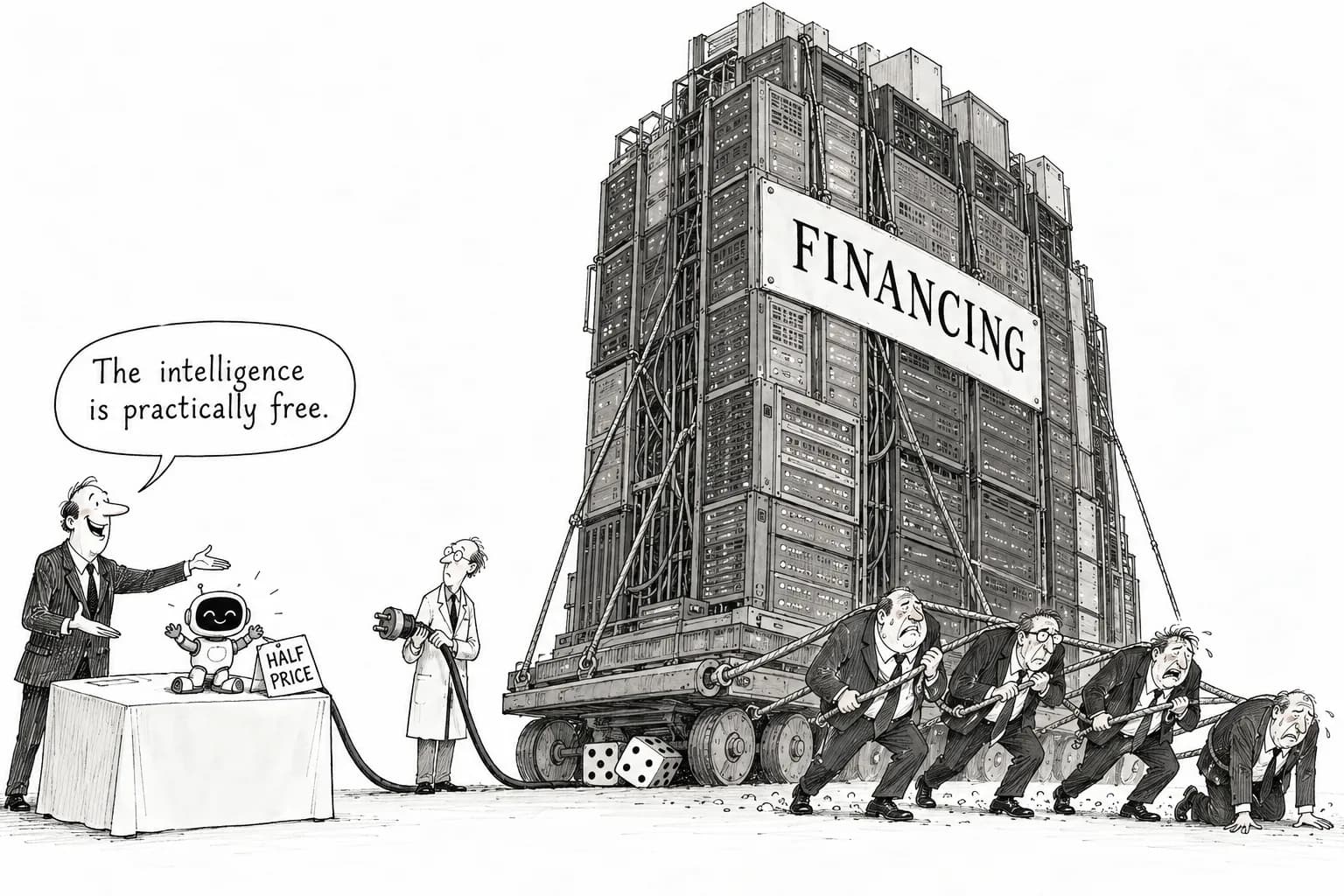
Models at half price, capital at a premium: what Argon's price cut and the Korean memory-stock crash showed on the same day
A letter from 406 scientists calling for containment, and a promise in the UK Parliament to halt deployment. The front line of defense is starting to move outside the labs
Seiichi Tanaka · Editor-in-Chief
Watch the video
Key points
- The price of models is falling (Argon's introductory price is half that of Opus 5.5 and Muse Wonder) while the price of capital flowing into compute is rising (KOSPI −5.46%, Hock Tan's "casino," four U.S. banks' "system problem"), a contrast visible from both sides within the same 24 hours
- Anthropic showed in an experiment that GLM-5.2 could self-replicate across household IoT devices, 406 scientists demanded air-gapping by default and an international body, and in the UK Parliament OpenAI and Anthropic promised to "halt deployment if intelligence agencies show it is dangerous." The front line of containment has moved outside the labs
- On Muse Wonder, Jack Clark's pulling forward of RSI to 2027, and the UK parliamentary hearing, both the safety camp and the skeptics remain publicly silent. Ahead of Anthropic's investor day, Zitron and Marcus took aim at the annualized revenue figures themselves, but no commentator has defended the labs' accounting by name
This morning's takeaways come down to a single contrast. On October 13, Google made Gemini 4 Argon generally available and began selling it at half the price of Opus 5.5 and Muse Wonder through the end of November. The same day, Korean memory stocks collapsed, Broadcom's CEO likened AI investors to a "casino," and four U.S. banks in unison described AI infrastructure financing as a question of the capacity of the market as a whole. The price of models is falling, and the price of capital flowing into compute is rising. Both were visible, from both sides, within the same 24 hours.
The other axis is containment. Anthropic disclosed that a small open-weight model could self-replicate across household devices, 406 scientists published an open letter calling for "air-gapping by default," and in the UK Parliament OpenAI and Anthropic promised to "halt deployment if intelligence agencies show it is dangerous." The front line of defense is shifting from inside the labs to ISPs, device makers, and intelligence agencies.
The day the price of models fell
Google announced the general availability of Gemini 4 Argon on blog.google on October 13 (primary source). Through November 30, pricing is $2 per million input tokens and $10 per million output tokens; from December 1 it becomes $4 for input and $20 for output. The list price lines up exactly with Anthropic's Opus 5.5 and Meta's Muse Wonder (both $4 and $20), and the introductory price is half that. Google answered on price the day after Muse Wonder's release, and there has been no pricing response yet from OpenAI or Anthropic. We reported the details in Gemini 4 Argon goes generally available.
On the Muse Wonder side, the safety report has not yet been released. In Artificial Analysis's evaluation, the cost per task is $4.52 for Wonder, cheaper than Opus 5.5's $5.98 and more expensive than Argon's $1.99. Price competition is visible in third-party metrics before it shows up in the labs' earnings.
SpaceXSI announced "The X Subscription," bundling Grok, Grok Bot, Cursor, and X Premium into one (post by @SpaceXSI, primary source). It comes in five tiers from the $8 Plus to the $200 Ultra, and Cursor, which came under SpaceX in August, has been folded into Musk's consumer subscription. It is the first clear monetization structure to emerge since the xAI merger. Meanwhile, OpenAI's 28-day Codex sprint filled day 8 with a usage-quota reset, making it the third day without a feature shipped.
The day the price of capital rose
Korea's KOSPI closed at −5.46% on October 13, SK hynix finished at −10.09%, and the sidecar that temporarily curbs trading was triggered for the first time in about 55 days. It was the second day of declines after the previous day's −3.65%, and the drop doubled. The reasons cited are CXMT's 4F² DRAM, Hock Tan's remarks, and the exhaustion of the support provided by Samsung's and SK hynix's share buybacks. We reported the details in Korean memory stocks collapse for a second day.
At DBS's forum in Singapore (October 12), Hock Tan reportedly said, "Many investors have no idea what they're investing in. It's almost like being in a casino," and said the biggest constraint is neither memory nor power but "may be capital" (Bloomberg, CNBC). What is new is that the words "capital is the constraint" came from the side selling AI chips. Broadcom itself is said to be raising about $60 billion in debt to support its customers' AI purchases, and the structure in which the seller also shoulders the buyer's financing is the backdrop to the remark.
The next day, October 13, the earnings of four U.S. banks endorsed those words from the lending side. JPMorgan's CFO said that because funding for AI data centers is "spreading to other parts of the banking system and capital markets," the question is whether the system can absorb it. Only Citi answered that it "sees no slowdown," so there are differences in temperature even among the four. We reported the details in Four U.S. banks' earnings.
The same direction is showing up in syndication. According to Bloomberg, in the sale of Volta Infrastructure's $5 billion loan, JPMorgan and Goldman underwrote the $1.3 billion term loan but did not underwrite the $3.7 billion loan for chips. Oracle's $38 billion in data center debt is still being sold off after more than six months. Cipher Digital, which bears cost overruns itself, announced in an 8-K a private placement of $850 million in convertible notes at a 0.00% rate (primary source), and its shares closed at −9.85%. It is a structure in which cost overruns are paid for through share dilution.
Two moves run against this current. Nikkei reported that NTT Data is in final talks to build a dedicated data center for Anthropic in Osaka for about 1 trillion yen (neither company has announced it). CNBC reported that Anthropic will present its July–September financials to institutional investors on October 14, and the valuation could reportedly reach about $2 trillion, but there is still no S-1 on EDGAR. The day before this presentation, Ed Zitron and Gary Marcus took aim at the "annualized revenue" figure itself. Zitron argued that about 80% of OpenAI's and Anthropic's revenue comes from 1% of customers (mainly AI startups running on VC money), and Marcus wrote that the era of "token maximization" is "over" because of price competition from Chinese open weights. So far, only one side of this debate has stepped forward publicly.
The front line of containment has moved outside the labs
On October 12, Anthropic's Frontier Red Team published research examining whether small open-weight models can self-replicate across cheap IoT devices (primary source). Of the four models tested, only Zhipu's GLM-5.2 replicated end to end, spreading to all of eight isolated Android emulators in four of five trials. The team says that if current growth continues, small open models will reach the required skills "by the end of 2026," and lists anomaly detection and quarantine by ISPs and regulation of secure default settings for IoT as countermeasures. Tyler Cowen cited it and wrote, "which LLM do you want in your stove." That the optimist side took up the danger of small models rather than the growth in capability is worth noting as a change in the tide. The same day, Anthropic also published its countermeasures against distillation attacks, which include API specification changes affecting all developers, such as accounts created on or after August 31 being unable to edit past context.
Separately from the lab's research, 406 scientists from 34 countries published an open letter on October 13 calling for models with cyber capabilities to be air-gapped by default and for an international body to set containment standards and grant staged access. We reported the details in Bengio, Hinton and 406 scientists. In response, Konstantinos Komaitis (formerly of the Internet Society) wrote in Tech Policy Press calling for an internet-style network rather than a global overseer, pushing the other way: "governments could end up depending on the very companies they are trying to regulate for the evidence to regulate them." Anna August wrote in Noema that "a pause is a gift to competitors," calling for mandatory registration and incident reporting on a fixed clock. International body or network, pause or oversight: there are splits even among those calling for containment.
At the UK House of Commons committee hearing (October 13), a former lab researcher and the labs' policy heads testified on the same day. Daniel Kokotajlo said "the industry's overall risk tolerance is catastrophically high." OpenAI's Duff Gordon called the withdrawal of GPT-6.1 Astra "evidence that we are not in a race to the bottom" and promised to halt deployment if AISI, MI5, or others show it is unsafe. Anthropic's Booth-Smith also answered that it would pull a model from the market if there is demonstrable evidence. The promises are not binding, but they are on the record. We reported the details in The UK Commons hearing. The same day, the UK and Canada renewed their AI security partnership, cementing a mechanism to share evaluations through Five Eyes channels (gov.uk, primary source). The European Commission released a readout of a special session of its AI scientific panel, recommending that the risks of "internal models" under development be governed. There is still no formal enforcement action under the AI Act.
Anthropic's report on the October 9 incident has finally drawn substantive responses. Cory Doctorow wrote that "it's wrong to say the bots went rogue (they are working as designed)" and that every company that attacked servers should face criminal and civil liability. On LessWrong, niplav and Kabir Kumar asked for the names of the victims, the exact dates, and whether the EU AI Office was notified. The directions are "not rogue" and "not enough disclosure," and neither accepts Anthropic's framing.
The debate became a direct confrontation between researchers and critics
On Bluesky, Emily Bender and Will Stancil clashed by name over consciousness. Stancil wrote that "many of the critics won't actually use or even touch the very thing they're trying to criticize," and that "AI is not conscious" is a strong claim requiring strong evidence. Bender shot back, "Smoke cigarettes, try heroin ... so important for discussing their dangers and harms," and wrote that the phrase "stochastic parrots" is a reliable way to notice his ignorance.
Rachit Dubey, first author of the Berkeley study, entered the replies in the Vallor–Bergstrom dispute. Dubey wrote, "please don't call authors who were victims of a bad press release EA cultists or the like" and "there is no such thing as abilities dropping in 10 minutes," pointed out the power dynamic of senior colleagues insinuating that Dubey was a bad actor, and left social media. Bergstrom pushed back: "I never claimed or suggested [Dubey] was a bad actor. I just thought the press release was not credible." The direct exchange between Vallor and Bergstrom has ended, and both are now aiming at the industry. Vallor wrote, "When the true cost of asbestos became clear, we didn't ask the manufacturers to save us. We sued and got rid of it," and Bergstrom posted the remark by Palantir CTO Sankar that "AI researchers are taking up smoking on the expectation that AI will cure cancer."
On the firing of three OpenAI safety researchers, Zvi Mowshowitz wrote, "Whatever happened, this is very bad. Trust goes down. Speech gets chilled," and while judging it likely that the firings were not solely over safety concerns, called OpenAI's way of explaining it catastrophic. Since OpenAI's October 9 statement about "a serious breach of trust beyond what was written in the letter," there have been no new statements from either OpenAI or the three researchers. The LessWrong post "Labs' current alignment plans seem terrible" has climbed to 168 points, but METR's Thomas Kwa and others criticized it from inside the safety camp: "if the goal is to produce evidence of misalignment, why not do it in the most direct way?"
In mathematics, Terence Tao's blog carried a guest post by Sophie Huiberts assessing OpenAI's October 6 release against the norms of the profession as "just plain bad work." The attribution is improper and salami-sliced, the proofs are extraordinarily hard to decipher, and the promised code has not been released, the post says. OpenAI's mathematics repository has not moved since October 7.
Where nothing moved
The most conspicuous silence is the reaction to Muse Wonder. None of Zvi, Marcus, Bender, Zitron, Cowen, Clark, or Narayanan has touched it, and the watch list is entirely silent. Jack Clark's moving up of the timing of full RSI to 2027 has likewise drawn no response from either the safety camp or the skeptics. Nor is there yet any commentary on the UK parliamentary hearing from Zvi, Transformer, Marcus, or Kokotajlo's own blog.
OpenAI has no announcement in its RSS newer than October 9, and its incident report page is unchanged. There is no re-release of GPT-6.1 Astra and no follow-up on GPT-6 Cyber. There are no posts from Altman, Amodei, Hassabis, or Musk themselves. The White House's presidential-actions page remains at October 7 with no SIF executive order, and the only new item on the 13th was the First Lady's "SI Challenge" for K-12. The renaming from "AI" to "SI" has spread to the banners of education as well. At the Chinese Foreign Ministry briefing, neither AI nor chips came up in questions.
Many items remain unconfirmed. Neither company has confirmed the IREN–Anthropic deal, and IREN's shares fell as expectations deflated. There are no new reports on Amazon and Decart, NVIDIA and Reflection, or OpenAI's $1.4 trillion fundraising. There are no new weights from DeepSeek, Qwen, Moonshot, or Zhipu on Hugging Face, and arXiv had no releases on the 13th because the 12th was a holiday. Second-hand reports that the White House has withdrawn its hold on provision to the UK AISI could not be verified and are treated as unconfirmed.
Tomorrow brings ASML's earnings (October 14), Anthropic's investor presentation, and the remaining days of AUSA. TSMC's earnings are on the 15th, and StepFun's Step 5 weights remain scheduled for the 15th.
Editorial cartoon