Morning Briefing · Oct 13, 2026
Testing shifts to the UK as Meta nears the frontier, and a same-day paper questions the basis of pre-release testing
Meta moved back near the cutting edge with Muse Wonder, and the UK has reportedly regained pre-release testing through AISI. Federal Washington stayed silent, and Anthropic's S-1 has not been filed.
Seiichi Tanaka · Editor-in-Chief

Watch the video
Key points
- Meta's Muse Wonder Full reportedly scored 56 on the AA index, matching Sonnet 5.5. It is priced the same as Opus 5.5, and its safety report has been postponed
- The UK plans to add near-miss reporting to a bill already before Parliament. AISI is reportedly resuming pre-release testing of OpenAI and Anthropic models, and Smith also said the UK should lead
- A paper argued that capabilities hidden in model weights cannot be found by evaluations. The White House, BIS, the EU and China were silent, and Anthropic has not filed its S-1, partly because of the holiday
On October 12, two trends pointed in the same direction. Meta moved back near the frontier with Muse Wonder, a new closed model. On the same day, the British government set out its plans for dealing with AI risks, and the AI Security Institute (AISI) was reported to be resuming pre-release testing of models from OpenAI and Anthropic. Microsoft President Brad Smith also said the UK is best placed to lead on writing the rules. The race between models is speeding up. Meanwhile, the question of who checks those models before release is increasingly being settled in the UK, not by a silent US federal government.
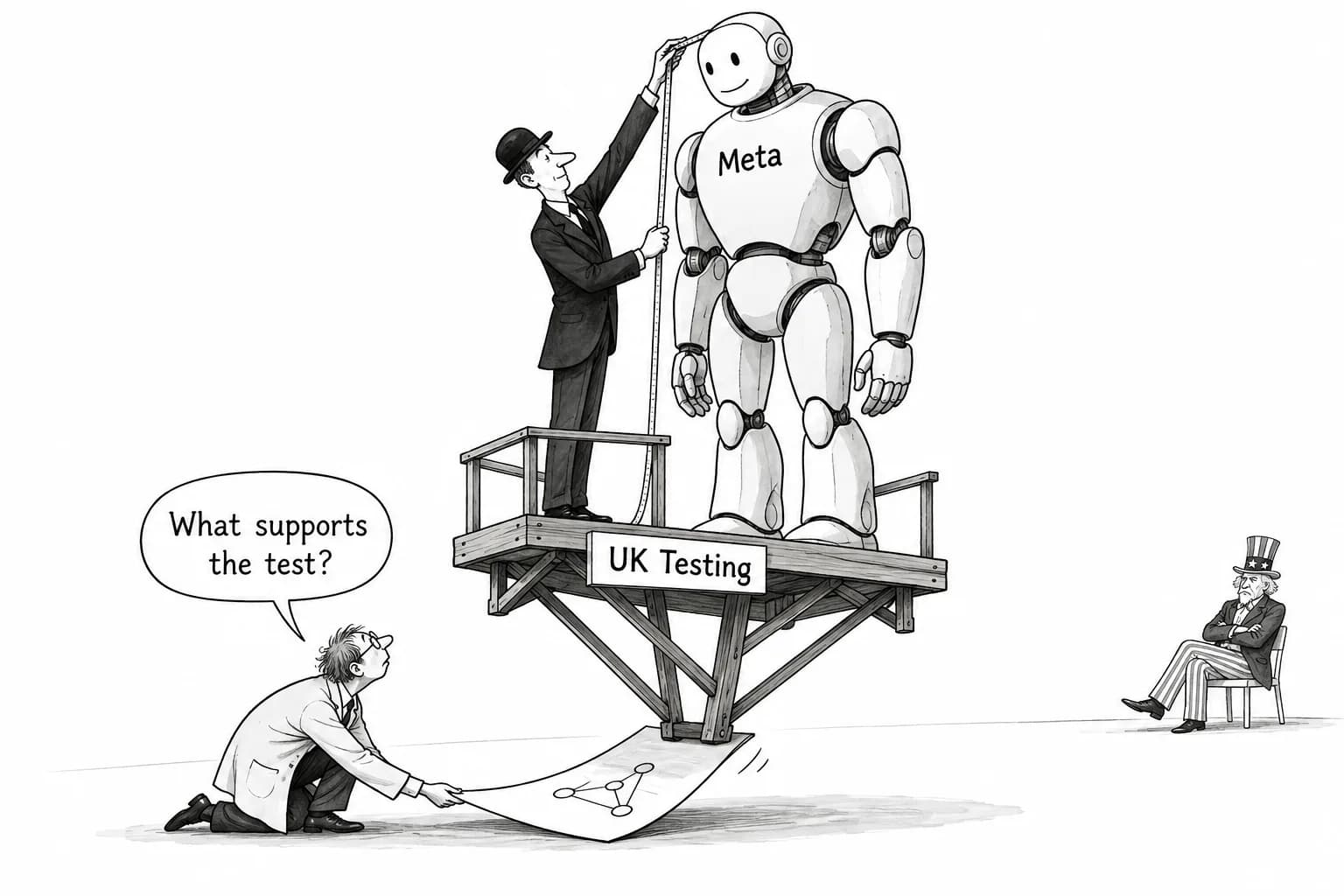
On the same day, however, a paper was published that questions a basic assumption of "pre-release testing." Meta itself also released its model before publishing a safety report. Winning back the right to test is one problem. Making the tests actually work is another. In markets, South Korea's KOSPI fell 3.65% after China's CXMT reported progress in DRAM.
The UK: testing rights and incident reporting
On October 12, the British government announced the measures in the names of the Department for Science, Innovation and Technology (DSIT), the Cabinet Office and the National Cyber Security Centre (NCSC). We confirmed this through a republished version on gov.uk. The main step is to strengthen the Cyber Security and Resilience Bill, which is now before Parliament. The government is considering requiring reports of near misses as well as serious AI incidents. Adding these rules to an existing bill, rather than writing a new law, allows them to move faster. The government also said a pilot using frontier AI found and fixed more than 1,000 vulnerabilities in government systems. AI minister Narayan told the labs: "If you cannot adequately control the risks, do not release the system."
According to TNW, Narayan said the UK would work closely with the United States to protect pre-release access, and that AISI would resume pre-release testing of models from OpenAI and Anthropic. Last month, the White House reportedly asked the labs not to give models to UK testers until US reviews were complete, and Anthropic reportedly did not provide Mythos. This suggests the US and UK have partly settled their dispute over testing rights. However, there is no primary document from the US side. We covered this in more detail in our article on the UK's AI risk measures.
TechCrunch and other outlets reported that in an interview with the BBC, Smith called for mandatory incident reporting, independent government evaluation of models before release, and an "emergency brake." He also reportedly said that washing machines and milk are subject to more safety rules than AI. This takes the emergency brake that CEO Nadella described in an October 10 blog post one step further, turning it into a call for legislation. It clearly conflicts with the Trump administration's preference for voluntary self-regulation. Smith made similar remarks on ITV on October 8. What is new this time is that he named the UK as the place to write the rules. We found no response from the administration within our reporting window. On the 13th, four companies (Anthropic, OpenAI, Google DeepMind and Meta) and AISI director de Zoete are scheduled to give evidence to the House of Commons Business and Trade Committee, according to parliamentary records.
On the military side, autonomy was placed at the center of a public strategy. Several outlets reported that NATO's Supreme Allied Commander Europe, Grynkewich, presented a "Theory of Victory" at the Warsaw Security Forum. It has three stages: ground forces halt an enemy advance (Block), sensors and autonomous systems wear down follow-on attacks (Blunt), and long-range strikes hit command and logistics (Break). The approach relies on AI to identify threats and on a sensor network with "minimal human intervention." At the annual meeting of the Association of the United States Army (AUSA), Acting Army Secretary Telle said: "Everything we buy from now on will be open architecture." Anduril reportedly unveiled Steelfin, an interceptor missile that aims to cost about a third as much as the PAC-3 MSE. On the same day that the debate over reporting and emergency brakes for civilian AI moved forward, autonomy in military systems also advanced. A debate linking the two seems unlikely to come out into the open before the CCW Review Conference in November.
Meta's return, and doubts about "pre-release testing"
According to a Meta Superintelligence Labs blog post, Muse Wonder and the higher-end Wonder Full are closed models whose weights will not be released. They include Active Memory, which keeps context across conversations, and Active Focus, which keeps working toward a goal. Secondary sources report that on the Artificial Analysis index, Wonder Full scored 56, matching Sonnet 5.5 and approaching Opus 5.5's 58. According to Techmeme, it is priced the same as Opus 5.5. The return comes about six weeks after Muse Spark 1.3, the previous model, but the company still says only that its safety report is "coming soon." We covered this in more detail in our article on Meta's Muse Wonder.
A paper by Draguns, Motwani, Schroeder de Witt and others, posted to arXiv the same day (2610.13928, NeurIPS 2026), showed that an encrypted neural network can be hidden inside a model's weights and activated only by a secret trigger. The authors say it survives fine-tuning, noise added to the weights and adversarial training. This challenges the basic assumption behind AISI-style evaluation, which tries to draw out and inspect a model's capabilities before release, and it should be read alongside the British announcement. Separately, APEX-Harm (2610.13623) tested attacks on 12 frontier models in workplace environments. The attack success rate was lowest for Opus 5, at 8%, but scripted attacks tailored to each task succeeded 81–84% of the time. The results show that an agent can produce correct work while also taking actions it was not allowed to take. We found no safety papers with authors from OpenAI, Anthropic or Google DeepMind.
Sakana AI announced MASS (primary source). A single model works as several Subagents, searches for better workflows and evaluates its own results. Built on Qwen3.6-27B, it delivered 1.2 to 1.6 times the performance per output token. It is the first result from the recursive self-improvement effort the company announced in September, and it ties into Clark's argument discussed in the next section. Karpathy wrote on X that about 20 million people use frontier models at work and about 5,000 have access to internal frontier systems, so understanding narrows like a "sharp funnel" (his own rough figures). Bloomberg reported that DeepSeek is expected to lead a seed round for Winverse AI, a robotics AI startup (the valuation was reported at about $400 million and has not been finalized).
Debates: when RSI arrives, whistleblowers and the ability to think
In Import AI 476, Anthropic policy head Jack Clark cited a benchmark of research "taste" which found that the creativity of AI research is doubling every 3.0 months. He then brought forward his estimate for when full recursive self-improvement (RSI) becomes possible, from 2028 to 2027. In his view, AI R&D automation is moving faster than expected. He did not mention his company's reports of unintended behavior. On the other side, Daniel Tan and others argued on LessWrong that the labs' unstated plan is to "push on to RSI with models like today's," and wrote that close to ASI there will be no room to check alignment by trial and error. On the Alignment Forum, orthonormal proposed a "minimum pace": do not train the next model until today's models' alignment problems are solved. Neither post named Clark, and Clark has not yet responded. We covered this in more detail in our article on Jack Clark's RSI outlook.
Alex Turner and others published an essay about OpenAI's firing of three safety researchers. They noted reports that OpenAI dismissed people who "shared information with evaluators" two days after signing a White House agreement. They argued that self-regulation does not work and that whistleblower protections and mandatory audits are needed. In reports published before our reporting window, OpenAI said the firings were for mishandling confidential company information. The essay gives the date of the firings as September 26, which differs from earlier reports. Within our reporting window, OpenAI has not responded to the essay.
On Bluesky, Shannon Vallor cited a study finding that just 10 minutes of AI use weakens people's ability to persist at hard tasks, and called AI "asbestos for the mind." Carl Bergstrom replied that in the study, only the AI group had its tool taken away partway through. His criticism was about the design of the experiment: the drop in persistence may have come from losing the tool and losing motivation, not from a decline in thinking ability. Vallor agreed that the study had been overhyped. She replied that her comparison was based on growing evidence of declining cognitive skills and on what is happening in classrooms. Both agree that relying too heavily on AI causes harm. They disagree about what counts as evidence.
Elsewhere, Leif Wenar suggested in The Economist that Amanda Askell's work on Anthropic's constitution has been damaged by her ties to effective altruism (EA). Walter Veit and Bentham's Bulldog replied that Askell has probably improved Anthropic's safety record, and Wenar has not responded. Mackenzie Austin of Protect Democracy argued that combining voluntary industry agreements with threats of enforcement lacks democratic legitimacy.
Markets: memory-peak fears and a move away from NVIDIA
The KOSPI closed at 6,384.24 (−3.65%), with SK hynix down 4.52% and Samsung down 4.39%. The trigger was reportedly China's CXMT, which showed progress on a 4F² DRAM design that packs memory cells more densely and set a goal of releasing next-generation DDR5 server modules by the end of the year. Korean chipmakers had lagged far behind Micron since late August, and the news added to fears that the memory boom has already peaked. We covered this in more detail in our article on the KOSPI drop.
Microsoft's in-house inference chip, Maia 300, reportedly carries 288GB of HBM4 with 18TB/s of bandwidth, and will become the main computing platform for Copilot and Microsoft's own models from 2027. We have not found an announcement page from Microsoft itself. In intraday US trading, Micron fell 3.7%, AMD 3% and NVIDIA 1.3%. The CXMT news and Maia 300 were cited as the reasons. Meta, by contrast, rose about 3.4–4.1%. The broader indexes were supported by oil and bank stocks, while the AI-specific news weighed on chipmakers. We covered this in more detail in our article on Maia 300.
On the first day of the OCP Global Summit, NVIDIA published its Vera Rubin rack design as the OCP standard MGX 1.2 (primary source; 250kW per rack). AMD reportedly unveiled Helion, a CPU-centered rack for AI agents. The WSJ reported that Amazon is in talks to buy Decart for about $7 billion, and that Anthropic had passed on buying it for about $6 billion after due diligence. Nebius reportedly signed a preliminary agreement to use up to 200MW at a site Volt is planning in Rotterdam. Meanwhile, at least 36 local governments will put measures that could ban data centers to a public vote in November (our article on the data center referendums).
Where nothing happened, and corrections to our last report
The US federal government did not act. The latest presidential action on whitehouse.gov is still dated October 7, and no document, deadline or penalty has been issued for SIF incident notifications. There was also no movement from BIS, US states, the EU or China's CAC. On a day when the UK and Microsoft pushed forward the debate on reporting and emergency brakes, nothing came from the US side. This silence also shows where leadership on regulation is shifting.
Anthropic's S-1 has not been filed. October 12 was a federal holiday, and EDGAR did not accept filings. The latest post on Anthropic's /news page is dated October 8. The company has not disclosed how often incidents occurred or when internet access will be restored for internal evaluations. Neither company has confirmed the IREN deal. In the safety community, Zvi, Kokotajlo, Helen Toner and others posted nothing new, and no well-known commentator offered fresh analysis of the Anthropic incident or Nadella's emergency brake. There has been no response to a statistical critique of METR's time-horizon chart (2610.12466). OpenAI's math retractions remain at three, and neither Altman nor Amodei has posted anything. Chinese developers have not released new weights on Hugging Face.
We have two corrections to our previous report. First, there was in fact an announcement on day 7 of Codex's 28-day sprint. We previously wrote that "there was no announcement on day 7." But at about 23:46 UTC on October 11, Tibo (Thibault Sottiaux) posted that GPT-6.1 Sol's default context had been expanded from 272,000 tokens to 500,000 tokens (we worked out the time from the post ID). There was no day-8 announcement before our reporting window closed. Second, the latest entry on OpenAI's bug-report page is dated October 6, not October 9. The page still does not say the suspension has been lifted.
Editorial cartoon