Morning Briefing · Nov 21, 2026
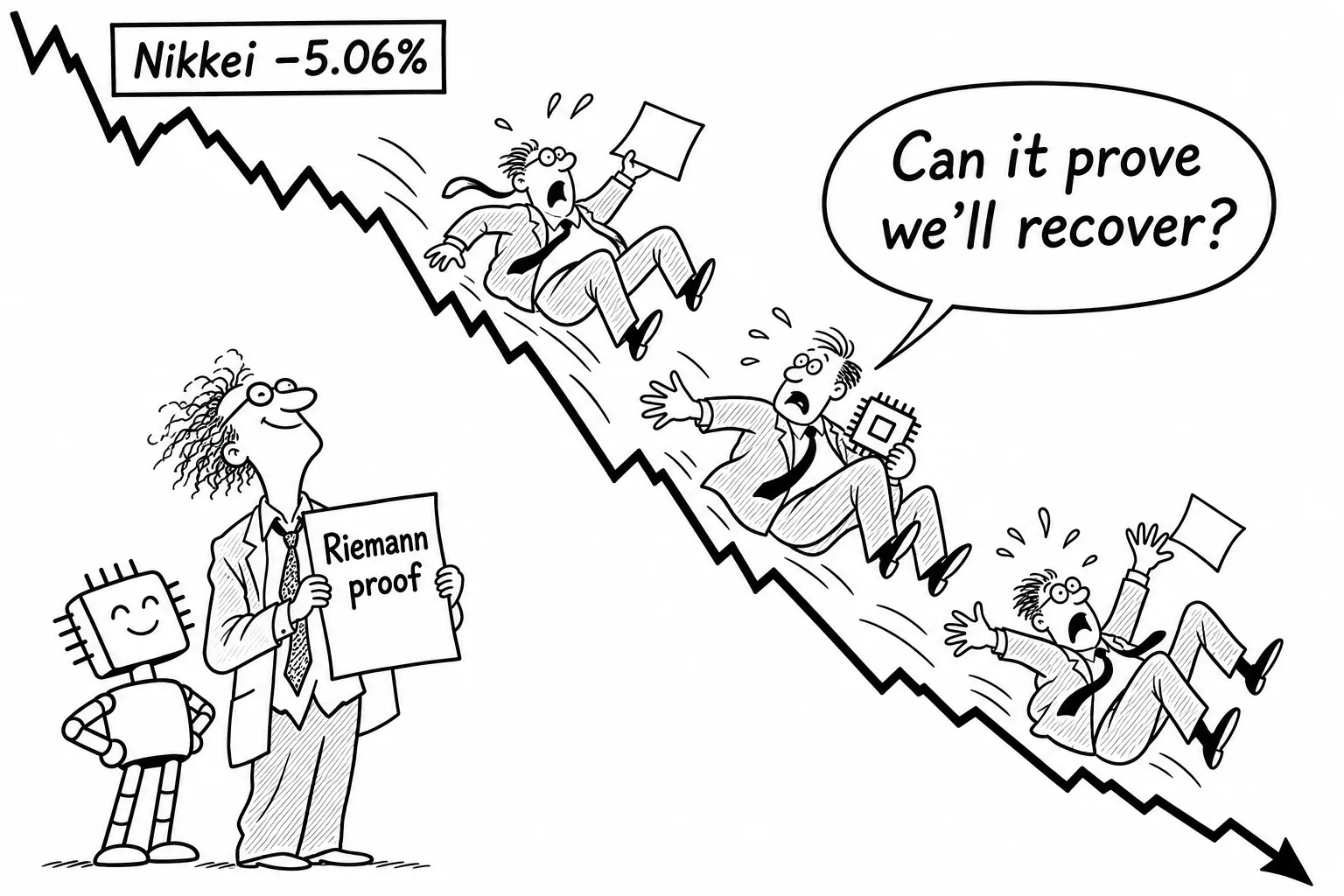
AI stocks sell off worldwide and the Nikkei drops 5%, on the same day a mathematician claims an AI-assisted proof of a famous problem
The selloff came from bad news inside the AI industry, not from interest rates. Experts have not yet finished checking the claimed proof of the Riemann hypothesis
Seiichi Tanaka · Editor-in-Chief

Watch the video
Key points
- The Nikkei fell 5.06% to 56,436.65 yen, and SoftBank Group dropped about 15%. On its second day of trading, Anthropic stock reportedly fell as low as $83.05 during the session, against an IPO price of $83
- TSMC and Samsung have reportedly stopped shipping to some Chinese customers under new US rules. Companies that supply parts or equipment to China should check this week whether their customers hold US licenses
- An Anthropic mathematician claimed to have proved the generalized Riemann hypothesis with Claude. No outside verification has been completed, and the company has made no official announcement
AI and semiconductor stocks sold off worldwide on Friday, November 20, and the Nikkei Stock Average closed down 5.06% at 56,436.65 yen. The selling was driven by bad news inside the AI industry, not by interest rates. Three things landed together: an investigation into NVIDIA, a halt to chip shipments to China under new US rules, and fading enthusiasm for the shares of Anthropic, which listed on November 19. Long-term US interest rates actually fell. The market appears to be doubting not the economy but whether the huge sums poured into AI will pay off.
Also on November 20, a mathematician at Anthropic claimed to have proved one of the most famous problems in mathematics with the help of Claude, the company's AI. On the technology side, claims of major breakthroughs keep coming. On the money side, doubt is growing. That gap is what drove today's events.
The 3-minute read
The Nikkei fell 5% on the day and 7.7% on the week, and SoftBank Group dropped about 15%. On its second day of trading, Anthropic stock reportedly came within 5 cents of its $83 IPO price.
Prices and plans for workplace AI tools (Microsoft 365 Copilot, ChatGPT for business, Gemini, Claude) have not changed over the past two days. Google and OpenAI expanded features that let AI operate a computer or shop for the user, but most of them are limited to the US and to English and are not yet available in Japan.
Manufacturers that supply parts, equipment or materials to Chinese smartphone and chip companies (Xiaomi, Oppo, Vivo, ByteDance and others) should have sales and export-control staff check this week whether those customers hold US licenses and whether orders have been halted. Finance teams at companies that pay for AI tools in dollars should factor the yen's slide toward 160 to the dollar into their estimates for December bills (Copilot's $30 list price comes to about 4,770 yen at 159 yen to the dollar).
Markets: AI stocks sell off and a new listing loses its gains
In Tokyo on November 20, chip stocks weighed heavily on the Nikkei. Advantest fell 10.5%, which alone took about 631 yen off the index. Tokyo Electron fell 7.19% and Lasertec fell 6.75%. Japan's October consumer prices rose 2.3%, which strengthened expectations that the Bank of Japan will raise rates in December, adding further pressure. Details are in our article "AI stocks sell off worldwide, Nikkei falls 5%; SoftBank Group down 15%."
In the US on November 20, the S&P 500 was reportedly down 2.05% and the Nasdaq Composite down 3.38% as of around 2 p.m. Eastern time. NVIDIA reportedly fell 6% to 7%, and AMD and Broadcom fell more than 11%. Meanwhile, the 10-year Treasury yield slipped below 5% to about 4.94%, and the yen tested 160 before recovering to about 158.8. Stocks fell even as rates fell, which suggests the selling was about AI itself rather than rates or the economy.
According to Anthropic's own announcement (a primary source), the IPO closed with 1.127 billion shares sold at $83 each, raising about $93.5 billion in total (about 14.9 trillion yen at 159 yen to the dollar). Separately, the company sold about $26 billion of stock to seven companies: AMD, Broadcom, Google, Micron, Microsoft, NVIDIA and TSMC. The stock closed its first day at $97.17 (+17%), but on the second day it reportedly fell as low as $83.05 during the session. The underwriting banks sold all of their additional shares, so a buyback by the banks to support the price is not expected.
Concerns also continue over the debt of neoclouds, the new cloud companies that rent out computing power for AI. CoreWeave bonds are reportedly trading at about 79.5 cents on the dollar, with yields on some above 17%.
US-China and regulation: chip shipments to China begin to stop
Contract chipmakers TSMC and Samsung have stopped shipping to some Chinese customers after a new US Commerce Department rule took effect, the Financial Times and Reuters reported. The customers named were Xiaomi, Oppo, Vivo, Baidu's chip unit and ByteDance. TSMC has reportedly halted orders at 16nm and below, close to the leading edge, unless the customer holds a US license. Details are in our article "Taiwanese and Korean chip giants halt some shipments to Chinese customers as US rule takes effect."
House Foreign Affairs Committee Chairman Mast released records of export licenses for NVIDIA and AMD sales to China. The Commerce Department bureau that approves exports (BIS) reportedly approved about 879,000 high-performance AI chips out of applications covering about 3.44 million. The government has said it keeps tight control, yet in practice it approved a large volume of exports. These records show that gap in more detail than ever before.
Treasury Secretary Scott Bessent said President Trump and Chinese President Xi Jinping agreed not to leave decisions on major military action to AI. Reuters and Bloomberg reported the remarks, which he made on CNBC. However, Bessent is the only one saying so. There is no joint document from the two countries and no White House material. China's foreign ministry statement only says, in general terms, that AI should stay under human control. Details are in our article "US Treasury Secretary says humans must make military AI decisions, describes US-China leaders' agreement."
California Attorney General Rob Bonta announced a subpoena (an order to hand over documents for an investigation) to NVIDIA, CNBC reported. The investigation will look at whether leading-edge chips reached China in violation of regulations and whether investors were misled. It is the second investigation, following a reported probe by the US Securities and Exchange Commission (SEC). NVIDIA's general counsel filed to sell 30,000 shares (about $4.54 million). The filing is a primary source, and the sale is under a plan set in May.
Research and products: a big math claim and AI that runs errands
Anthropic mathematician Levent Alpöge claimed to have proved the generalized Riemann hypothesis with Claude. The generalized Riemann hypothesis extends a 167-year-old problem about how prime numbers are distributed. The proof was written in Lean, a language that lets a computer check it line by line. MIT mathematician Andrew Sutherland ran the proof himself to check it and reportedly called it "a historic moment," while adding that "there is still much to do." No outside verification has been completed. Details are in our article "Mathematician claims AI-assisted proof of the Riemann hypothesis; expert verification still to come."
China's Tencent released the weights of Hy4, a large AI model, on Hugging Face on November 20. It has 770B (770 billion) parameters in total, 49B of which are active at a time, and a context length of about 1.05 million tokens. It can operate a computer. The release page calls it one of the strongest models anyone can download. However, accounts of its license conflict. Chinese media say it is under Apache 2.0, which allows free commercial use, while the release page lists a Tencent-specific license. Companies that want to use it should have their legal teams read the license on the release page first.
On November 19, Google announced on its blog a feature in the Gemini app for Mac that lets AI operate the computer. It is limited to the US, to English, to paid plans and to users 18 and older. On November 20, Google also expanded a feature in Search and Gemini that picks out groceries at retailers such as Target and completes the payment (US only). For developers, it released "Tool Retrieval" at no extra charge. Even for agents with many tools, the AI always sees each tool's name and description, while detailed argument definitions are loaded only when needed, which cuts how much the AI has to read. It is the same idea as Agent Skills.
OpenAI has begun testing "dots," an agent that gets tasks done ahead of time, with some ChatGPT Plus users and has expanded it to Business users, 9to5Mac reported. dots reportedly has its own cloud computer and connects to more than 4,000 apps. No change to ChatGPT business pricing has been reported.
Tokyo-based Sakana AI announced on November 20 that it has formed a security research group. It is led by Akihiro Umetani and co-founder David Ha. The company says its Fugu-Cyber model scored 86.9% on the CyberGym cyber benchmark, on par with leading cyber-focused models, but it did not name the models it compared against or describe how it measured. It says it will share defensive procedures but will not release code that could be used for attacks.
Debate: bubble, fad, or AI takeover
In the debate over whether AI is a bubble, cognitive scientist and AI skeptic Gary Marcus pointed to the fall in Anthropic's stock and wrote that it was shaping up to be "one of the most embarrassing IPOs in history." He also wrote that "there is no way OpenAI goes public at $1 trillion in this environment." Tech critic Ed Zitron wrote that the bubble "hasn't popped yet, but it's clearly coming." The only argument on the other side was a precedent cited in financial media, that "Facebook and Uber also fell about 11% on their second day of trading." We found no rebuttal from a named bull.
In the debate over whether AI is a passing fad, Washington Post reporter Will Oremus wrote that "there is almost certainly an AI bubble right now, but AI will survive if it bursts." He compared it not to crypto but to the web in 1998. Linguist Emily Bender replied that because "AI" is not one coherent thing, the claim is fine as far as it goes but empty, and that it is certainly swallowing the hype. Alex Hanna of DAIR, a group that studies AI harms, argued that "AI" as a political project for control will not last. Details are in our article "Is AI a passing fad? A reporter and critics debate amid the stock slide."
On the risk of AI taking control from humans, AI safety writer Zvi Mowshowitz agreed with AI safety researcher Paul Christiano's view that "the probability that AI takes control from humans within a year is close to 10%." He did, however, express doubt about how Christiano arrived at it. Neither the AI companies nor those who argue for faster development have responded. Details are in our article "Chance AI takes control from humans within a year is near 10%, safety writer agrees, but questions the reasoning."
Transformer, a publication that covers AI policy, wrote that policy can still work even on short timelines, and that it would be a "catastrophic mistake" for the safety side to give up on policy now. It said the fastest route is through the states. As an example, it cited a proposal in a California report to cap AI improving itself (recursive self-improvement).
Here is what we could not confirm. The US stock prices are intraday figures, not closing prices. We do not know the final number of Anthropic shares allocated to Japan. We do not know which assumptions (axioms) the Riemann hypothesis proof relies on or which Claude model was used. Hy4's correct license terms have also not been confirmed.
Where nothing happened
Investors and commentators who argue for faster AI development (including prominent investor Marc Andreessen) have not publicly pushed back on the global AI stock selloff. Skeptics wrote with one voice that "the bubble has started to burst," while the bulls stayed silent, leaving the debate one-sided. However, we cannot read X directly, where the bulls are most active, and that is our biggest blind spot.
Anthropic has made no official statement about its mathematician's claim to have proved the Riemann hypothesis using Claude. It issued an announcement closing its IPO but did not mention the proof or disclose which model was used. The company behind what could be the biggest mathematical achievement by AI has not yet acknowledged it.
NVIDIA has not yet filed its quarterly report (10-Q). The board's response to the Treasury Secretary over issues involving former CEO Jensen Huang (due around November 25) has not been issued either. The White House has not issued a new executive order on AI. With state and federal investigations piling up, neither the company nor the administration has said anything official yet.
Editorial cartoon