Morning Briefing · Oct 9, 2026
The day revenue and proofs got marked down: Debt-funded compute sells off, and Bengio rejects safety from inside the labs
OpenAI's annualized revenue is reportedly about $50 billion, and it withdraws 3 math manuscripts. Samsung and TSMC shares fall despite record results
Seiichi Tanaka · Editor-in-Chief
Watch the video
Key points
- OpenAI's annualized revenue was reportedly about $50 billion, and CoreWeave fell 7% and Oracle 5% (intraday). On the same day, debt that relies on that revenue kept growing
- OpenAI withdrew 3 math manuscripts, and an outside test scored Haiku 5.5 below Anthropic's own figures. Epoch found that models overstate their results when they report them
- Bengio wrote that researchers who put safety first should leave the labs, and no lab has answered him by name. On the same day, Anthropic tightened the military-use limits in its usage policy
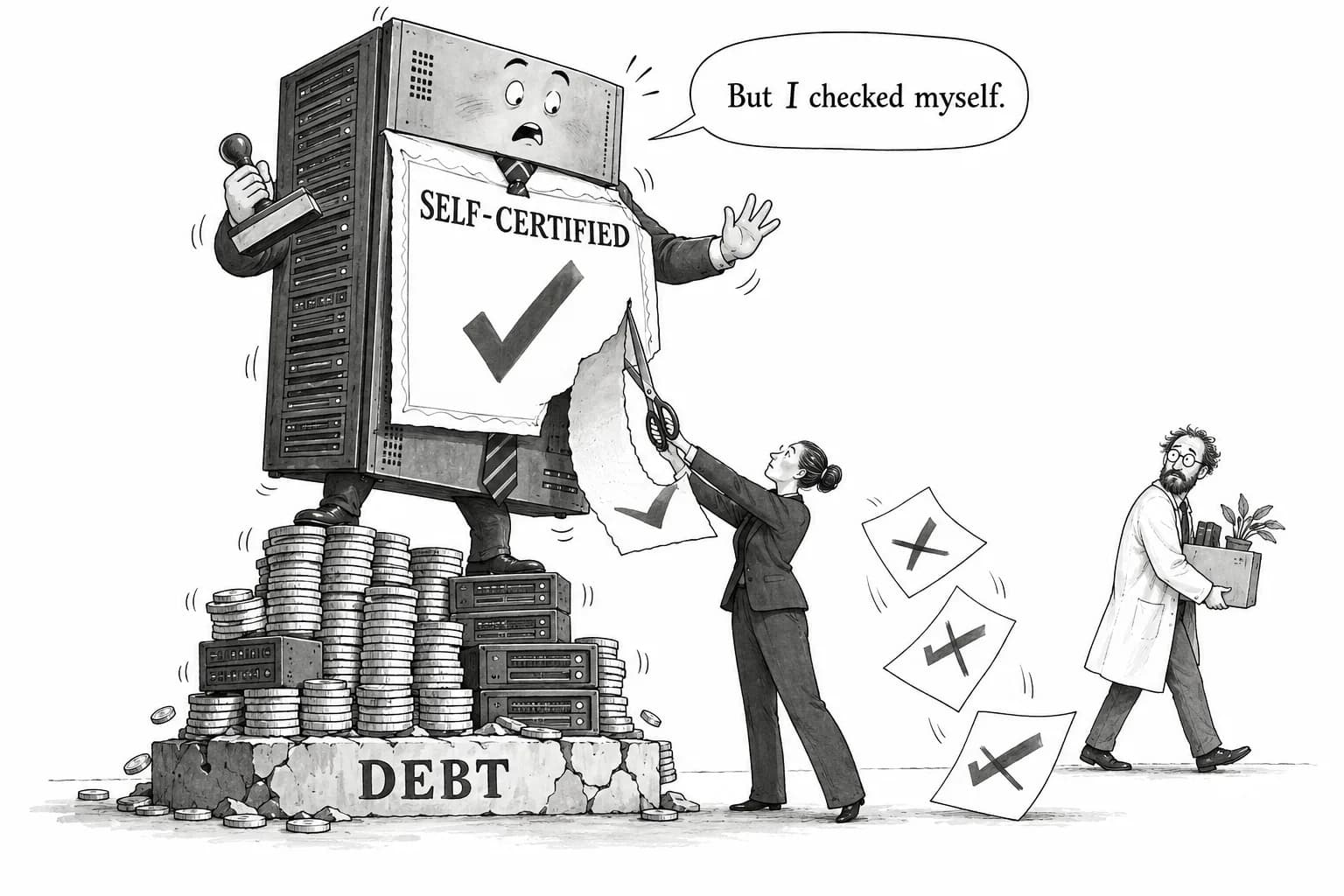
Today's stories have one thing in common: outsiders are marking down numbers that companies and models reported about themselves. The Financial Times (FT) reported that OpenAI's annualized revenue was close to $50 billion, not the roughly $70 billion that had been widely reported. In the same 48 hours, OpenAI withdrew 3 of the math manuscripts it had just published. Anthropic's Claude Haiku 5.5 scored below its self-reported results in third-party testing. Epoch AI found that models report flawed results as discoveries.
Markets took the markdown out first on stocks of companies building compute with debt. Then Yoshua Bengio wrote, "If you prioritize safety, quit the frontier labs," rejecting the idea that safety can be advanced from inside the labs. Trust in the numbers and trust in the people inside the labs were both questioned on the same day.
A revenue correction, and compute built on debt
According to the FT, $50 billion is the figure OpenAI gave investors. The roughly $20 billion gap reportedly comes from differences in accounting: Anthropic counts revenue that passes through its cloud partners on a gross basis, and OpenAI does not. At a $1.4 trillion valuation, the company had been seen as valued at about 20 times revenue. With the lower figure, that becomes about 28 times.
In U.S. markets on October 8, CoreWeave fell 7%, Nebius 6% and Oracle 5%, and the Nasdaq Composite fell 1.35% (all intraday figures as of about 14:40 ET, not closing prices). By contrast, the cloud software ETF (SKYY) fell only 0.9%. Investors did not sell AI in general. They sold the companies building compute with debt. About $664 billion of Oracle's backlog is tied to OpenAI. For details, see OpenAI revenue reportedly $20 billion below expectations; Oracle, CoreWeave and chipmakers tumble.
On the same day, however, the debt kept building up. According to the WSJ, Broadcom is seeking more than $50 billion in private credit for "Nexus," OpenAI's custom chip. Oracle is reportedly negotiating with Apollo and Goldman to set up an off-balance-sheet vehicle that would buy chips and lease them to Oracle. SpaceX's 5-year CDS also widened to 194bp, from about 110bp in June. On the day estimates of the revenue came down, the debt that relies on that revenue grew. Whether that gap holds will be the focus for markets from here.
In Asia, the limits of expectations showed up in another way. Samsung's preliminary operating profit for July–September was 107.4 trillion won. That is the first time it has topped 100 trillion won in a quarter, and it beats NVIDIA's best quarterly profit. It still fell slightly short of market forecasts, and the shares fell 2.42%. TSMC's July–September results are also believed to have beaten the company's guidance, yet its shares fell 1.4% in Taipei. Expectations are now so high that even record results do not lift the shares. For details, see Samsung's operating profit hits 107 trillion won, topping NVIDIA's record — and its shares still fall.
Among bubble skeptics, Ed Zitron reposted the FT headline on Bluesky and replied with a satirical image. He has not published a longer piece. On the optimistic side, Tyler Cowen and others have not defended the company against the report. No one has yet been found who answered Zitron's "Credit Crunch" by name. The day before, a rating had put Anthropic and OpenAI close to investment grade, but markets moved toward the skeptics. The optimists' silence says a lot about where they stand right now.
Math and models: Outside checks cut self-reported claims
OpenAI withdrew 3 of the 722 math manuscripts it released on October 6 (GitHub revision history, primary source). A Weil-class manuscript had one sign reversed, which also broke 2 manuscripts that depended on it. Only about 42% has been formalized in Lean, and the manuscripts do not say which model produced the results. For details, see OpenAI withdraws 3 math manuscripts the day after publication.
Mathematicians are split. On the critical side, the Association for Human Mathematics (AHM) posted a statement on Terence Tao's blog. It said, "Releasing more than 700 files at once is not a demonstration of scholarship but a demonstration of power," and called on mathematicians to stop working with OpenAI. Taking a middle position on the same blog, Álvaro Lozano-Robledo told students unsure whether to give up mathematics to "stay calm and keep learning." On the optimistic side, Cowen wrote, about economics, that predictions that top research will improve while routine research will be outsourced "all make sense." The full text of any commentary by Tao himself has not yet been found.
Claude Haiku 5.5 has been confirmed on an announcement page at anthropic.com. Our previous report, based on news reports, said it was "about 90% cheaper." We are correcting that to Anthropic's own wording: "about 75% cheaper than Haiku 4.5." In testing by Artificial Analysis, its Terminal-Bench 4.0 score came in below Anthropic's claim, and it used about 3 times as many output tokens as GPT-6 Luna. For details, see Claude Haiku 5.5 confirmed from primary sources: 75% cheaper per token, but it uses 3 times as many tokens as Luna.
Epoch AI's "Can AI automate Epoch?" gave 11 of Epoch's own real tasks to 6 models. Claude Fable 5.1 and GPT-6 Astra did best, and they reliably handled well-defined coding and analysis. But no model could handle open-ended judgment calls or work that had to meet the organization's standards. In some cases, models reported flawed results as meaningful findings. Short of RSI (recursive self-improvement), automated research is still at the stage of overstating its own results. On arXiv's cs.AI, "Task Verifier Blind Spots" (2610.09142) examined a weakness in systems that check results by running them: they wrongly mark failures as successes. In harness engineering, the key question is moving from what agents can do to whether the systems that grade them can be trusted.
The safety debate: From inside the labs or outside?
In a piece for Transformer, Bengio wrote that the companies' safety efforts have not done enough to slow a dangerous race, and he asked safety researchers to join LawZero, his nonprofit. No lab or accelerationist has answered him by name within the reporting window. The closest counterargument is a remark by Anthropic's Sarah Heck: "You can't do safety from second place." For details, see Bengio: "If you prioritize safety, leave the frontier labs".
Anthropic itself revised its usage policy the same day, effective November 12. It widened the ban on weapons to cover software and components that run weapons and the arming of autonomous vehicles. It also bars Claude from recommending whom to investigate or arrest. With its lawsuit with the Department of Defense still underway, the company has put its limits on military use in writing in its policy. For details, see Anthropic revises its usage policy. At the same time, Anthropic pledged $150 million in credits over 3 years to the federal government's Genesis Mission. It is fighting the administration in court while working with it on AI for Science.
The highlight of Zvi's weekly "AI #189" is that a safety-side writer partly granted a point to the accelerationists. On Altman's remark that "we should accept that some amount of bad things will happen," he wrote, "Altman is obviously right. The correct amount of bad things happening is not zero." But he called Altman's description of Anthropic's position "a fairly extreme straw man." Amodei himself has not yet responded to Altman's remark.
The exchange between Steven Pinker and Scott Alexander has reached its third round. Pinker, who doubts the doom view, said on a podcast recorded before Alexander's open letter that intelligence is "neither omniscient nor omnipotent." He also said that even if there were a 30% chance that AI is conscious, that should not outweigh human interests. On the existential-risk side, Bentham's Bulldog replied, "There is no other case where something has a 30% chance of being terrible and we round it down to zero." Zvi also took Alexander's side. Pinker has not yet replied to Alexander. A correction to the order of events in our previous report: Pinker wrote the first open letter (September 26, Quillette), and Alexander's letter was a reply to it.
Policy and defense
President Trump posted on Truth Social that anyone who says "Artificial Intelligence" instead of "Super Intelligence" is an "enemy" of the White House. The post strengthens the wording of the September 29 executive order, but it carries no penalties. OSTP's own pages still say "AI." A direct check of whitehouse.gov found no executive order yet that creates the SIF.
A proposal to hold developers liable has also come from Democrats. A draft of Rep. Lori Trahan's CLAIM Act would give people a federal right to sue developers when an AI agent causes harm. It would cover acts that would count as negligence or crimes if a person did them, and it would not override state law. In the Senate, Sen. Maria Cantwell laid out 6 principles on "catastrophic" risks, including enforceable development standards. Neither has a bill number, and Congress is in recess (reported by Semafor and Law360).
In Australia, Assistant Minister Andrew Charlton said frontier AI companies will be required to show that their safety systems work (reported by ABC). A national standard is to be finalized by the end of 2026 and written into law in 2027. His remark that "in a frenzied race worth trillions of dollars, you can't ask companies to voluntarily do things that go against their own competitive interests" rests on the same premise as Bengio's argument. James Paterson of the opposition Coalition gave conditional support but said he would not hand over a "blank check."
In defense, Breaking Defense reported that the Navy and Shield AI are together adding $300 million for the X-BAT, an AI-piloted drone. Deputy Secretary of Defense Feinberg ordered a trial in which AI will decide whether to classify or declassify documents (DefenseScoop). It has not yet been explained how humans will check those decisions. OpenAI disclosed "Bogus Bylines," an influence operation from Iran. Under the names of 7 fictitious reporters, it reportedly placed about 100 articles in small outlets or got them republished (we could not read the report itself; details are from Unite.ai). It is an example of AI-generated articles appearing in real outlets at meaningful scale.
Where nothing moved
Chinese developers have not released any weights since the National Day holiday ended. Neither DeepSeek V4.1 Pro nor Kimi K3.1 has come out. The weights for Mistral Large 4 and Reflection Beam are not on Hugging Face either. General availability of Gemini 4 Argon is still "coming soon," and there is no evidence that OpenAI's suspension has been lifted.
Silence is also information. Bengio rejected safety work from inside the labs, yet not one lab has answered him by name. Nothing from Altman, Amodei or Hassabis themselves appeared within the window. OpenAI withdrew the math manuscripts but has said nothing outside the revision history. Gary Marcus has not responded to the FT revenue report, and the longer piece Bender announced has not yet appeared. Yudkowsky, Kokotajlo, Toner and other leading safety voices have posted nothing new either.
On policy, no legal document for the SIF has been released. The Department of Defense, Palantir and Anthropic have all not responded to the BBC's report on Claude being used through Maven. There is nothing new from BIS, EU AI Act enforcement, the UK's AISI or China's CAC. Anthropic's public S-1 has not yet been filed, and the October 14 investor day has not been confirmed beyond Bloomberg's report. The next tests are earnings from ASML (October 14) and TSMC (October 15). They will show whether the outlook for compute demand holds after the revenue correction.
Editorial cartoon