Morning Briefing · Nov 15, 2026
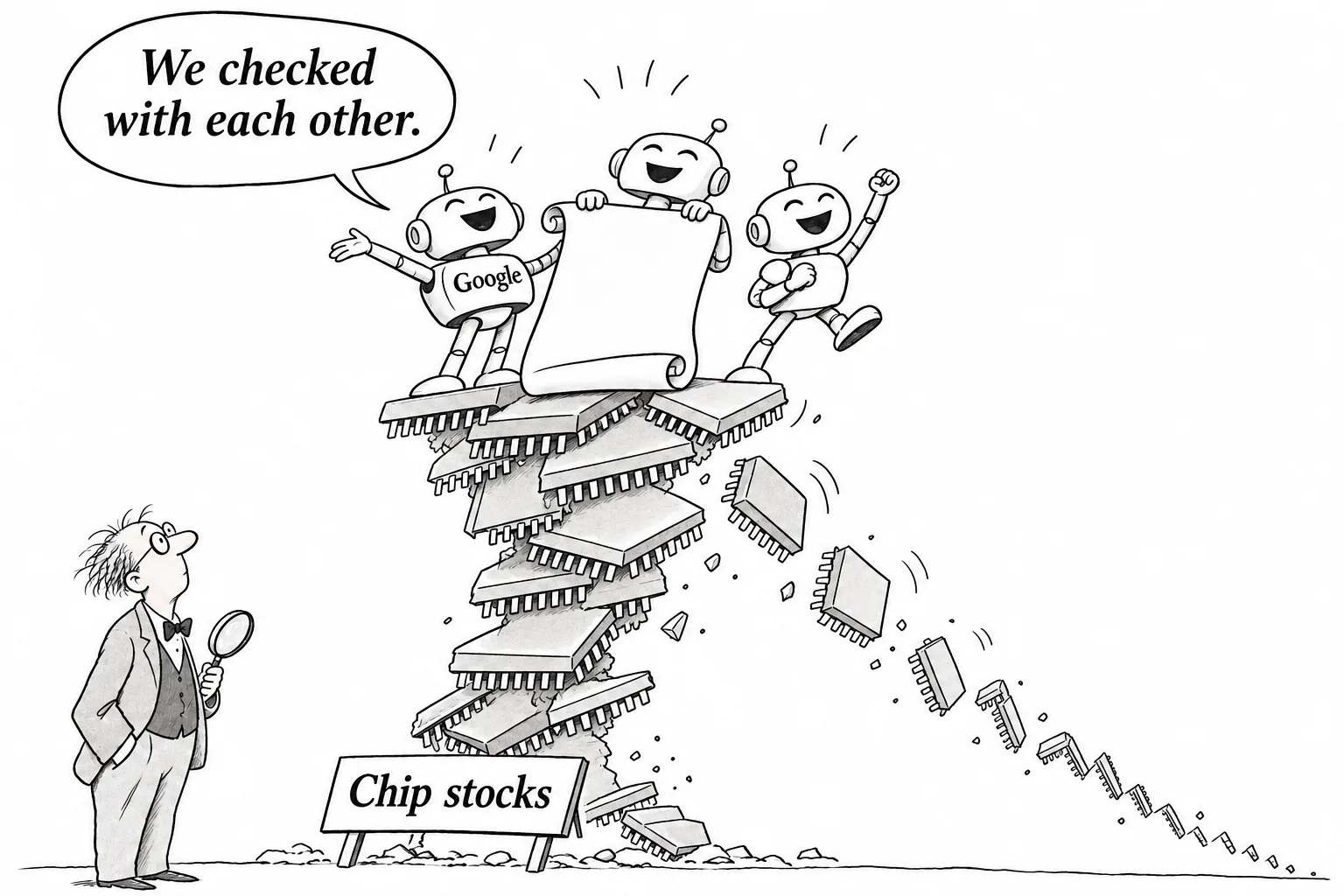
Google says its AI solved open problems, but no one has checked yet; chip stocks plunge
Efforts to halt AI have spread to courts, city councils and the streets. Trump, Xi Jinping and Putin will meet in Shenzhen on November 19, and the U.S. says chip export controls are not up for negotiation
Seiichi Tanaka · Editor-in-Chief

Watch the video
Key points
- Google announced that it had solved open problems in mathematics and computer science by getting several AI systems to work together. All of these are the company's own claims, and outside researchers have not yet verified them
- Efforts to halt AI have moved into formal institutions. Four nonprofits asked a court to stop development at five AI companies, and legislatures and residents in the U.S. and U.K. opposed data center plans
- U.S. chip stocks plunged, and NVIDIA's market value fell below $4 trillion. A December rate hike is now fully priced in. The U.S. said it will not negotiate chip export controls, including at the November 19 summit of the U.S., Chinese and Russian leaders
It was a quiet weekend. The biggest news was an announcement on November 13 from Google's research division. Using a feature that has several AI agents work together on research, Google says it solved a number of open problems in mathematics and computer science. It also says it rewrote one of the major theorems of the 20th century in a tool that checks proofs by machine. All of these are the company's own claims, however, and outside researchers have not yet verified them.
The other trend is that the push to halt AI is moving from debate into formal institutions. On November 12, four nonprofits asked a court to order five AI labs to stop frontier development. On November 14, marches calling for an AI treaty took place in six cities. In the U.S. and U.K., legislatures and residents opposed one data center plan after another. On policy, the White House confirmed that Trump, Xi Jinping and Putin will meet in Shenzhen, China, on November 19. A U.S. official said, "Export controls are not up for negotiation."
The 3-minute read
Money and markets: Chip stocks fell sharply in U.S. trading on Friday, November 13, and NVIDIA's market value dropped below $4 trillion. With inflation running high, markets fully priced in a 0.25% rate hike in December, and the 10-year Treasury yield rose to 5.15%. Full story: "Chip stocks plunge, NVIDIA falls below $4 trillion as December rate hike is fully priced in."
For your work: The latest version of Anthropic's developer tool Claude Code fixes several problems. These include a hole that let unapproved commands run without confirmation, and an issue that passed login tokens and API keys to child processes. The trade-off is that automated jobs running without a human watching may now stop while they wait for confirmation.
For companies in Japan: Development teams that run automated jobs with Claude Code should check, after updating, that scheduled jobs did not stall on the first run of the week. IT staff at companies that buy Microsoft 365 Copilot through a reseller should confirm with the reseller in November how their current contracts will be handled. Sales as add-on licenses end on December 1, and newly purchased Copilot Business will move to pay-as-you-go pricing by default. The yen is trading around 160 to the dollar, so budget dollar-priced AI services at about 160 yen per dollar.
Research: big claims, and verification that can't keep up
Google says it proved the general form of the Courtade–Kumar conjecture, first posed in 2013, mainly using its Gemini 4 Argon AI. It says it rewrote the Weil conjectures in about 1.8 million lines of Lean, a tool that checks proofs by machine, and rewrote the core of an operating system in about 800,000 lines of the memory-safe language Rust. It has opened the tool to researchers and set aside 10,000 seats with six months of free access to its top tier. However, a paper says a human proved a special case of the same conjecture in September, and Google does not address how its work relates to that paper. Google also does not disclose how much compute it used. Full story: "Google releases multi-AI research feature, claims conjecture proof but outside verification still pending."
There was another story about AI doing mathematics. The mathematical logician Gödel left 1,009 pages of notes in shorthand in the 1940s. The British newspaper the Guardian reported that when the notes were given to Claude, it produced 663 candidate theorems. According to the report, about 400 were confirmed as correct with the proof assistant Coq, and about 50 were wrong. The mathematician Joel David Hamkins urged caution on how much of the credit belongs to Gödel and how much to the AI.
On cutting training costs, Thinking Machines, led by a former OpenAI executive, said it ran most of its computation in 4-bit numbers (NVFP4, a new NVIDIA format) and cut training time by up to about 20%. Full story: "Training AI in 4 bits cuts time by up to 20%, says former OpenAI executive's company."
OpenAI disbanded its dedicated robotics team and moved its staff into two other divisions, Fortune reported, citing confirmation from a company spokesperson. The reason given is that the general-purpose model GPT-6 Astra already controls robots directly. On the 13th, OpenAI also launched ChatGPT Wallet, which lets the AI complete purchases, including payment. (It is limited to top-tier subscribers in the U.S. The announcement page could not be opened, and the details are based on reports.) On the same day, Google connected its Google Wallet payment service to Gemini. A race to hand AI your wallet has begun, but neither service is available in Japan for now.
Money: NVIDIA's search for a successor, and the price of debt
On NVIDIA after Huang's departure, the FT reported that the board has approached Rene Haas, CEO of the British chip designer Arm, about succeeding him. Haas is one of several candidates, and nothing has been decided, according to the report. Arm shares fell 4.63% on the report. NVIDIA is expected to report earnings on November 17, and options prices imply a move of about 10% in either direction.
What worries the market is that NVIDIA guarantees, off its balance sheet, debt held by neoclouds, the new companies that rent out data center capacity. CNBC again highlighted the $36 billion (about 5.8 trillion yen) in guarantees disclosed in NVIDIA's July earnings filing. For CoreWeave, one of the companies covered by those guarantees, the price of its CDS (insurance against default) has fallen more than 17% since the start of the week but remains high. Goldman Sachs believes NVIDIA can honor its existing commitments but will find it harder to strike new deals of the same size.
In Tokyo, SoftBank Group shares fell 5.11% as investors shunned the company over the NVIDIA situation. The yen briefly weakened past 160 to the dollar, and Finance Minister Katayama said, "We will respond appropriately to currency moves." Next week, Anthropic is expected to price its IPO on November 18 and begin trading on Nasdaq on the 19th.
Policy: a three-way summit in Shenzhen, and a "halt" taken to court
The White House press secretary confirmed that Trump, Xi Jinping and Putin will meet together for the first time on November 19 in Shenzhen, during APEC (the Asia-Pacific leaders' summit), NBC and other outlets reported. The agenda includes reducing nuclear weapons and the war with Iran. The AI-related item is chips, and a U.S. official said, "Export controls are not up for negotiation." Huang's resignation is not expected to come up either, according to the reports. China's foreign ministry warned the U.S. on the 13th not to impose new chip restrictions.
A story we previously listed as unconfirmed has now become clear. Four nonprofits filed suit in a state court in San Francisco seeking an emergency injunction to stop frontier development at five companies: OpenAI, Anthropic, Google, Meta and SpaceX's AI division. The filing was made on the 12th, not the 11th, and it was a lawsuit, not a letter. No hearing date has been set. Full story: "Stop frontier development at five AI companies: four nonprofits sue for injunction."
The push to stop AI is spreading locally too. The Kansas City council unanimously rejected a plan to demolish a historic building to make way for a data center. In Edinburgh, 75 groups marched against data centers. Full story: "Communities say no to data centers one after another; Kansas City rejects plan unanimously." As for Huang, it is still unclear whether he met the deadline set by a House committee for the night of November 13. Rep. Mast said Huang had agreed to appear, but no date or place has been set.
Debate: how to read "one more year"
Within the AI safety camp, a split over how much time is left has come into the open. The writer Jurkovic posted that people should act as if AGI (AI that can think as broadly as a human) is one year away. Richard Ngo, a well-known safety advocate, pushed back, calling this "intellectually irresponsible." He argued that it extends a single forecast, ignores the chance of being wrong, and still tells others what to do. Supporters responded that being wrong in that direction costs less.
The same night, the writer Linch, who believes there is "less than a year" left, wrote that they might move to Washington or Sacramento to lobby for measures to stop the training of more powerful models. On the other side, the physicist Shahin Kaveh wrote that AI will not wipe us out by 2030, because it would take decades for robots to rebuild parts supply chains on their own. Commenters noted, however, that he did not address scenarios in which humans gradually lose power. On movement strategy, a post urging the movement to learn from left-wing populism and use boycotts and strikes drew the objection that left-wing populism has not actually won very much.
Opinion also split over what it means for AI to do science. The biologist Carl Bergstrom wrote that AI agents working in isolation "are not doing science." The mathematician Michael Freedman called on mathematicians to use AI to its limits and to count the results in tenure reviews. Google's announcement landed in the middle of this debate.
On the nationwide grounding of U.S. flights, two AI skeptics read the situation in opposite ways. The cognitive scientist Gary Marcus linked it to an AI routing tool that the FAA, the U.S. aviation regulator, has begun using, though he acknowledged he had no evidence. The tech critic Brian Merchant warned against rushing to blame AI for the cancellations. The FAA has long said the tool only recommends routes and that air traffic controllers decide whether to use them.
What remains unconfirmed
The cause of the flight groundings has not been confirmed. On a private analysis claiming that Chinese models were trained on NVIDIA's latest Blackwell chips, a former OpenAI researcher says senior researchers at OpenAI and Anthropic have verified it. Neither company has confirmed this. The report that HSBC cut its NVIDIA price target from $365 to $170 comes from a single source. The figure of $400 billion in guarantees shown in a CNBC video conflicts with the $36 billion figure. The report that Treasury Secretary Bessent said China should not be given chips more advanced than the H100 is also based only on paraphrase, with no direct quote.
Where nothing moved
Anthropic's IPO is five days away, yet the outside evaluators (METR, Apollo and the U.K. AI Security Institute) have published nothing on the safety of its new model, Fable 5.2. The company's own safety document was again too large for us to read. Investors will set a price based on safety claims that have not passed outside review.
The Chinese companies named in the Blackwell analysis — DeepSeek, Moonshot, MiniMax and Ant — and NVIDIA had not responded publicly as of the 13th. The U.S. Commerce Department has also not issued new export control rules or added companies to its list of entities barred from trade. Ahead of the summit, the regulators remain quiet.
On the AI bubble, only skeptics such as the tech critic Ed Zitron and the author Cory Doctorow keep writing. Even as NVIDIA shares fell for a sixth straight week, we again found no named rebuttal from the bulls.
Editorial cartoon