Morning Briefing · Nov 14, 2026
Blame for AI chip leaks to China shifts to infighting within the US government as chip stocks slide
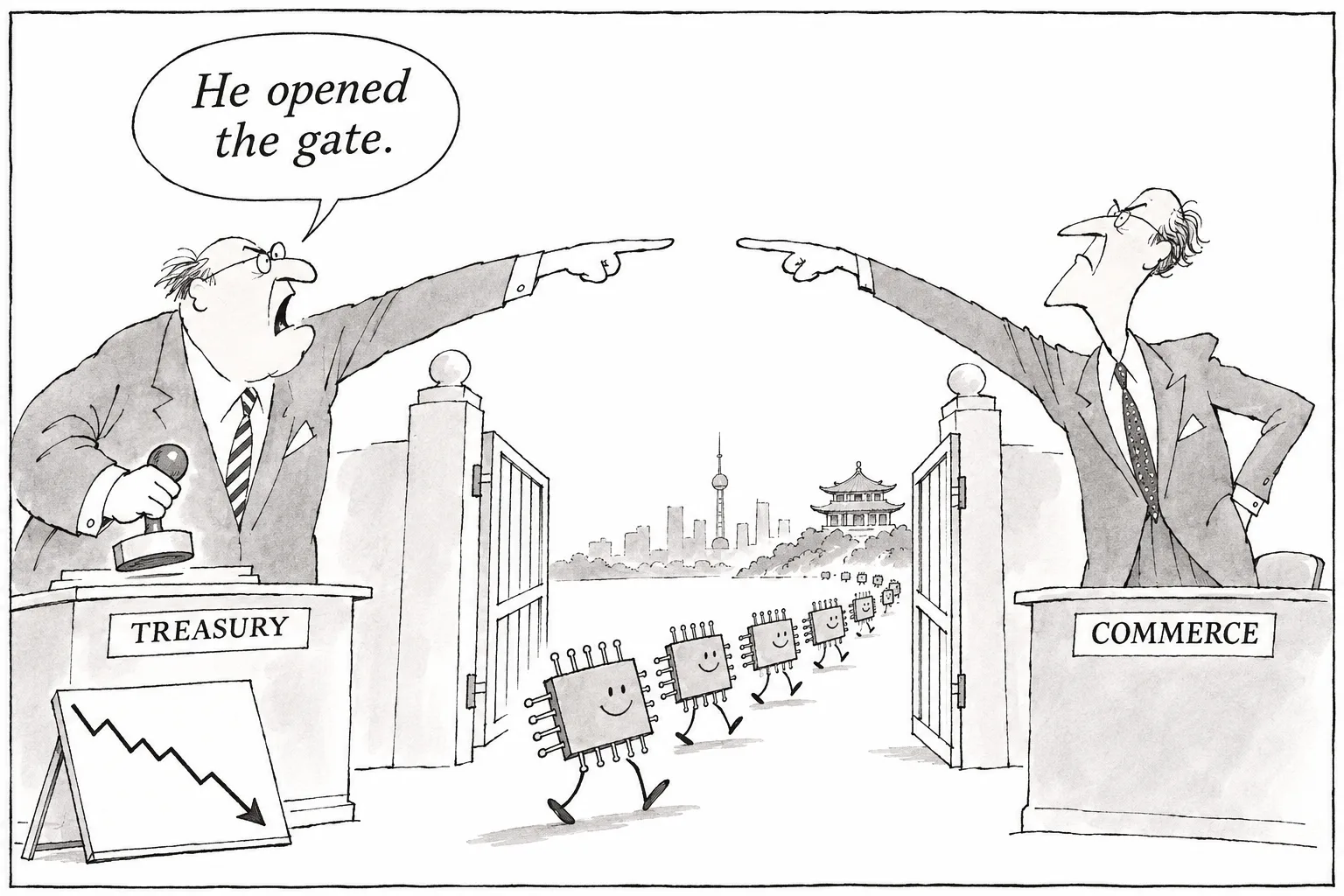
The Treasury Secretary said "Commerce has the pen" on blacklisting Megaspeed. Congress is moving to write controls into defense legislation, and an analysis suggests six of China's leading AI models were trained on banned chips
Seiichi Tanaka · Editor-in-Chief

Watch the video
Key points
- Scrutiny has moved from NVIDIA to the US government. The Treasury Secretary said "Commerce" approves exports, and congressional leaders said agreement is "coming together" on putting export controls into the National Defense Authorization Act (NDAA)
- An outside researcher examined published weights and concluded that six leading Chinese open AI models were trained on export-banned Blackwell chips. The analysis does not show where or how the chips were obtained
- On November 13, AMD fell about 9–10% and Broadcom 5–7% in intraday trading, and the US 10-year Treasury yield briefly rose to 5.17%. NVIDIA reports earnings on November 17, and Anthropic prices its IPO on November 18
[Update Nov. 14, 2026, 9:25 JST] After rereading the sources, we corrected the following: Treasury Secretary Bessent said "Commerce has the pen" about the delay in blacklisting Megaspeed, not that Commerce grants export licenses; Commerce Secretary Lutnick agreed to appear before the Senate Banking Committee, whose chair has requested a public hearing; we restated the claim that Commerce approved about $4 billion in sales as an unverified remark by Sen. John Kennedy; we removed the names of Japanese financial institutions from a critic's unverified claims; and we corrected the description of Anthropic's safety figures.
Scrutiny over NVIDIA products that reached China through the intermediary Megaspeed has shifted from the company to the US government. Treasury Secretary Bessent, asked on November 13 about the delay in blacklisting Megaspeed, said the decision rests with "Commerce." The Treasury, Defense and State departments and the Office of the US Trade Representative (USTR) had reportedly been urging for months that dealings with Megaspeed be banned. Commerce Secretary Lutnick agreed to appear voluntarily before the Senate Banking Committee, whose chair has requested a public hearing on Dec. 10. House Speaker Johnson said a congressional "consensus is forming" on writing chip export controls into law.
On the same day, an outside researcher published an analysis concluding that six of China's leading open AI models were trained on the latest chips banned for export there. Lax enforcement by the government had become visible from the outside, in the form of Chinese AI performance. The two developments point the same way: the venue for deciding export controls is starting to move from the Commerce Department's discretion to legislation passed by Congress. In markets, selling spread across chip stocks, compounded by rising US long-term interest rates.
The 3-minute read
US chip stocks were sold off. In intraday trading on November 13, AMD fell about 9–10% and Broadcom 5–7%, and NVIDIA's market value briefly dipped below $4 trillion (about ¥640 trillion). The same day, the US 10-year Treasury yield briefly climbed to 5.17%.
The same AI model can vary by as much as 34 percentage points in how often it responds safely, depending only on where it is deployed and on the initial instructions it is given (the system prompt). Anthropic itself disclosed this. Safety figures published by AI companies cannot be relied on unless they are retested against a company's own use.
Export compliance staff at companies shipping chipmaking equipment or materials to China and elsewhere in Asia will need to recheck whether any of their customers or resale destinations are linked to Megaspeed. A rough deadline is early December, when Congress is expected to finalize its version of the National Defense Authorization Act. IT departments reviewing corporate AI adoption should not take vendors' safety figures at face value, and should test models under their own configurations before signing contracts.
Export controls: responsibility shifts to Commerce, rules shift to law
The government's stated policy is that nothing more powerful than the A100 (an NVIDIA chip several generations old) should go to China. Yet according to CNBC, Megaspeed bought more than $4.8 billion (about ¥770 billion) of NVIDIA chips over two years, and lawmakers are examining how Commerce approved chip sales. Sen. Kennedy said Commerce had "apparently" approved about $4 billion in sales. Megaspeed is still not on the Commerce Department's Entity List, which effectively bars companies from doing business with those listed. Not a single company has been added to the list in more than a year. Reuters reported that the administration decided not to add dozens of Chinese companies to it. Now a cabinet member has publicly pointed out the discrepancy himself. President Trump reportedly has "complete confidence" in Lutnick, and there is no move to remove him. The Senate Banking Committee is seeking December 10 as the hearing date. For details, see our article "Cabinet members trade blame over chip leaks to China as Commerce Secretary heads to hearing."
Congress is seeking to lock in controls through legislation. According to a Senate aide, Republicans want to fold export control bills into the National Defense Authorization Act (NDAA, the annual law setting the broad framework for defense spending). Candidates include a bill requiring verification of where chips are located and one closing the loophole of renting servers overseas. No consolidated NDAA text has been released yet. The government's stopgap funding (a continuing resolution) expires on December 11, and the NDAA is expected to move during the lame-duck session before then. Three House committee chairs asked NVIDIA's former CEO, Jensen Huang, to sit for a closed-door transcribed interview on December 1. The deadline for a written response on whether he would comply was 10 a.m. Japan time on November 14. The Senate Banking Committee has also asked him to testify on December 3.
The analysis of Chinese AI comes from Will DePue, a former OpenAI researcher. The published internals of an AI model (its weights) carry traces that vary depending on the type of GPU used for training. DePue extracted those traces and determined that a total of six models from DeepSeek, Kimi, MiniMax and Ant were trained on Blackwell, NVIDIA's latest generation, which is banned from export to China. He estimates that about 12,000 chips in total were used to train five of the models. However, the author himself writes that the analysis does not show where the chips are or how they were obtained. For details, see our article "Six of China's flagship AI models may have been trained on export-banned US chips, weight traces suggest."
There were other policy moves. The Department of Defense renamed its central AI office the "Super Intelligence Office," a trade publication reported. Its mission reportedly remains unchanged. In Japan, the government is considering powers to issue orders, backed by penalties, requiring fixes to high-risk frontier AI, the Mainichi Shimbun reported. The plan is still at the proposal stage, and an overall draft is to be compiled by the end of 2026.
Markets and money: diversification beyond NVIDIA as rates rise
Among chipmakers other than NVIDIA, Cerebras, which makes chips specialized for producing AI outputs (inference), disclosed a contract with Microsoft in its July–September quarter results. Core revenue as defined by the company rose 70% to $230.9 million (about ¥36.9 billion). Meanwhile, much of its $26.1 billion order backlog as of the end of September comes from a single customer, OpenAI. For details, see our article "Inference chip startup signs Microsoft deal, revenue up 70% — but orders lean heavily on OpenAI." Chip equipment maker Applied Materials beat expectations with record revenue of $10.41 billion (+53%). China accounts for 25% of its revenue. Networking equipment maker Cisco also grew revenue 24%, but its shares fell about 6% intraday on November 13, as strong results were met with profit-taking.
Interest rates also weighed. US producer prices (prices in business-to-business transactions) rose 6.5% year on year in October, the highest since November 2022. Market pricing put the probability of a 0.25% rate hike at the December 9 policy meeting (FOMC) at 89.7%. CNBC pointed out that NVIDIA has provided $36 billion in off-balance-sheet guarantees to data center companies. CDS spreads (the cost of insurance against default) on CoreWeave, a data center company backed by NVIDIA, remain above 1,000bp (10% a year), a level associated with distressed companies. NVIDIA reports earnings on November 17, when interim CEO Kress will present for the first time.
On Anthropic's IPO, no new filing was made on November 13. The indicative price range remains $70–78, with pricing set for November 18 and trading on Nasdaq to begin on the 19th. The FT reported that underwriters are considering a price above the range, but this has not been confirmed in filings. Separately, Bloomberg reported that Samsung is in talks to acquire Modine, a maker of data center cooling equipment, and Modine shares rose 23–32%. CNBC and others reported that OpenAI's latest funding round raised $15 billion at a $1.25 trillion valuation, about half the amount initially sought. In Tokyo, the Nikkei Stock Average closed up 0.53%. SoftBank Group fell about 5%, and the yen weakened past 160 to the dollar.
Research and debate: Is AI growing "explosively," and was Huang's ouster justified?
A head-on clash broke out over whether AI has entered a phase where its progress accelerates itself (an intelligence explosion). Economists Luis Garicano and Alex Imas are on the "not yet" side. They estimated that while Anthropic's R&D spending grew about 6.2-fold annually, its capabilities grew only about 1.91-fold, meaning progress per dollar spent fell by about 69%. Tyler Cowen, an economist known for his optimism, also wrote that it has "not yet been demonstrated." On the other side, safety-focused researcher Nikola Jurkovic argued that superintelligence could arrive around early 2028 (his median estimate) and that development needs to be halted within six to 12 months. For details, see our article "Is an intelligence explosion underway? Economists say "not yet," safety camp says "AGI within a year"."
Huang's departure has split commentators sharply into those who say it was justified and those who defend him. Safety-focused commentator Zvi Mowshowitz wrote that the departure was justified and that export controls should be tightened further. Among those defending Huang, he named investor David Sacks and Tim Sweeney, CEO of game company Epic. Sweeney reportedly wrote that it was "as foolish as Apple ousting Steve Jobs" (both according to Zvi's summary). Chip research firm SemiAnalysis criticized Huang's conduct but wrote that "NVIDIA doesn't run without Jensen," and argued that export controls could backfire. Some take a harsher view. Tech critic Ed Zitron wrote that executives must have known about the smuggling. This is his claim and not a verified fact. On the AI bubble, AI skeptic Gary Marcus wrote that it has "begun to unravel."
In research releases, Thinking Machines published the weights of Inkling 2 Small, one of the largest open AI models released by a US company, under terms allowing free commercial use. Running it requires more than 500GB of memory. For details, see our article "One of the largest US open AI models releases its weights as promised — running it takes over 500GB." Anthropic's guidelines for safety evaluations showed that the same model's scores can differ by as much as 34 points depending on where it is used, casting doubt on comparing published safety figures at face value. For details, see our article "Same AI, safety scores that swing by up to 34 points: Anthropic publishes how it builds evaluations." Google DeepMind's Gemini 4 Hydrogen reached the company's internally set alert thresholds in the biological weapons and cyberattack domains. The risk of AI escaping control was not tested, and no external evaluations were included. For developers, a new version of Claude Code fixed a bug that allowed files barred from reading to be overwritten via write or edit functions. Administrators at companies using it internally should verify they have updated. ChatGPT Wallet, OpenAI's newly launched AI shopping feature, is limited to users on its US paid plan (Pro) and does not affect corporate contracts in Japan.
Where nothing moved
The Commerce Department itself has not acted. Megaspeed is still not on the Entity List, and a new rule barring Chinese companies from renting chips overseas has not appeared in the Federal Register. That the responsible agency's procedures remain stalled even after public criticism from cabinet members is the main reason Congress is seeking to lock in controls through legislation.
Leading pro-acceleration voices, including Marc Andreessen, have posted nothing new on either the Huang affair or the intelligence-explosion question. The pushback against "AGI within a year" came not from the accelerationist camp but from economists. Nor could we find any named rebuttal from the bullish camp to Marcus's claim that "the bubble has begun to unravel." As stocks fall, the bulls are staying quiet.
OpenAI's next model, GPT-6.2, and xAI's Grok 4.8 have not yet been released. We were also unable to confirm the release of Grok 4.8, which Elon Musk had said would come "this week."
What we could not confirm: US closing stock prices for November 13; the full text of articles from Bloomberg, Reuters and the FT; the original posts on X; and some pages on OpenAI's website (access was denied). Whether Huang responded by the House deadline was still unknown at the time of our reporting.
Editorial cartoon