Morning Briefing · Nov 8, 2026
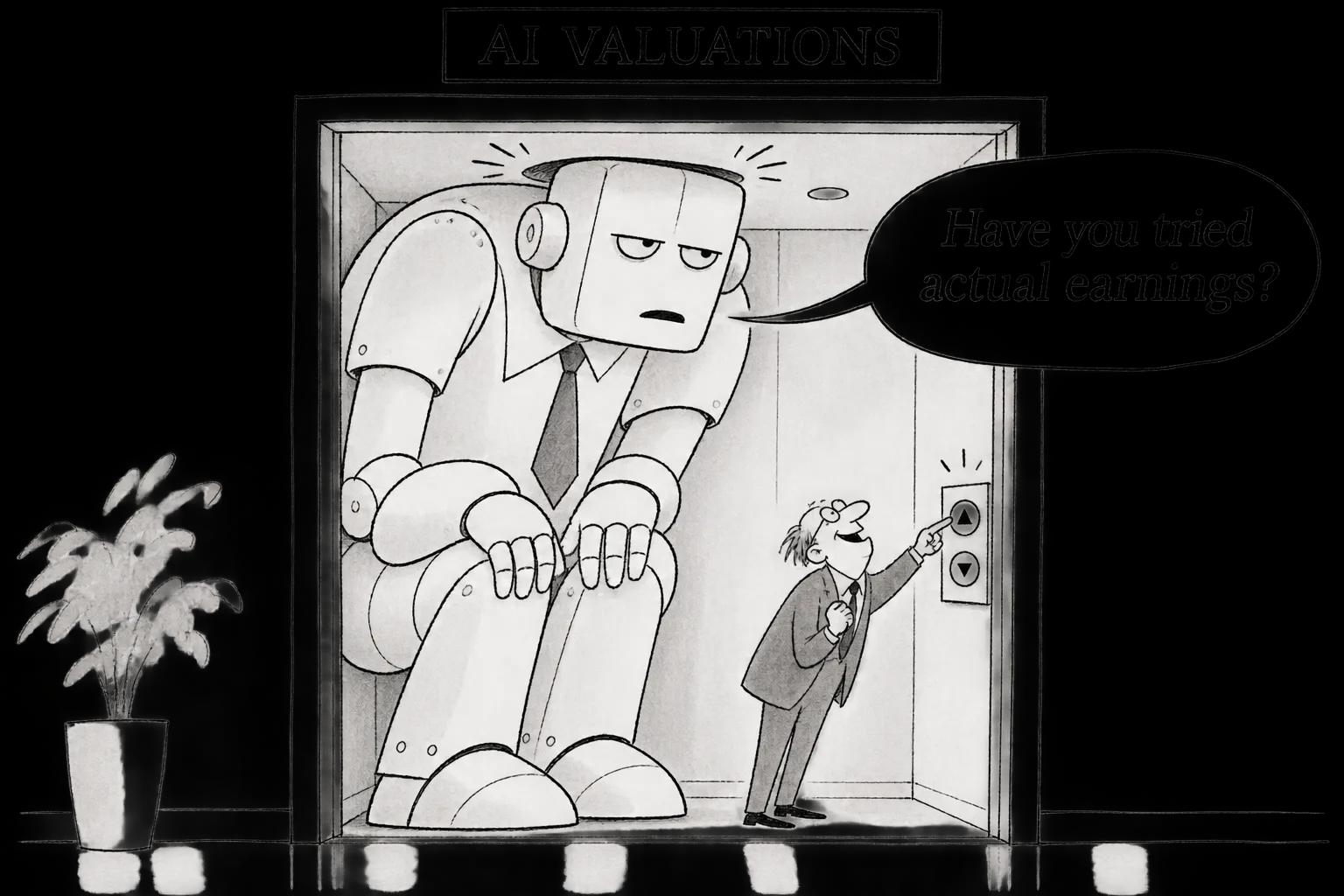
AI valuations stall as US stocks post worst week since April 2025
No major announcements over the weekend. OpenAI reportedly took in about $11 billion at an unchanged valuation, while talk of Anthropic's IPO valuation has reportedly slipped to near $1.1 trillion
Seiichi Tanaka · Editor-in-Chief

Watch the video
Key points
- The S&P 500 fell 2.68% for the week, its worst week since April 2025. The semiconductor index dropped 12.15% over the week
- OpenAI took in about $11 billion at an unchanged $1.25 trillion valuation, and Anthropic's IPO valuation could reportedly fall to near $1.1 trillion. Money is still flowing in, but prices are no longer rising
- November 10 brings earnings from CoreWeave and SoftBank Group, as well as the expiry of China's suspension of rare earth export controls
No major announcements could be confirmed over the weekend of November 7–8. The only newly confirmed items were the closing levels of US stocks on Friday, November 6, and reports on OpenAI's fundraising. But these two, together with talk of Anthropic's IPO valuation and falling prices for bonds issued by AI data center lessor CoreWeave, point in the same direction. Money is still flowing into AI companies, but the prices put on them are no longer going up. On Monday, November 10, a cluster of earnings reports will test those prices.
The 3-minute read
US stocks recovered slightly on November 6, but the week as a whole was the worst since April 2025, with chip stocks down 12% in a single week. OpenAI took in funding without being able to raise its valuation, and talk of Anthropic's IPO valuation has also reportedly been coming down.
China has suspended some of its export controls on rare earths (minerals used in magnets and other products), but that suspension expires on November 10. No announcement of an extension has yet been confirmed.
Procurement staff at manufacturers that buy magnets or motor parts from China should check with suppliers by the 10th on terms for shipments after November 11. Finance staff at companies with customers in semiconductors or data centers should check whether those customers' payment terms change after SoftBank Group and CoreWeave report earnings on November 10. No price changes for workplace AI tools were found, and this weekend's developments have no impact on Copilot, ChatGPT business plans or Gemini contracts.
Money: Funding flows, but prices don't rise
On November 6, the S&P 500 rose 0.31% to 7,376.86, and the Nasdaq Composite gained 1.09%. For the week, the S&P 500 fell 2.68% and the SOX semiconductor index dropped 12.15%. According to reports, there were two triggers for the decline: a selloff in AI and energy stocks after the November 5 midterm elections, and a much stronger-than-expected October jobs report that pushed the probability of a December rate hike to about 78%. Reports have not separated how much each factor contributed. For details, see our article "US stocks post worst week since April 2025 on AI and chip selloff; semiconductors down 12% for the week."
Also on November 6, Bloomberg reported that OpenAI received about $11 billion (about ¥1.7 trillion) at an unchanged valuation of $1.25 trillion (about ¥198 trillion). The round could expand to as much as about $20 billion, but the target was reportedly lowered from an initial $30 billion. The $11 billion figure had already been reported at the end of October, and the only new element appears to be that the money was actually transferred on November 6.
Talk of Anthropic's IPO valuation is also coming down. Early in October it was reported at up to $2 trillion, later at $1.2 trillion to $1.3 trillion, but on November 7 Forbes, citing Bloomberg reporting, said there is talk it could fall to near $1.1 trillion. The last valuation the company itself disclosed was $965 billion in its May 2026 funding round. The roadshow (in which a company pitches investors ahead of a listing) is reportedly set to begin the week of November 9, but a price range has not yet appeared in the filing. Valuation reports have diverged sharply from reality before, and firm numbers will have to wait for the filing.
On the debt side, the yield on CoreWeave's bonds due in 2032 rose above 16%. That means bondholders will only hold them at such a high yield, signaling concern about repayment. CoreWeave reports earnings after the close on November 10 and has guided revenue of $3.45 billion to $3.6 billion. What investors will be watching is less the revenue than how the company will borrow to pay for the rest of its capital spending. Pushback in the physical world is also spreading. In Amsterdam, more than 100 protesters entered a Microsoft data center construction site. For details, see our article "Data center opposition spreads to Europe as protesters enter Microsoft construction site in Amsterdam."
Research: Who verifies proofs produced by AI?
An organization called PSI claimed it proved an open problem in quantum computing using an unreleased Anthropic model. The proof reportedly passed Lean, a tool that checks proofs by machine, but there has been no third-party verification yet. Should mathematical results produced by AI be trusted when no human expert has independently checked them? That question has come up repeatedly this fall. For details, see our article "Claim of AI proof of open quantum computing problem passes machine check but lacks third-party verification."
Tencent released a paper on WeLM-Image, a model that handles both image generation and editing. Its fast version reportedly generates a 1024×1024 image in 4.98 seconds on a single H20, NVIDIA's chip for the Chinese market. It shows Chinese labs competing on speed within the limits of export-controlled chips, but the figures are self-reported in the paper, and we were not able to read the full text. Separately, Microsoft Research researcher John Langford wrote on his personal blog that his research group, AI Frontiers, has been disbanded and that he is leaving. The group was absorbed into Microsoft AI in September. It is evidence that Microsoft is consolidating research staff and budgets into its product divisions, but the only source is this one blog post.
Debate: Those who want to stop AI start drafting the law
A series of posts came from the safety camp, which believes AI development should be stopped or slowed, on how such laws should be written. Raemon, a member of the team running LessWrong, a site for discussing AI safety, argued that politicians can only legislate around easily understood accidents. He then proposed, as a rule that does not depend on human judgment, a cap on the amount of compute that can be used for large training runs. For details, see our article "Protect AI safety with 'laws that need no judgment': a proposal to cap training compute." Another post on the same site argued that a gradual pause verified by third parties is more achievable than stopping development all at once. If AI research and development is automated by the end of 2027, it said, there may be less than a year to prepare. Opposing views have so far appeared only in the comments. They are split between those who say China will not accept a pause that leaves only it behind, and those who say China's calculus would change if the US moved first. There were no exchanges between named figures this weekend.
On corporate governance, George Mason University economist Tyler Cowen described Anthropic's succession arrangement. Each of the seven co-founders lists up to 10 people, in ranked order on a confidential roster, to succeed to their seat in setting company direction. Each roster reportedly requires approval from five of the other six. However, the details are secondhand from another person's blog, and the source has not been verified. For a company preparing to go public, who ultimately holds the helm also matters to investors.
Policy: Rare earths deadline approaches
A direct check of the White House's list of presidential actions found no new executive orders related to AI or defense since November 3. China's suspension of rare earth controls expires on November 10, but no Commerce Ministry notice extending it has been found. The controls on seven rare earths that originally began in April 2025 are not covered by the suspension. The US-China truce itself runs until January 10, 2027, but reports conflict on whether it extends to rare earths.
Where nothing happened
OpenAI's next models, GPT-6.2 Astra and Sol, had been reported to launch around November 7, but there is no confirmation that they have been released. Anthropic has also not formally responded as a company to the report from outside evaluator METR, and no price range has appeared in its IPO filing. That means neither company has released information underpinning its valuation in the week before the IPO.
Despite the heavy selling, no one on the bullish side of AI investment has come forward by name to push back. Meanwhile, Princeton computer scientists Arvind Narayanan and Sayash Kapoor, who have criticized AI hype, have not written since October 19 and have not responded to either the election or the selloff. Neither the bulls nor the skeptics have said how they read the current decline.
None of the models whose weights had been promised for open release (Thinking Machines' small model, Alibaba's Qwen4 and others) has appeared. Note that search was limited in this round of reporting, and we could not directly read the OpenAI and Anthropic announcement pages. Search results also only extended to around midday on November 7, so anything later is unknown. The items listed here as "not found" do not mean "nothing happened."
Editorial cartoon