Morning Briefing · Oct 31, 2026
AI stock selloff hits second day as markets start asking whether capex will turn into cash
Amazon, Intel and SanDisk fell despite beating some estimates, as funding shifts toward debt and guarantees. On the lab side, a unified AI-training opt-out signal and a demonstration of exploits built with an open model
Seiichi Tanaka · Editor-in-Chief

Watch the video
Key points
- Strong results still got sold. AWS grew 39.3%, but Amazon's trailing 12-month free cash flow fell to −$42.4 billion. Markets are now looking less at growth and more at whether capital spending will turn into cash
- With Microsoft's $25 billion bond sale and NVIDIA's reported talks to guarantee Nscale's debt, capex funding is shifting from cash on hand to borrowing and guarantees
- The four major labs adopted a single signal for opting out of AI training. Epoch AI showed that an open model can produce exploit code for about $1,000 per version. Bubble skeptics such as Gary Marcus and accelerationists alike stayed silent
The selloff in AI stocks ran into a second day. On October 30, the Nasdaq fell 3.60% and the SOX semiconductor index dropped 7.2%, according to reports. After Alphabet's 12.6% slide the previous day, Amazon, Intel and SanDisk, all of which reported after the close on October 29, were sold off too. All three had beaten expectations on at least some measures.
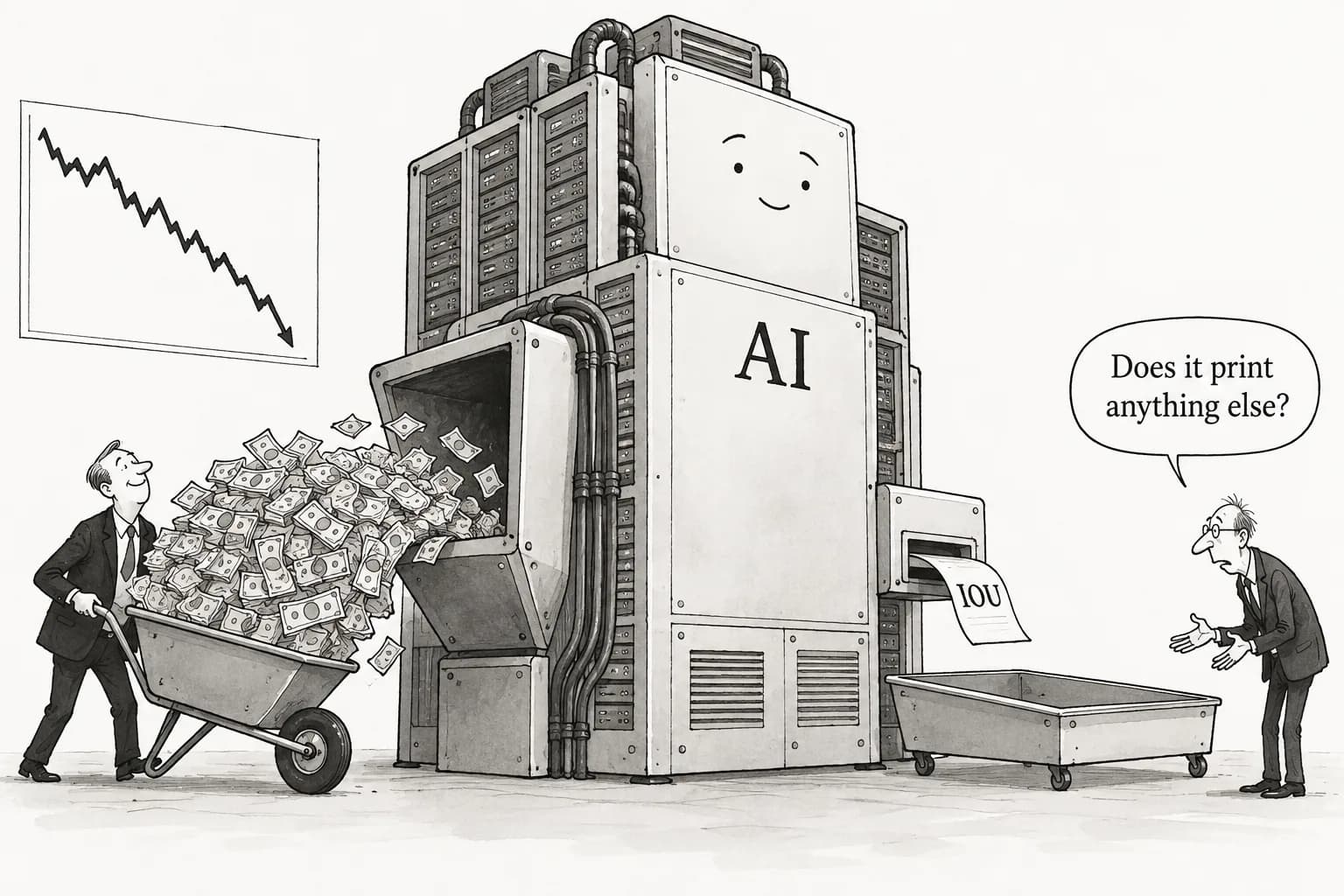
What the three share is that good numbers did not hold up their stocks. AWS grew 39.3%, its fastest pace in about five years. But Amazon's purchases of property and equipment for the July–September quarter came to $77.26 billion (8-K, primary source), and its trailing 12-month free cash flow fell to −$42.4 billion. Market attention appears to have shifted from whether these businesses are growing to whether capital spending will turn into cash. In the same 48 hours, Microsoft issued $25 billion of dollar-denominated bonds, its first such sale since 2017. NVIDIA was also reported to be negotiating a guarantee of Nscale's debt. Capex funding is moving from cash on hand toward borrowing and guarantees. Along the way, shareholders have started to doubt it first. That is the picture today.
The labs released no major new models. Two things stood out. The four major labs adopted a shared signal for opting out of AI training. And Epoch AI showed that an open model can turn Firefox patches into exploit code.
Markets: what got sold was "good earnings"
Intel's July–September revenue was $16.5 billion (+21%), within its guidance range. But its revenue outlook for October–December was $15 billion to $16 billion, well below expectations of about $17.07 billion (earnings release, primary source). The main reason was an October 14 explosion at Fab 28 in Israel that halted production for about two weeks. The shares fell roughly 28% to 31%, reportedly the steepest drop since 1974. Full details are in Intel outlook plunges; $1 trillion reportedly wiped from chip stocks.
For the full Amazon story, see AWS up 39%, but $42.4 billion in cash flows out of Amazon. Two points here. First, Amazon kept its 2026 capital spending plan at about $220 billion. Subtracting the nine-month net figure of $172.2 billion leaves about $48 billion for October–December, which does not square with the $75.9 billion spent in July–September. For 2027, the company said only that it would spend "considerably more," without giving a figure. Second, according to the 10-Q, the fair value of Amazon's Anthropic convertible notes is $146.2 billion, of which $140.3 billion is unrealized gains. There are also $164.9 billion in leases that have not yet commenced. Valuation gains on lab investments, borrowing and off-balance-sheet leases are all swelling at the same time. Separately, the "$94.8 billion on equipment" figure reported by AP appears to have been confused with non-cancelable purchase commitments ($94.759 billion).
Memory followed the same pattern. SanDisk beat its guidance with revenue of $11 billion (+378% year on year) and a non-GAAP gross margin of 85.1%, and announced an 8-for-1 stock split. Its shares still fell about 14%, apparently on a growing view that price increases are near their peak. Samsung again declined to give a figure for HBM revenue on its earnings call.
Not all of the selling was about AI. Tensions in the Middle East pushed Brent to $112.86. About $6.3 billion was stolen from Binance, and bitcoin fell about 5%, according to reports.
[Correction] In the previous edition, we put ServiceNow's October 29 decline at around 20%. On a closing basis it fell 27%, its worst day since going public. The same week, Serval, which pitches itself as a ServiceNow replacement, raised $150 million at a $3 billion valuation. The fear that AI will eat SaaS was priced on both sides, among the sellers and the buyers.
[Resolved] Microsoft's "about $170 billion" was its capital spending outlook for calendar 2026. It was lowered from about $175 billion because deliveries of external GPU capacity were delayed. The next question is how that delay shows up in results from CoreWeave (November 9) and Nebius (November 10). Their shares fell 36% and 33%, respectively, in October alone. NVIDIA's guarantee talks (reported by The Information; believed to exceed $5 billion and not yet signed) would fund the 460MW second phase of Monarch for Anthropic. If the deal goes through, NVIDIA would be chip seller, shareholder and debt guarantor on the same project.
Views also split on the credit rating of Anthropic, which is preparing to go public. According to a news flash citing the FT, Blackstone told investors that Anthropic's post-IPO rating was likely to be double-B. On the skeptical side, Ed Zitron noted that even WeWork, which wanted to raise only $500 million in its IPO, was rated BB−, and wrote that he did not see how this could be justified. On the valuation side, Aswath Damodaran (October 28) put the company's value at $1.475 trillion. Treating roughly $472 billion in compute commitments as debt, he argued that BB+ reflects the real risk. He said he would not buy above $1.25 trillion.
Labs and research
OpenAI, Google, Microsoft and Anthropic adopted "__usage_ai-training," a robots.txt signal for opting out of training. Sites no longer need to write separate rules for each company's crawler, and the signal treats use for training separately from use as grounding for answers. Start dates vary, however, according to reports: Microsoft on February 1, 2027, and Google sometime in 2027. OpenAI's announcement page returned a 403 error, so its contents were confirmed through secondary sources. No post on the matter could be found on Anthropic's news page. Full details are in Four major labs unify AI-training opt-out signal, but start dates vary.
Epoch AI used Z.ai's open-weight GLM 5.3 to build working exploit code from published patches for all six Firefox versions it tested (primary source). Each was completed before the update reached users. The cost was about $1,000 per version, and the same approach failed against Chrome. It supplies part of the dollar figure the cyber debate has been missing. What it measures, however, is the cost of an attack, not the cost of damage. Full details are in Open model turns Firefox patches into exploits for about $1,000 per version.
Cohere will receive up to C$1.6 billion in investment from the Canadian government (Prime Minister's Office, primary source; conditions include keeping its headquarters in Canada). It also announced that it will acquire AISLE and turn it into "Cohere Cyber," and that it will begin frontier-scale training with partners in allied countries within 12 months. While stressing that more than 70% of open-model tokens come from Chinese models, it did not mention Qwen or the data-exfiltration case. A lab that is neither American nor Chinese is heading for the frontier with state capital.
OpenAI disclosed for the first time that it made more than 200 referrals to police and other authorities in the July–September 2026 quarter. Full details are in OpenAI discloses more than 200 referrals to police for the first time.
Open questions from last time: There is still no model card for Gemini 4 Carbon and no Frontier Safety Framework report. Nor could we find any statement acknowledging that a cyber CCL had been crossed. On the ETH rebuttal, PR #4 was merged into openai/math, but it fixed the file name of a different result and has nothing to do with ETH. On distillation, Seoul Economic Daily (secondary source) reported that after Anthropic's countermeasures, extraction by DeepSeek and Moonshot moved to GPT-6 Astra. Neither company responded. Separately, Anthropic's "Scaling Misuse Detection with Self-Assessment" circulated as an October 30 release, but the page is dated October 16.
Ideas and debate
In the dispute over AI audits of economics research, Gabriel Zucman, whose work was audited, pushed back (X, October 29). He named Musk and Cowen, and pointed out that the attack came six days before California's wealth tax vote. He called the audit "an ugly use of artificial intelligence, and a farce," and took issue with the lack of expert review. He also wrote that his team's code and data are public. Tyler Cowen, on the auditing side, has not responded to Zucman directly. Instead, he highlighted a revised version that splits the findings into 53 "serious flaws" and 94 "disputed significant choices." He has not clearly released either the prompts or the code, however. On transparency, the audited side is ahead of the auditors. Saez has stayed silent. Full details are in Zucman, target of AI audit, hits back as dispute moves to tax vote.
Within the safety camp, Jan Kulveit published "Microdosing the spirit of Anthropic" on LessWrong. Lab insiders' views each make sense on their own, he argued, but taken together they form a combination that benefits the company. The cause, he said, is not malice but selection and peer pressure, and he wrote that more people should leave the labs and fewer should join. There has been no response from the labs yet. Another post asked what OpenAI's Mission Advisory Council actually is. The council was one of the addressees of a letter from three fired researchers. OpenAI's Boaz Barak replied that it is made up of senior employees who advise leadership, and promised more transparency.
In the debate over pausing versus pacing, Geoffrey Irving (October 28), on the pause side, wrote that Anthropic or OpenAI should first pause unilaterally. The pacing side has Amodei's pacing proposal from September. No new exchanges within the window. [Resolved] Altman's remark that "alignment was easier than we thought" was made in a conversation at the Stanford Graduate School of Business. Transformer's weekly newsletter rendered it the other way, as "harder," and we do not use that version.
On the ethics-critique side, Brian Merchant and Paris Marx called opposition to data centers "the most bipartisan issue in politics," citing 75% opposition to building one locally. On October 29, construction moratoriums took effect in Tazewell County, Illinois, and Martin County, Florida. Sioux County, Iowa, meanwhile, lifted its moratorium and wrote rules, moving to accept data centers.
Policy and defense
A joint statement from the Canada–EU summit said the two sides aim for mutual recognition of "conformity assessment results for AI systems" (primary source). It is the first time a non-EU G7 country has sought a path to the EU AI Act's conformity results. But it is a commitment to "aim for," not an agreement. Canada is also joining EuroHPC. Together with the Cohere investment, Canada is building a foothold outside the US on both compute and regulation.
The US FCC reportedly voted 3–0 to adopt an order barring test labs from countries without mutual recognition agreements (Reuters). In practice, it covers all of mainland China. Chinese labs tested 82% of the equipment submitted for FCC certification in 2025. China's Ministry of Commerce said on October 30 that it had "already taken countermeasures" and warned of further steps if the US did not reverse course. It is the biggest decoupling so far in the US–China hardware certification chain. In defense, Salesforce is acquiring Rune Technologies, which makes logistics software for environments with unreliable communications. Terms were not disclosed.
Where nothing moved
The most conspicuous silence came from the bubble camp. Over two days in which Alphabet posted its worst drop since going public and Intel plunged, Gary Marcus posted nothing on Substack or Bluesky. Ed Zitron had no new essay either. At the opposite pole, the accelerationists (Andreessen, Verdon, Sacks) said nothing about the S-1, the ratings or the stock selloff. Both extremes were silent, and only the market numbers spoke. Narayanan and Kapoor of the "normal technology" school have not posted since October 19.
Among labs, there were no new releases from Anthropic, Google DeepMind, Meta, xAI or the major Chinese labs. METR and the UK AISI were also quiet. On the money side, Anthropic's S-1/A with a price range has not yet been filed. OpenAI's raise of up to $30 billion at $1.25 trillion passed October 30, the reported investor deadline, but neither signing nor funding can be confirmed. In policy, there have been no reports that AUTOWARCOM's Project Agincourt plan was delivered by its October 30 deadline. The stall itself is news.
Next week brings Palantir on November 2, the midterm elections and AMD earnings on November 3, and Arm and Qualcomm earnings on November 4. After that, CoreWeave reports on November 9 and Nebius on November 10. The question of whether capex turns into cash will likely be tested most sharply by the neocloud results.
Editorial cartoon