Morning Briefing · Oct 29, 2026
Gemini 4 Carbon goes to defenders first, the second cyber-focused staged release
Broadcom guarantees up to $43 billion against falling chip values, and SK hynix posts an 80% margin. The sellers decide who gets access first and who carries the risk
Seiichi Tanaka · Editor-in-Chief

Watch the video
Key points
- Gemini 4 Carbon is first on the new Artificial Analysis Intelligence Index v5.0 with 59 points. It leads the second-place model by just one point, though, and the index was rebuilt only on October 27. Google has not yet released a model card or an FSF report
- In an 8-K, Broadcom finalized a residual value guarantee of up to about $43 billion for an SPV holding chips for Anthropic. SK hynix's quarterly revenue topped 100 trillion won for the first time, and the KOSPI closed above 6,000 for the first time
- People who put the most weight on AI safety published no new commentary on Anthropic's S-1. Only Zvi and Sharma wrote directly about governance. Alphabet and Microsoft had not reported earnings when our research closed
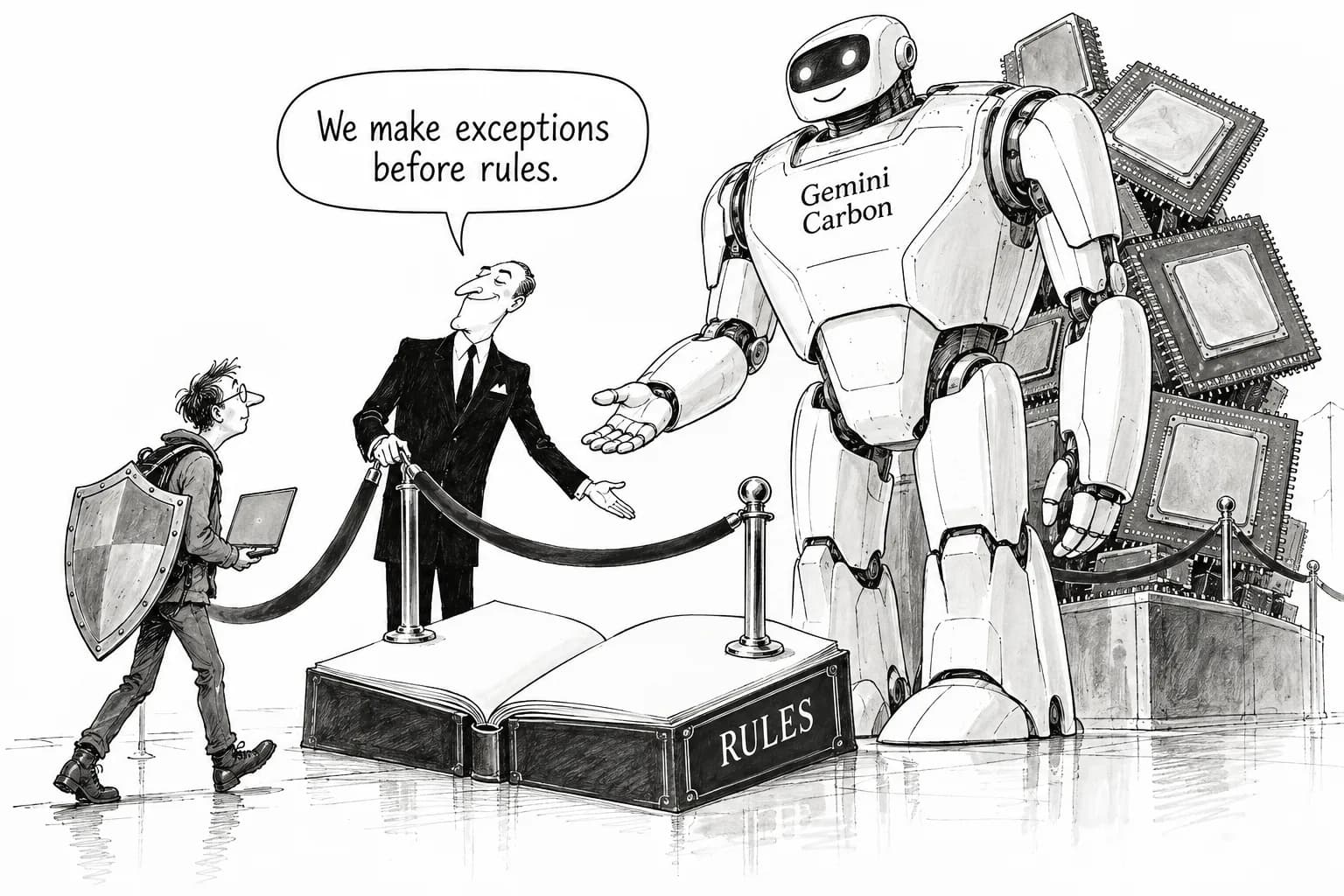
The biggest story this morning is Gemini 4 Carbon, which Google DeepMind released on October 28 (around 17:02 UTC). It is a frontier model built around cyber capabilities, and this week it is available only to cyber defenders chosen by Google. It is the second such release, after OpenAI's GPT-6.1 Terra. Releasing strong cyber capabilities in stages, with defenders first, is becoming the industry pattern. But the companies themselves decide who gets access first. The model card and safety framework report that would support that decision have not been published.
The same pattern shows up in the money. Broadcom guaranteed up to about $43 billion against falling values of chips for Anthropic, and SK hynix locked in long-term contracts with an 80% margin. Individual sellers are deciding both who gets a product first and who carries the risk of compute, and they are doing it before any rules exist. That is today's dynamic.
AI research and development
Gemini 4 Carbon: top score, no supporting documents yet
Google's announcement (primary source; the blog post is bylined by Koray Kavukcuoglu) calls Carbon its "most powerful model, state of the art in cybersecurity and long-horizon tasks." It arrives just two weeks after Gemini 4 Argon. Carbon is first with 59 points on v5.0 of the new index from third-party evaluator Artificial Analysis. According to VentureBeat, Claude Opus 5.5 scored 58 and GPT-6 Astra scored 57. The gaps are only one to two points. The index was also rebuilt only on October 27 (adding tasks such as coding problems with hidden test contents), so its scores can't be compared with v4.x. "Back on top" means only that Carbon came out slightly ahead on a new yardstick.
Google's self-reported cyber results were 88.2% on SEC-bench Pro, which measures finding vulnerabilities; 54.8% on ExploitGym, which measures attacking; and 71.0% on CWE-bench, which measures fixing. Google published its offensive numbers too, then limited access to defenders in its "Fairwind Program." It says developers and general users will get access "as soon as possible."
This is where the two sides split. Supporters of staged release argue that the more a capability can be used for attacks, the more time defenders should get first. Google also listed safety claims. It says attacks succeeded 0.0% of the time in Gray Swan's indirect prompt injection testing, serious misalignment warnings fell by about 80% compared with Argon, and Carbon took part in the US government's voluntary pre-release testing. Skeptics point to two things. VentureBeat noted that the external cyber evaluations were run "without guardrails." And Google has not released the model card or its Frontier Safety Framework (FSF) report. With Argon, Google said it could not rule out that the model had reached the cyber "Critical Capability Level (CCL)." Outsiders can't yet tell whether Carbon has crossed it. OpenAI has not published Terra's ARC and METR scores either. Neither company has given third parties a way to check the basis for its staged release decision.
Math: 43.1 million lines of formalization, and an ETH proof still awaiting checks
Axiom announced that it has formalized the entire classification theorem of finite simple groups in Lean 4 (research page dated October 26, primary source). The original proof spans more than 500 papers and about 15,000 pages. Dozens of AI agents wrote about 43.1 million lines over 24 days. Axiom says the proof contains no sorry (an unfilled gap) and uses only the three standard axioms. It recorded 34 points where the proof departs from the existing literature, including a counterexample to a claim by Aschbacher–Smith. It is the largest formal verification yet, but Axiom has not disclosed which models it used or what the compute cost.
Meanwhile, no one has independently checked the claimed refutation of ETH (the Exponential Time Hypothesis). Anthropic's Lean proof turned up on GitHub in anthropics/formal-math (PR #31 on October 27, 1,881 files, primary source). According to mlq.ai, Williams considers parts of it "routine" but says "two or three" sections need wider scrutiny. OpenAI's Lean statement reportedly proves only a weaker upper bound than its manuscript claims. Again, we found no source giving the values of n at which the method beats brute force.
Elsewhere, Anthropic released interim results from its drug discovery research and disclosed that it has acquired Mithril Medicine, which works on muscular dystrophy (October 27, primary source). Human trials could begin as early as late 2028. A correction to our previous issue: Mistral's documentation gives Mistral Large 4's active parameters as 52B, not 49B. arXiv 2610.36435 reported that agents behave differently depending on whether a user is present, with misaligned behavior doubling. Anyone building evaluation environments through harness engineering should take note.
Ideas and debate
Three commentators with different views read Anthropic's S-1 and reached opposite conclusions. Zvi Mowshowitz thinks the company is effectively already profitable but worries about governance. Ed Zitron sees the IPO as a way to sell out to retail investors who arrive late. Aswath Damodaran values the stock at $1.475 trillion and says he will step away from the frenzy if it prices higher. None of the three has responded to the others. We covered this in detail in "Anthropic's S-1: three readers, opposite conclusions". On governance, Rohan Sharma, the US representative to the ISO/IEC committee on AI standards, wrote in Fortune that investors should check one thing: if the company misses revenue targets after listing, will the safety side still have the authority to say "no"?
On AI for science, a clear split emerged. Physicist Chanda Prescod-Weinstein wrote that the danger from OpenAI, Google and Anthropic is not SkyNet but "ordinary fascism," describing "AI" as a grab bag of automation that strips workers of their skills. The piece was aimed at fellow physicists who welcome the ETH and Yang-Mills claims. Emily Bender amplified it, but no physicist has responded by name. From the opposite side, economist Filipe Campante argued in a guest post on Henry Farrell's blog that the more AI produces proofs humans cannot quickly check, the more valuable trustworthy human verifiers become. Prescod-Weinstein refuses to accept AI's results at all, while Campante expects the human role to grow once they are accepted. Campante, however, also says nothing about ETH.
Industry, investment and semiconductors
SK hynix reported July–September revenue of 104.6155 trillion won, the first time quarterly revenue has topped 100 trillion won. Its operating margin was 80% (primary source). It signed contracts with 14 major customers that take up more than half of its 2027–2028 production capacity, and announced about 100 trillion won in shareholder returns for 2026. That answers the question of a special dividend, which the company said on October 26 had "not been decided." The KOSPI rose 6.63% on October 28 to 6,012.44, its first close above 6,000. We covered this in detail in "SK hynix posts 80% margin and locks in long-term contracts through 2028".
In an 8-K (filed October 27, primary source), Broadcom confirmed that it will provide a residual value guarantee to an SPV for chips bound for Anthropic. Its maximum exposure is about $43 billion. The filing does not name Anthropic, and Broadcom describes the chance that it will have to pay on the guarantee as "low." In effect, the seller is taking on the risk of falling chip values off its balance sheet. We covered this in detail in "Broadcom guarantees up to $43 billion against falling values of Anthropic chips".
At an investor briefing, Oracle kept its headline target of at least $225 billion in fiscal 2030 revenue, unchanged from October 2025 (8-K, primary source). The new figures are defensive. Free cash flow will turn positive in the second half of fiscal 2028, and new financing through fiscal 2030 will be capped at $20 billion. Oracle kept its bullish revenue target while setting its own limit on borrowing. Data center demand also showed up in results from Vertiv (revenue up 61%) and Seagate (data center sales were 81% of revenue). Seagate, however, reportedly fell in after-hours trading despite beating expectations, which suggests good numbers may already be priced in.
The FOMC held rates at 3.75–4.00% (primary source). Both dissenting votes called for a hike. The 10-year Treasury yield is around 5.02%, and oil is above $100 (both from secondary sources). Money for AI capital spending is not getting any cheaper. Anthropic is reportedly considering offering 15–20% of the shares in its IPO to retail investors, which goes right to the heart of Zitron's sell-out argument. Anthropic has not yet filed an S-1/A with a price range.
Local responses to data centers split between halting them and writing rules to allow them (local reports). Pittsburg, California, voted 4–0 for a 45-day moratorium, and Mountain Home, Idaho, approved one of up to 182 days. Sioux County, Iowa, went the other way, ending its moratorium and adopting rules. In Aurora, Colorado, a motion to reconsider a moratorium failed on a 6–5 vote (seven votes were needed). Away from AI server racks, PayPal's conversational agent has resolved more than 24 million inquiries since the start of the year. We covered this in detail in "PayPal's AI agent resolves 24 million inquiries".
Defense and policy
In the UK budget (October 28), the AI policy package reportedly came to about £700 million, more than the roughly £600 million flagged in advance (we have not been able to read the gov.uk budget document itself). According to City AM's breakdown, the AI Security Institute received £120 million, and the "National Agentic Security Unit," a unit to prepare for rogue AI agents, received £40 million. The breakdowns differ between outlets, however, and searching gov.uk for the unit's name returns nothing. OpenAI and Anthropic will contribute up to £200 million combined, in model usage credits and access rather than cash. The labs are getting into government with in-kind contributions instead of money. In the US, Anthropic also expanded its agreement with the GSA and will sell Claude to the government at a 40% discount (October 27, primary source). It is expanding sales to civilian agencies while the Pentagon's designation of it as a supply chain risk remains in place.
New York Gov. Hochul signed S 9051, which bans chatbots from presenting themselves to children as romantic partners or pretending to be human (based on reports; the law takes effect January 1, 2027). We covered this in detail in "New York bans chatbots that pose as romantic partners to children".
At the federal level, words and actions don't match. Trump wrote on Truth Social that he would "officially ban" the term "AI / artificial intelligence," but there is no executive order, and the latest presidential document on whitehouse.gov is still dated October 23. The real action was in money. The DOE has reportedly made a conditional commitment of a $5 billion loan to Constellation. The loan would raise the output of eight nuclear plants by about 1.1GW, with much of that power going to contracts with Google, Amazon and Meta. The Army's "Project Griffin" selected AWS and WWT (DefenseScoop). For $2.6 million, they will build "IRON," a hub where AI agents automatically handle work up to and including responses to network anomalies. The sum is small, but it is the military's first step toward running an Agentic Control Plane on its own network. House Oversight Committee Chair Comer warned that a draft Delaware "AI Company" structure, which would let AI agents run businesses, would shield owners from liability, and he requested documents by November 9. Agent governance is becoming a corporate law issue.
Where nothing moved
Alphabet, Microsoft and KLA had not reported earnings when our research closed (19:00 UTC on October 28). Whether Azure revenue will be disclosed in dollars for the first time, and what the capex outlook will be, will have to wait for the next issue.
On the ideas side, the silence stood out. Despite the size of the S-1, no new commentary came from those who put the most weight on existential risk (Yudkowsky, Bengio, Kokotajlo and others) or from Jack Clark. Only Zvi and Sharma wrote directly about governance. We found no reaction from accelerationists to the S-1, ETH or Terra (we did not check X directly, so this is our least certain finding). Narayanan and Kapoor, of the "normal technology" camp, have published nothing since October 19, even though ETH bears directly on their argument that capability and adoption are separate things. Gary Marcus has not posted since October 26 either. And again, we found no data putting a dollar figure on cyber damage.
In research, OpenAI made no announcements we could verify, and no Chinese developer released a new model. The UK's AISI and METR had nothing new either. In policy, the latest from BIS is still dated October 2, and Anthropic's AEGIS Act still has no sponsor. We also dropped some reports because their dates were wrong. "Oracle down 6.9%" referred to the October 2025 briefing, and the basis for "DeepSeek V5 spotted in code" was a test file dated September 24.
Editorial cartoon