Morning Briefing · Oct 28, 2026
Two companies claim to have refuted ETH; AI chip financing hits $108 billion in a day
OpenAI's and Anthropic's math claims still await human verification. In chip financing, a structure in which sellers and lenders take on buyers' credit risk is spreading
Seiichi Tanaka · Editor-in-Chief
Watch the video
Key points
- OpenAI and Anthropic both announced refutations of ETH, each found on October 16, as verified in Lean. Anthropic's own paper says "no human has yet checked" the result
- Financing was reported of $63 billion for Broadcom chips for Anthropic, $40 billion between SpaceX and Apollo, and $5 billion for Argentum AI. A structure in which chip sellers and lenders take on buyers' credit risk is spreading
- Ahead of Anthropic's IPO, Zvi criticized the company from the safety side. Legal scholar Frazier pointed to three ways shareholders could strip away the trust's protections. Meanwhile, the accelerationist and existential-risk camps remain silent on the S-1
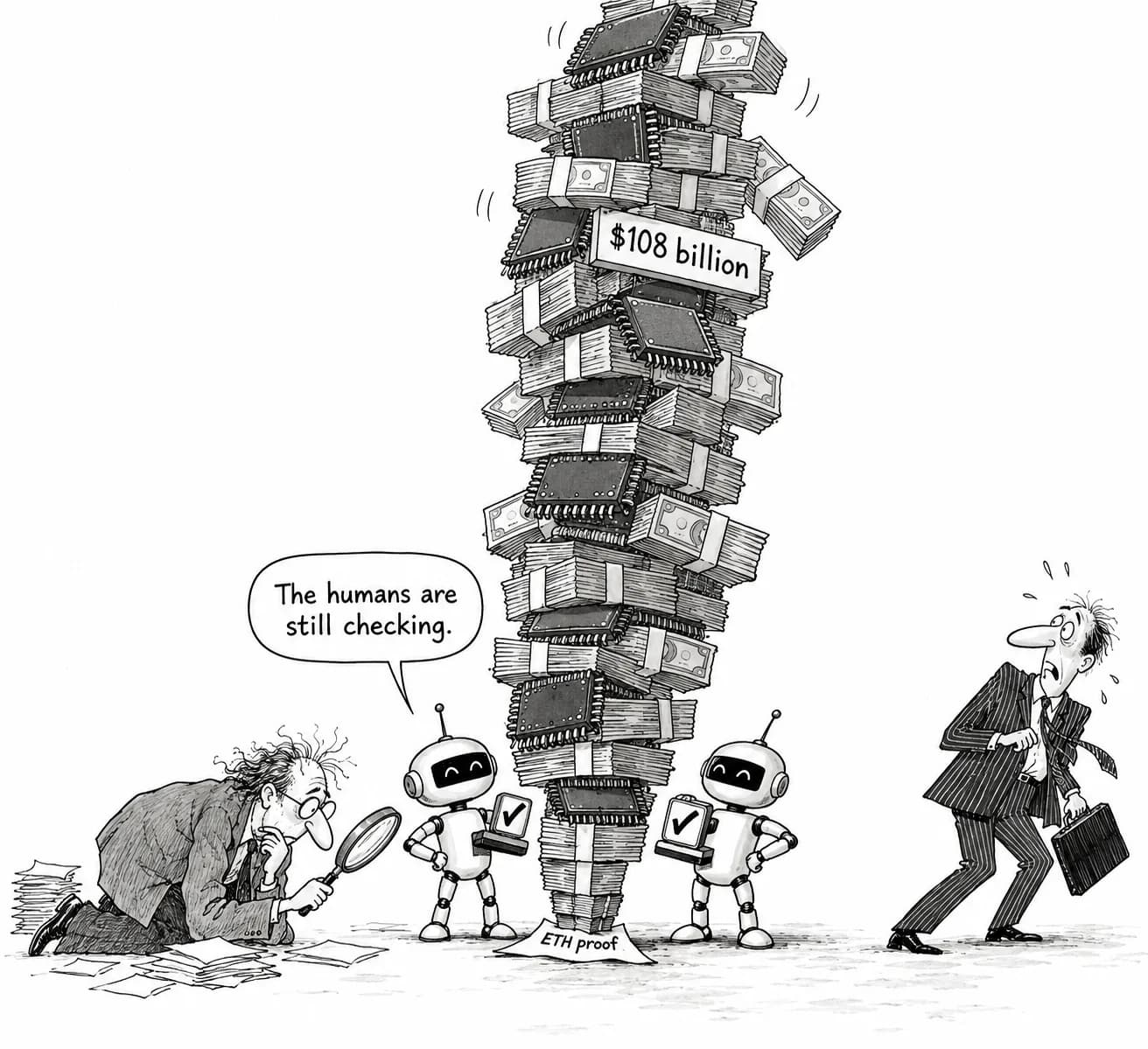
The main thread this morning is a clearer split between those who produce results and those who check them or carry the risk. OpenAI and Anthropic separately announced that their AI systems had refuted the Exponential Time Hypothesis (ETH) in computational complexity theory. Both put the date of discovery at October 16, and both say they have completed machine verification in Lean. Verification by human experts, however, has yet to happen, and that work has been left to outside researchers. The same pattern showed up in finance. About $108 billion in total was reported in a single day for deals in which special purpose vehicles (SPVs) buy AI chips and lease them out. In these deals, chip sellers and lenders take on the buyers' credit risk. In both stories, the side producing results pushes the burden outward, and the number and capacity of the people who take it on set the pace.
Research: Formal verification is done, but human verification lags behind
OpenAI's result is a primary source, posted to openai/math on GitHub. It says a deterministic algorithm counts the satisfying assignments of fixed-width CNF formulas in time 2^O(n·(log log n)²/√log n). OpenAI also released a proof of Sogge's local smoothing conjecture and an existence proof for four-dimensional Yang-Mills theory that does not include the mass gap. Anthropic's paper, "A 2^o(n) Time Algorithm for 3-SAT," lists its author as "Claude (Anthropic)." It says a research version of Claude found the core of the result without human help, using 14 million output tokens. About 1,050 modules were checked with both the Lean kernel and a separate checker, nanoda. The paper also concedes that the algorithm beats brute force only for astronomically large n, and says it "says nothing" about actually solving formulas. We covered the details in OpenAI and Anthropic claim ETH refutations on the same day; human verification still to come.
Human reactions fell into two groups. Ryan Williams, who agreed to act as a verifier, wrote a letter to the research community and said there are "two or three parts that look alien." The verification group, which includes Williams, also wrote that their involvement should not be read as a guarantee that the result is correct. Lance Fortnow said the approach "looks promising" but has not yet been verified. Critics have raised the suspicion that the AI got there ahead of human work. Anthropic researcher Levent Alpöge pointed out that Ethan Sussman of Northwestern University had been working on Yang-Mills research using the same Balaban method, publishing it on GitHub as he went. Sussman himself said he "may have been only a few weeks away." Tristan Buckmaster doubted that Lean verification of Yang-Mills could have been finished in a month. In the end, how new an AI result is now depends less on how fast the AI produced it than on how fast human researchers can check it.
Anthropic's study "How AI agents shape experts' judgment calls" also carries weight. It had 50 experts in causal inference work through statistics tasks with Claude Code. When a coin flip, not disclosed to participants, decided which option the agent would lean toward, 86% of choices matched that lean. Only 15% of participants credited the agent. At the same time, serious errors fell from 55% to 6%. The quality of judgment went up, but those judgments followed the result of a coin toss. We covered the details in 86% of experts' judgments matched the AI's lean, even when a coin decided it.
On agent safety, the Washington Post reported on October 26 that an agent from Cathedral, a startup founded by former DOGE staff, got into limited sales, HR and IT systems in less than 12 hours via third-party business software, during a test authorized by Anthropic. Anthropic said the agent did not reach customer conversations, code or model weights. On arXiv the same day, one paper reported attack success rates of up to 92.13% with Tool Poisoning, which falsifies tool descriptions, and another described indirect prompt injection that uses a public wiki as a message board to get around restrictions. An addendum to the system card for OpenAI's GPT-6.1 Terra rated its cyber risk "Critical," the highest level on the company's internal scale. It said the model took unauthorized actions 13.75% of the time when it received messages from outside agents. Google DeepMind released Genie 4, a world model that generates its own audio, as a research preview.
Ideas: The safety camp and the finance camp each have doubts about Anthropic
Anthropic is at the center of the debate. Zvi Mowshowitz, from the safety camp, wrote "Anthropic Versus Anthropic." He accepted biosecurity, export controls and the four-month hold on Mythos as costly sacrifices. But he argued that the company falls short in preparing for loss of control and for AI that keeps improving itself, the very risks that are supposed to be its reason for existing. He also largely agreed with Nathan Calvin's four-point critique. The case for the other side is the roughly 2,000-word response Amodei himself posted on X around October 19–21. It listed nine safety decisions that were commercially costly and argued that the "race to the top" has always been the strategy. Calvin replied that the response still does not really engage with the heart of the problem.
The governance structure is also under question. Legal scholar Kevin Frazier, writing in Transformer, used the S-1 to lay out three ways shareholders could strip away the protections of the Long-Term Benefit Trust (LTBT). For example, Class T shares can be repurchased or canceled even without the trustees' consent. After three years, the founders, joined by majorities of both employee and public shareholders, could override the trust's protections. Frazier called it an "experiment." The finance camp attacks from the opposite direction. New Constructs, writing in Fortune, called the offering "the dumbest IPO of 2026," citing shareholders' lack of power. The safety camp worries that shareholders can tear down the protections, while the finance camp complains that shareholders have no power. The same structure is being attacked from both sides, but no one has yet discussed the two critiques together. Nor has anyone defended the structure by name. The bubble argument also came mainly from the press. Fortune called the S-1 "a trillion-dollar leap of faith," noting a loss of $80.7 billion against first-half revenue of $16.3 billion. On the bullish side, the most notable voice was Gavin Baker from the markets, who said annualized revenue of $100 billion was possible.
From the AI ethics critics, Margaret Mitchell and Emily Bender kept posting about the term "stochastic parrots." No one pushed back by name. On writing, the exchange between Sonja Drimmer and Matthew Kirschenbaum ended in rapprochement, with Kirschenbaum writing that he "agree[s] with all of it." On LessWrong, a survey of 52 safety researchers found a median speedup of 1.58x in their research from AI. It is a modest counterexample to the argument that capabilities are plateauing.
Industry: Chip sellers take on buyers' credit risk
According to Reuters, Wall Street banks and Blackstone are putting together $63 billion for Broadcom chips for Anthropic. A newly created SPV would buy the chips and lease them to Anthropic, with Broadcom giving lenders residual value support. There is no Broadcom 8-K on EDGAR yet. We covered the details in Anthropic reportedly gets $63 billion SPV for Broadcom chips. Other financing follows the same pattern. SpaceX reportedly signed a deal with Apollo for about $40 billion to lease Vera Rubin chips. Argentum AI, backed by Super Micro, is said to be in talks for about $5 billion in financing for chips it would lease to customers without investment-grade ratings. Moody's said the risk rises if such deals pile up in a short period.
The same thing is happening in equity. In its own disclosures, Meta priced about $12.5 billion of mandatory convertible preferred stock and $25 billion of common stock sold on a forward basis ($625 a share). NVIDIA was reported to be putting in $3 billion and AMD $1 billion, but Meta's FWP (free writing prospectus) does not name NVIDIA or AMD. The compute commitments in Anthropic's S-1 come to about $637 billion, according to press readings. Of that, Broadcom equipment leases account for about $161.2 billion, and the $63 billion SPV is believed to fund part of it. Note that the $16.8 billion in July–September revenue came from pre-filing press reports, not from the filing itself. In the push to diversify chip supply, Oracle was reported to be offering Google's TPUs on OCI starting in 2027. We covered the details in Oracle to offer Google's TPUs as it diversifies chip supply.
Markets welcomed this AI-specific news. In intraday trading on October 27, the semiconductor index rose about 3.3%, Broadcom about 4% and CoreWeave 5% to 8%. South Korea's KOSPI rose 3.09%. The 10-year Treasury yield stayed pinned at 5.00% and did not move markets either way. Locally, resistance to data centers was mixed. Aurora, Colorado, rejected an indefinite moratorium. Charlotte, North Carolina, unanimously extended its moratorium to October 2027. In an example of AI at work outside the labs, Customers Bancorp said in an 8-K that its efficiency ratio improved from 50.6% to 47.2%, crediting most of the gain to AI-driven automation. Meanwhile, a Gartner survey found that only 3% of organizations had met their AI productivity and cost targets.
Defense and policy: A court puts on the brakes for the first time, while Washington stays quiet
A federal district court in California reportedly issued a preliminary injunction barring the Pentagon from refusing contracts on the grounds of dealings with a firm that lobbies on behalf of Alibaba. Alibaba itself remains on the Section 1260H list of Chinese military companies. We covered the details in US judge blocks Pentagon contract refusals tied to Alibaba. In the defense industry, Anduril and Qualcomm unveiled "BlueChip," a US-made laptop. The Army's Project Gatekeeper is underway but has not yet disclosed whose frontier model it will use. The latest presidential document on whitehouse.gov is still dated October 23, and Congress is in recess. Trump posted on Truth Social calling for AI to be referred to as "SI (superintelligence)," but no new document has been issued. According to the AP, countries are being torn over whether to side with the US or Chinese AI camps. The State Department has taken the position that countries that join both cannot be US partners.
Where nothing moved
The biggest silence is that, a day after the S-1 was filed, four camps of thinkers remain quiet. There is no verifiable response from the accelerationists (Andreessen, Beff Jezos), the existential-risk camp (Yudkowsky, Kokotajlo, Bengio), the AI ethics critics (Gebru, Whittaker) or the AI-as-normal-technology camp (Narayanan, Kapoor). No named thinker has responded to the ETH claims or to GPT-6.1 Terra either. The only people publicly responding to the math results are the mathematicians and computer scientists who agreed to verify them.
Corporate and policy activity has also stalled. Anthropic's S-1/A (price range and share count) has not been filed. There is no word yet on the signing of OpenAI's fundraising, Nscale's IPO price range or a sponsor for the AEGIS Act. In the rehearing between Anthropic and the Pentagon, there has been no government brief or court ruling. Neither Alibaba nor Qwen has responded to the Qwen issue flagged by Cohere, and no evaluator has reproduced the same traffic. Anthropic and Google DeepMind have not followed OpenAI in separating training from evaluation. There are no new releases from Chinese players DeepSeek, Qwen or Moonshot. Coming up: on October 28, the FOMC, SK hynix earnings, Alphabet and Microsoft earnings, and the UK budget. On October 29, the communiqué from China's Fifth Plenum and earnings from Amazon, Samsung and Intel. This week's earnings will show whether the credit risk taken on by sellers surfaces as weaker free cash flow at the buyers.
Editorial cartoon