Morning Briefing · Oct 19, 2026
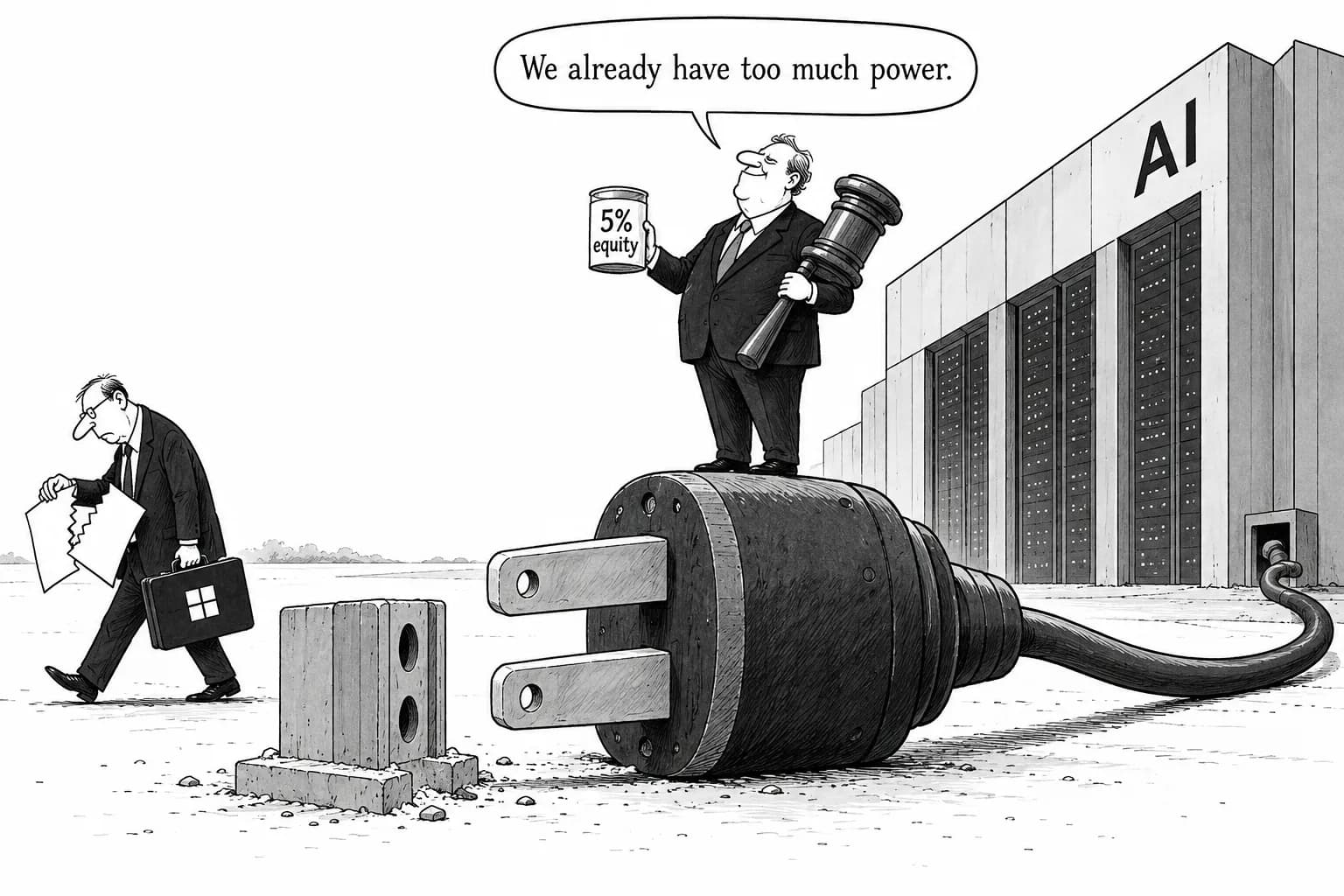
Grid constraints start to unravel AI contracts; Anthropic announces a 5% equity fund as its draft bill draws fire from both sides
Markets and governments were quiet over the weekend. Reports of Microsoft's pullout from Nscale and the FT's "47 projects" figure show how much AI infrastructure can actually get built
Seiichi Tanaka · Editor-in-Chief

Watch the video
Key points
- Microsoft has reportedly pulled out of Nscale's Loughton site in the UK (about 23,000 GPUs) because the grid connection is slipping into the 2030s. The FT reported that at least 47 large U.S. projects have been delayed or halted
- Anthropic announced it will set up a Public Benefit Fund with 5% of its equity (primary source). Its governance has not been decided. After criticism from the safety camp, the draft bill has now also been attacked by AI Now's Khlaaf, leaving it under fire from both sides
- A VK data center was hit in a Ukrainian drone attack. Compute now faces two physical limits at once: the power grid and war
- Markets were closed. The White House, Congress, the EU and Chinese authorities had nothing new, and almost no one has spoken up to defend the bill
The weekend was mostly quiet. There were two notable developments. They look unrelated, but both lead to the same question: who decides, and by what standard? First, Microsoft reportedly backed out of a contract to lease about 23,000 GPUs at a site run by the British neocloud Nscale. The reported reason was not money but a grid connection that is slipping into the 2030s. Power constraints have moved from delaying construction to wiping out contracts altogether. Second, Anthropic announced that it will create a fund for the public benefit with 5% of its shares (primary source). The same weekend, its draft federal bill was criticized by the AI ethics camp, following earlier criticism from the safety camp. Markets were closed, and the White House, Congress, the EU and Chinese authorities had nothing new.
Industry and infrastructure: The grid starts to move contracts
The Telegraph broke the story, and Reuters and Bloomberg followed it. According to those reports, Microsoft has stepped away as the anchor tenant of the site in Loughton, Essex. The roughly £2 billion site was announced to coincide with Trump's state visit in September 2025. The connection delay itself was reported on September 29, so the new part is the withdrawal. Nscale told Reuters that "the relationship is strong and long-term, and there is no impact on other contracts." The news is still based only on reports, but it would be the first time a hyperscaler has walked away from an anchor contract with a neocloud. Nscale filed an S-1 for a NYSE listing on September 18 and is reportedly aiming to raise about $3 billion at a valuation of up to $35 billion. Microsoft and Anthropic reportedly make up about 85% of its contract backlog, so the listing review will have to weigh the loss of one of its two biggest customers. Details are in our report Microsoft reportedly pulls out of Nscale's Loughton site in the UK.
An FT report, "Cracks in America's $10tn AI infrastructure boom," suggests this is not a one-off. (We have not been able to read the FT article itself. Its figures come from secondary sources, and its publication time has not been verified.) According to a tally by RegLayer, at least 47 large U.S. data center projects were delayed, withdrawn or blocked in 2026. Bernstein estimates that only about 35% of planned projects are credible. The reasons cited are grid connections, transformer shortages and liquid-cooling constraints. More than 1,000 municipalities have reportedly tried to halt or restrict construction this year. SB Energy, which is affiliated with SoftBank, reportedly needs about $174 billion to deliver $430 billion in contracted revenue, but it has yet to complete a single data center.
The two sides of the debate look like this. Bulls say that "demand is real, and the only question is how fast supply can catch up." Bears say that "contract backlogs and corporate bonds are piling up on the assumption of projects that will never be built." The Loughton case shows that contracts can disappear when the power doesn't arrive, even if the demand is there, and that gives the bears new ammunition. Over the weekend, though, neither camp published a new piece under a named author. The first test is Meta's earnings on October 21. The question is whether it keeps its 2026 capital expenditure outlook of $130 billion to $145 billion.
In semiconductors, the Seoul Economic Daily reported that Samsung will use TSMC's 3nm process for the base die of "NVHBM," an HBM product made only for NVIDIA. Reuters followed the story, but it rests on a single source, and none of the companies commented. According to the report, NVIDIA has asked all three memory makers to build their base dies on TSMC's 3nm process. If true, all three would depend on TSMC for the logic part of HBM, which would be a headwind for Samsung's foundry business. In the previous week (October 12–16), SK hynix fell 24.33% and Samsung fell 17.75%. For both, it was the worst week since October 2008 (according to a Seoul Economic Daily summary). Some aggregator sites list the SOX's 3.83% drop as the figure for "October 17." However, the 17th was a Saturday, and that number is the closing figure for Friday the 16th.
Anthropic: A company that sets its own yardsticks
The Public Benefit Fund announced by Anthropic is an LLC wholly owned by the company. It will start with 5% of the company's equity (subject to shareholder approval), and 2% more can be added each time the valuation rises 50% above a baseline. Together with existing pledges by the co-founders and matching of employee donations, about 20% of the company's equity would go to the public benefit, the company says. The fund's shares cannot be used for lobbying or politics. However, Anthropic says it will lay out the governance structure and the valuation milestones "in the coming months," so the key parts have not yet been decided. Details are in our report Anthropic to set up "Public Benefit Fund" with 5% of its equity.
The same weekend, NBC reported that Anthropic had talked with legal scholars and experts on democracy about who should decide Claude's values. The final decision still rests with the company, according to the report. (The article is for subscribers only, and we have not been able to read it.) The fund's governance, the model's values and the bill's thresholds all follow the same pattern: Anthropic listens to outside voices, but draws the lines itself. That is exactly where the criticism landed.
Heidy Khlaaf of the AI Now Institute wrote on Bluesky that the draft's definition of "catastrophic risk" (more than 50 deaths or more than $1 billion in damage) is "plainly authoritarian." Her argument is that the thresholds were set without democratic deliberation and leave out the harms AI is causing today. Last week, Zvi and others in the safety camp criticized the bill as having "weak enforcement and overly strong preemption of state law." Khlaaf's attack is different: she targeted the safety framing itself. That means the bill is being criticized from two sides, by those who say the regulation is too weak and by those who say the question is framed wrongly in the first place. Few have defended it. Anthropic has said nothing new, and the only explanation is an earlier report that the bill puts its June Advanced AI Framework into legislative form. A post on LessWrong, however, quoted the text and pushed back on part of Zvi's reading. It says court injunctions expire after 45 days and that model shutdowns are excluded from preemption. Still, both arguments are disputes over how to read a leaked draft, and the original text has not yet been verified. Details are in our report Anthropic's draft bill also criticized by the AI ethics camp.
Mother Jones also criticized the thresholds and wrote that Anthropic's federal lobbying spending in the first half of 2026 had already exceeded its total for all of 2025 (secondary source). CryptoBriefing reported that the draft covers models at "10^25 FLOP," but the report has no date and no corroboration, so its reliability is low. No lawmaker has yet come forward to introduce the bill, and OpenAI, SIF, and officials in California and New York have not responded. Congress is in recess until November 9.
Anthropic also drew a separate line of criticism. Its October 16 report, "The AI expectations gap," includes a figure showing that running employees' answers through the report's model yields 17.1% GDP growth in 2030. Carl Bergstrom fired back that the authors were "huffing paint." The report itself states that the 17.1% figure is not a direct forecast and "does not represent Anthropic's plans." No named person defended the figure during the period covered.
Research and development: A Lean journal and unconfirmed model names
Terence Tao's blog published two guest posts on AI and mathematics. One proposes a new journal that would require every proof to be formally verified in Lean. The other, by Francesco Maggi, lists eight choices that will decide whether LLM-driven acceleration of discovery leads to a golden age or a dark age for mathematics. The institutions that will receive AI-generated mathematical results are starting to be built on the assumption that the results can be checked by machine. Details are in our report New journal proposed that would require Lean verification for all proofs.
Claims spread on X that three unreleased model IDs (including aurora-red-alpha) appeared in OpenAI's API and then disappeared. The leak comes from secondary sources, and OpenAI has issued no comment or documentation. Only "red" reportedly returns a 503, but no request that actually got a response has been shown. Because Codex is in the middle of a 28-day sprint, some speculate that the IDs signal a new model, but this has not been confirmed. On day 13 of that sprint, a tracking page reflected a sixth reset of usage limits, though we have not verified the original post. There was no announcement on day 14.
We are correcting one point in our previous article. We wrote that all four items posted on October 15 to OpenAI's issue-report page were "critical," but the severity shown on the page was "High." We were swayed by the wording in news reports. The total number of reports remains 19, with no new items. DeepSeek V4.1-Flash-1017 still has no third-party evaluation, and its parameter count is still inconsistent: 763B on Hugging Face and 552B on the model card.
Policy and defense: Data centers become targets
The contents of the catalog attached to China's Announcement No. 48 have come to light through secondary sources. Exports of model weights will be restricted if a model meets any of these conditions: training compute of 10^26 FLOP or more, 2 trillion parameters or more, or a place in the world's top 10. AI-driven vulnerability discovery is also covered by the restrictions. We have not yet verified the original text of the attachment, and we could not find any response from the U.S. government. Details are in our report Contents of China's AI technology export control catalog revealed.
Ukraine launched more than 1,000 drones at Russia overnight, hitting an oil terminal in St. Petersburg, a VK data center, electrical substations and other sites, according to several outlets. VK confirmed the strike but said its services had not been interrupted. Russia also attacked a data center in Kyiv this month, so data centers have clearly become targets for both sides. Put next to the British case at the top of this brief, it shows compute facing two physical limits at once: grid delays and war. In the defense industry, an Anduril executive told Reuters that the company is considering building Steelfin, the interceptor missile it unveiled last week, in Europe. Poland is seen as the likely location.
In Germany, the government partnership announced by NVIDIA's Huang is expected to be formally unveiled at the "Invest in Germany" summit on October 19–20. We are also correcting a point from our previous article here. Huang's GTC Berlin keynote starts at 11:00 CEST on Wednesday, October 21, at the Tempodrom (according to NVIDIA's official page).
Where nothing happened
The most notable silence this weekend surrounds the bill. Anthropic itself has not yet explained it in detail, and the only person to have endorsed it, with conditions, is Charlie Bullock, as previously reported. Dean Ball, who has moved to OpenAI, has not written anything either. Ethics critics such as Bender, Gebru and Whittaker have not followed Khlaaf in speaking out. Apart from Bengio, there have been no new reactions to the four OpenAI incidents. There were no new weekend prices for CoreWeave's bonds or CDS, and no company statement or rating change. In the bubble debate, neither bulls nor bears published a new piece under a named author (Zitron's posts during the period had nothing to do with AI).
The White House has not issued an executive order on AI (the latest was an October 16 executive order on sanctions). SIF Chair Clayton called himself a "cop on the beat" on a Fox program but did not present any new policy or deadline. Anthropic's S-1 is not yet on EDGAR, and there has been no statement about Replit moving away from Anthropic. There was nothing new from Google DeepMind, Meta AI, xAI, China's major labs, Epoch or METR, and arXiv published nothing over the weekend. We were unable to check X, so posts on X by Yudkowsky and others are unconfirmed.
This week's focus falls on two days. On October 20, the Memphis City Council votes on halting a data center (xAI's is believed to be the target), and GTC Berlin opens. On October 21 come Meta's earnings and Huang's keynote. That will be the first real test of how far the FT's "47 projects" and Bernstein's "35%" affect the assumptions behind hyperscaler capital spending.
Editorial cartoon