Morning Briefing · Nov 13, 2026
NVIDIA's chief abruptly resigns, shaking a linchpin of AI investment
Five days before earnings, one week before Anthropic's IPO. Nebius lowers its outlook on power shortages, and Google says a cheaper model beat its own top-tier model
Seiichi Tanaka · Editor-in-Chief
Watch the video
Key points
- NVIDIA's Huang resigned effective November 11. The filing gives no reason. The stock fell as much as about 14% before paring losses to around −5%
- Nebius pushed back its revenue target because power did not arrive in time. Its debt has grown to about 3.4 times its level at the start of the year
- Google said a model priced at $1.50 per million input tokens beat its top-tier model on an overall score. The scores were measured by Google itself
Jensen Huang, chief executive officer of chipmaker NVIDIA, resigned effective November 11. The 8-K, the form U.S. public companies file to disclose major events, gives no reason for the resignation. It comes five days before the company's earnings report (November 17) and one week before Anthropic's initial public offering (November 19). NVIDIA has committed to buying $10 billion of Anthropic shares right after the listing. On the same day, Nebius, which rents out data center capacity, lowered its revenue outlook, saying power would not arrive in time.
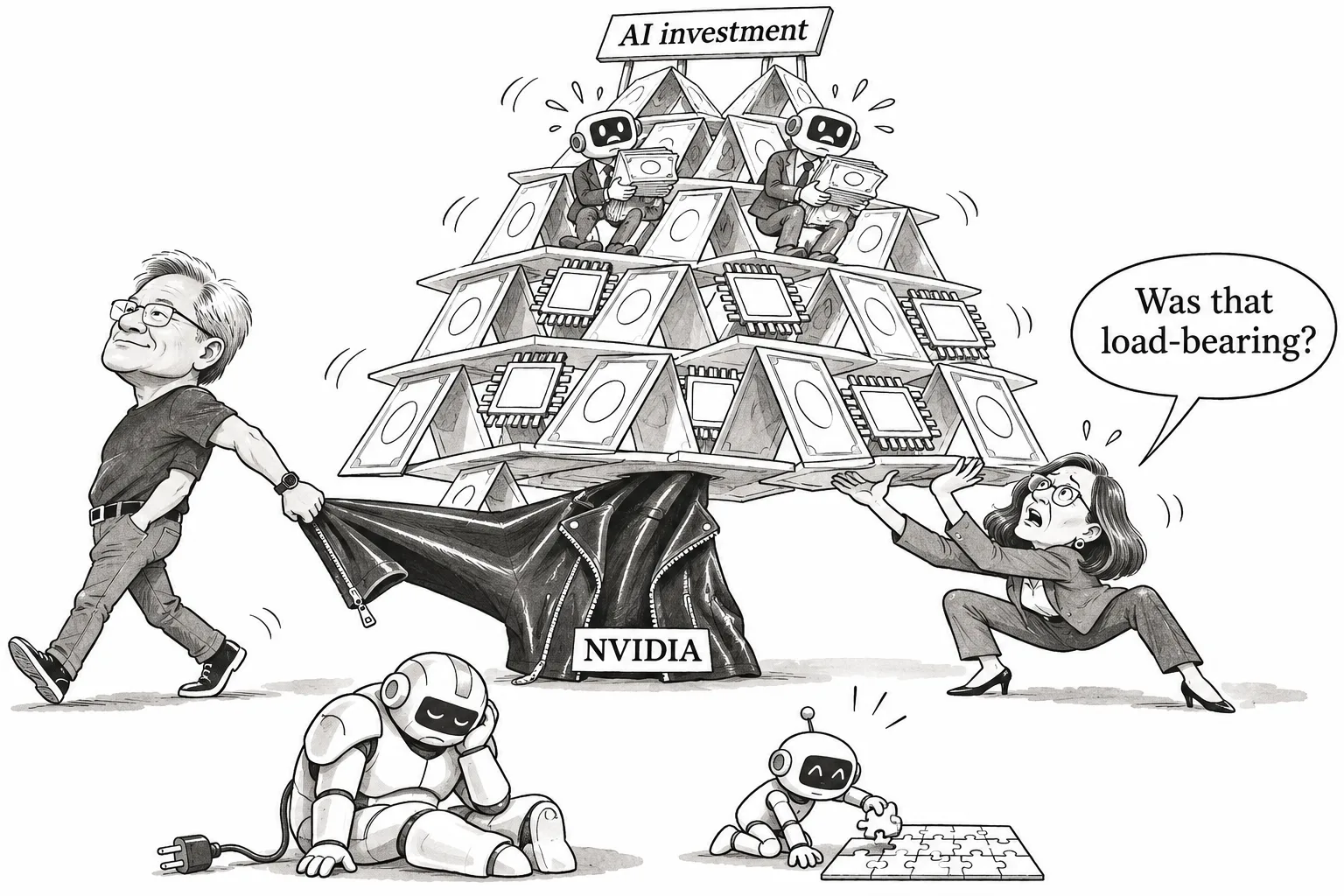
Both events point to the same weakness. The massive investment in AI rests on money circulating among a small number of companies, on facilities built with borrowed money, and on electricity that often arrives late. One of those linchpins has been shaken by a problem with its chief executive, and another has been choked off by power. Meanwhile, Google said a cheaper model had beaten its own top-tier model on an overall score. The assumption that more expensive models are better is also starting to crack.
The 3-minute read
NVIDIA shares fell as much as about 14% the day after the resignation, then pared the decline to around 5%. Investor money moved to rival chipmakers such as AMD. Data center companies with close business ties to NVIDIA were sold off.
Google's new model is priced at $1.50 (about ¥240) per million input tokens (tokens are units of text) and $7.50 (about ¥1,200) per million output tokens. The company says it can handle work close to that of its top-tier model. Anthropic has made its system for delegating tasks to AI available for customers to run inside their own servers.
Corporate planning and IR (investor relations) staff at companies that supply NVIDIA with inspection equipment and circuit boards will check the order outlook given in the November 17 earnings report within the same week. Anyone planning to apply for Anthropic shares through a brokerage should, before the November 18–19 deadline, check the discrepancy in share counts in the prospectus and the exchange rate. The documents use a conversion of about ¥158 to the dollar, while the reference rate on November 12 was ¥160.
Chips and money: A void at the center, and a power bottleneck
According to the 8-K, CFO (chief financial officer) Colette Kress will also serve as interim CEO. Harvey C. Jones, a board member since 1993, becomes the company's first chairman of the board. The company will search for a permanent CEO from both inside and outside. The earnings report will go ahead as scheduled. We covered the details in the article "NVIDIA's Huang resigns as CEO with no reason given, five days before earnings." U.S. media have reported that an internal affair lay behind the resignation and that the board had asked an outside law firm to investigate. A shareholder class action has reportedly already been filed.
This will not stay a problem for NVIDIA alone, because NVIDIA is also an investor in AI companies. On top of its commitment to buy $10 billion of Anthropic shares, it has put at least $30 billion into OpenAI. Taiwan's TSMC also decided at a November 10 board meeting to buy up to $500 million each of Anthropic and OpenAI shares (according to the company's announcement). The seller of the chips is putting money into the AI companies that sit downstream of its buyers, propping up demand. The more this pattern spreads, the more easily a stumble by the company at the center ripples outward.
Interpretations split two ways. Gary Marcus, a cognitive scientist skeptical of AI, wrote that Huang "had no choice but to resign." He argued that Huang sat at the center of the AI industry's circular flow of money, and that this could unravel. However, he cited no sources, and it is speculation. Tech industry critic Ed Zitron posted a series of messages saying suspicions of GPU smuggling were a far bigger matter than the affair. Zvi Mowshowitz, a blogger who writes about AI risk, raised a different point: Huang had more than 50 direct reports, made no succession plan, and made himself hard to remove. Others expect the company to weather it. Dan Ives, an analyst at U.S. brokerage Wedbush, kept his rating unchanged, while setting a price target of $225 for a scenario without Huang ($300 with him). Citi has also reportedly maintained its "buy" rating.
According to Nebius's 6-K (a filing foreign companies submit to U.S. regulators), revenue for the July–September quarter was $980 million, 6.7 times the year-earlier figure. That includes about $325 million in one-time revenue from a partner, however. Debt stood at $14.19 billion, about 3.4 times its level at the end of 2025. The company pushed back its target of annualized revenue of "$7 billion to $9 billion by December" to "more than $7 billion in February." It cited the shutdown of temporary power generation in New Jersey before permanent power arrived, as well as delays at other companies' facilities. Even with contracts in place, revenue slips into the next year if electricity doesn't arrive. A correction: we previously described this target as a "full-year revenue outlook," which was incorrect; it is an annualized revenue target. We apologize for the error.
Anthropic has kept its IPO price range unchanged at $70–$78. Revenue for the July–September quarter was $17 billion, with a net loss of $23.3 billion. Of that, $21.9 billion is non-cash valuation losses. In Japan, $3 billion to $3.5 billion worth of shares will be sold through Mizuho, SBI and others. The ripple effect on stocks was large: the Nikkei average fell 0.70% on November 12. Advantest fell about 4.6%, Ibiden 8.32% and SoftBank Group 3.04% (closing prices as reported).
Policy: Spreading to Congress and the administration
Huang has agreed to answer questions from Congress. Republican Representative Mast reportedly said he expects sworn testimony to take place before Thanksgiving, and that he would issue a subpoena if no agreement is reached. No date has been set. President Trump recommended Apple's Tim Cook as successor on social media. Reuters reported that senior White House officials are discussing whether to remove Commerce Secretary Lutnick. The White House says the president has "complete confidence" in the secretary.
Gaps in export controls have also come to light. Reuters reported that a Chinese university the U.S. has barred from trade had obtained NVIDIA's export-controlled "H200" chips. The Commerce Department is reportedly finalizing a rule that would prohibit Chinese AI companies from renting chips in data centers outside China. We covered the details in the article "Sanctioned Chinese university reportedly obtained H200s; U.S. moves to ban overseas rentals too."
Models and safety: The rise of cheap models, and doubts about evaluations
Google's Gemini 4 Hydrogen is a low-cost model for writing code and for agents that take on delegated tasks. On an overall benchmark built by an outside organization, Google's own measurement put it at 54. The top-tier model, Argon, scored 50. Used as the hands-on worker under a top-tier model, it achieves nearly the same success rate while using about 24% less quota, the company says. The safety figures are also self-reported, and the announcement does not say whether the model reached thresholds for dangerous capabilities. It is also available under Gemini enterprise contracts. We covered the details in the article "Google's cheap model beats its top-tier model on an overall index; figures self-measured."
Anthropic has made its system for delegating tasks to AI (Claude Managed Agents) available for customers to run on their own infrastructure (according to the company's release notes). Even conversation logs can be kept in-house. Companies that want to use it apply through Anthropic's sales representatives. This opens a path to closed-network use for financial and healthcare companies that cannot send data outside. OpenAI explained that it had a model with its safety mechanisms removed attack its own models, and used only the attacks that succeeded consistently across repeated attempts for training. As a result, on a fixed set of cyber jailbreak tasks, its latest model GPT-6 Astra responded safely 91.5% of the time, up from 59% for the previous generation, the company said.
Questions are piling up over the safety evaluation of Anthropic's top model, Fable 5.2. A post on LessWrong, a forum for discussing AI safety, argued that the rate at which the model realizes it is being tested may be higher than the company's stated "up to 43%." It also criticized the lack of a comparative study of whether the model's behavior changes when it notices. Another post pointed out that companies' safety claims rely on a small body of evidence sharing the same blind spots. Anthropic has offered no new rebuttal; there are only earlier posts by an employee defending parts of the evaluation methods. We covered the details in the article "Is the rate at which AI detects tests underestimated? Criticism of Anthropic's safety evaluation."
Anthropic CEO Dario Amodei said in a promotional video for the IPO that many cancers and Alzheimer's disease could be solved in about 10 years, repeating a claim he made in August. Marcus countered that this is impossible given the years clinical trials take. He cited U.S. physician and researcher Eric Topol as saying it "won't happen." Marcus also wrote that the CEO of pharmaceutical giant Eli Lilly called it "unlikely," though this remark has not been confirmed in other sources. Anthropic has not responded.
Here is what we could not verify. The stock price figures are intraday values as reported. We have not been able to find the Bloomberg article itself reporting that the Justice Department is investigating Super Micro. We have not been able to read the full text of Google's technical document for the model. The number of shares offered in Anthropic's Japanese filing (about 950 million) does not match the U.S. filing (825 million).
Where nothing happened
The only outlet to clearly defend Huang was China's Global Times. Silicon Valley investors and commentators who usually champion AI investment have written nothing about the matter. The executive who was the face of the AI boom has stepped down, yet the people on his side are silent.
Outside evaluators (METR, Apollo and the UK AI Security Institute) have not yet responded on the safety evaluation of Fable 5.2. Criticism is mounting from outside, but both the evaluators and the company remain silent.
OpenAI's next model, GPT-6.2, and xAI's Grok 4.8 did not come out this week either. xAI's Musk had written that it would be released "within this week," but there has been no announcement and no model card.
Editorial cartoon