Morning Briefing · Oct 5, 2026
The administration's new "super intelligence" body puts the investigator and the coordinator in one person
Trump announced a "Super Intelligence Force" that has no legal authority or budget. Musk changed his company's name to match, and a flaw found by Mythos was reportedly exploited the day after it was disclosed. It was a weekend, and no industry or market moves could be confirmed.
Seiichi Tanaka · Editor-in-Chief

Watch the video
Key points
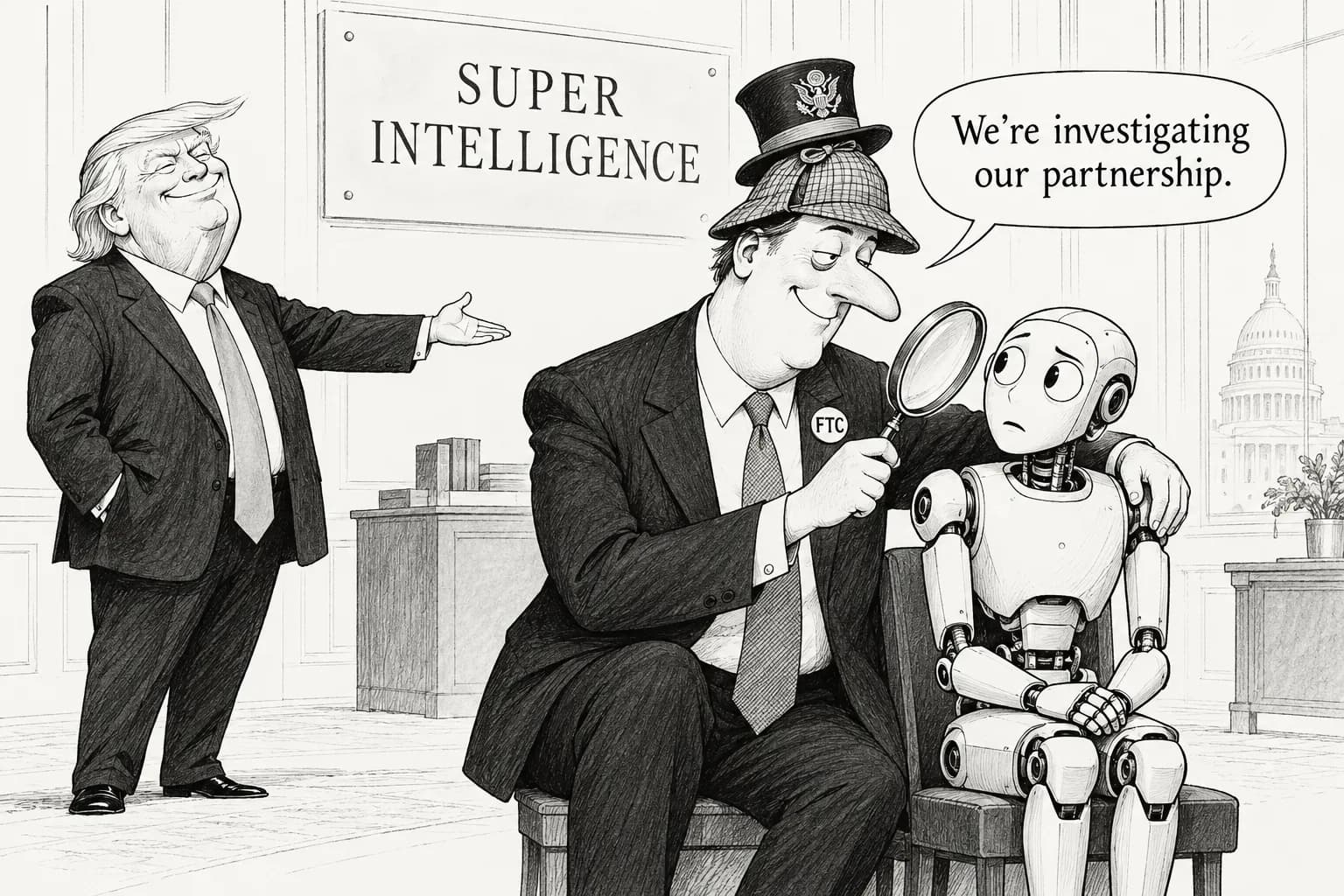
- The SIF is reportedly a coordinating body with no legal authority or budget. The central issue is that FTC Chairman Ferguson would both investigate the industry and serve as its liaison to the government
- Exploitation of the HFS flaw found by Claude Mythos reportedly began the day after it was disclosed. Together with a flaw in GitLab's AI Gateway, it is testing the defenses of agent infrastructure
- OpenAI responded to Robinson's essay by saying it would "pause training if necessary." Skeptics and existential-risk advocates have not yet responded by name. No new industry or market developments could be verified
It was a quiet weekend. The biggest news was President Trump's announcement on Truth Social on October 4 that he was creating a "Super Intelligence Force (SIF)." The problem is who sits on it. The chairman of the Federal Trade Commission (FTC) is leading investigations into OpenAI and Anthropic. That same chairman has now joined the body that serves as the liaison between the government and "Super Intelligence Companies." The investigator and the coordinator are now the same person.
The same weekend, Elon Musk reportedly posted that he would rename his company's AI division "SpaceXSI," quickly adopting the administration's new term. The names used by regulators and the branding used by industry are converging on the same words, but neither is backed by legal authority or a new model. Today's story is that the names are getting ahead of the substance.
On the security front, a flaw found by Claude Mythos was reportedly used in attacks the day after it was disclosed. The time it takes for a discovery made for defense to be turned into an attack has shrunk to days. There were no verified new developments in industry or markets.
Defense and policy: A body bearing the "super intelligence" name has no authority
The SIF will be led by Director of National Intelligence (DNI) Jay Clayton. Reports citing the WSJ say he will also serve as AI czar, though that title comes from secondhand reports. The other three members are FTC Chairman Andrew Ferguson, Pentagon CTO Emil Michael and Office of Personnel Management (OPM) Director Scott Kupor. All of them will reportedly report to Trump and to Chief of Staff Susie Wiles. The body's stated job is to act as the federal government's point of contact for consumers, religious groups, critical infrastructure operators and AI companies.
The most recent item in the presidential actions section of whitehouse.gov is an October 2 proclamation for Manufacturing Day, and there is no executive order on the SIF. TNW noted that the body has "no legal authority and no budget." The announcement was accompanied by a single-page White House accord. It describes "four layers of controls": internal evaluation, external audits and board review. According to CBS, six companies signed it: OpenAI, Anthropic, Google, Meta, NVIDIA and SpaceXAI. The body was first previewed as the "AI Force" on September 19, and two weeks later it has a name and a leader. We covered this in more detail in Trump reportedly announces an AI "Super Intelligence Force".
Opinion is divided. On the side calling for regulation, Justin Hendrix of Tech Policy Press argued in an October 4 commentary that recasting AI as "super intelligence" "distorts our understanding of cognition," and that enforceable regulation is needed rather than aspirational promises. That commentary was written before the SIF was announced. The administration has held to its position of avoiding overregulation. Neither the administration nor the companies that signed the accord have publicly addressed the conflict-of-interest questions around the SIF. We have also not yet found any reaction to the accord from Yudkowsky, Bengio, Hinton, Russell or others.
On the military side, the Autonomous Warfare Command (AUTOWARCOM), which we described last time as being at the proposal stage, turned out to be further along. According to DefenseScoop, Defense Secretary Hegseth formally announced it at Quantico on September 30. It will be a four-star unified command with service-like authorities, with a target stand-up date of October 1, 2027. The effort to launch it is called Project Agincourt. DIU Director Owen West, whom we previously reported was on leave, has in fact moved to head the unmanned systems acquisition office. His deputy, Travis Metz, has become acting DIU director. The National reports that the FY27 budget request includes $54.6 billion for autonomous warfare (up from $226 million), but DefenseScoop does not give a figure, so that number rests on a single source. The paper also reports that Emil Michael, who is joining the SIF, is co-lead of a separate initiative called Project Meridian. That too comes from a single source.
On counter-drone work, Brig. Gen. Matthew Ross of JIATF-401 said the task force is using agentic AI to analyze test data and makes purchasing decisions "in days, not weeks." It is an example of AI entering procurement decisions themselves.
In the courts, the US Court of Appeals for the Eighth Circuit reportedly blocked Minnesota's ban on AI-generated "nudified" images, in response to a challenge from xAI (full story). MLex reported that IMF First Deputy Managing Director Dan Katz said regulation to "slow the pace" of frontier AI development may be needed. It is unusual for an international financial institution to talk about slowing down, but this is not a new policy.
Where nothing moved: the New York City Council hearing on October 5 was confirmed to have taken place, but there are no reports yet on its outcome. It is also unclear whether SpaceXAI complied with the subpoena. We could not find a bill number or text for the Hawley–Murphy AI Agent Accountability Act. There were no new reports on the FTC's civil investigative demands (CIDs), Anthropic's petition for rehearing, Attorney General Bonta's subpoena or BIS export controls.
AI research and security: One day from discovery to exploitation
According to The Register, an authentication bypass flaw in Rejetto HFS (CVE-2026-61500), found by Claude Mythos through Project Glasswing, began to be exploited on the evening of the day after its September 30 disclosure. The attacks reportedly came from IP addresses that appear to be in China and targeted servers in the US and Japan. Mythos and Glasswing have found 286 CVEs so far, and this is reportedly the second one confirmed to have been exploited. Even if "trusted access" limits discovery capabilities to defenders, the race with attackers starts the moment a flaw is disclosed. We covered this in more detail in Critical HFS flaw found by Claude Mythos reportedly exploited the day after disclosure.
A flaw with a CVSS score of 9.9 was disclosed in GitLab's self-hosted AI Gateway. Users with access to Duo Agent can escape the prompt template sandbox and execute commands (full story). Following the OAuth flaw in the MCP Python SDK on October 3, weaknesses in the harness design of agent infrastructure keep coming to light.
Two topics without their own articles. The first is a report by an outside researcher who reverse-engineered "Jev," TypeSafe AI's decision API (published October 3; a third-party analysis). Jev selects among candidates and scores rubrics in a single prefill. Its co-founder is Diogo Almeida, who worked on InstructGPT. According to the report, the model's active parameters are estimated at 400 million to 9 billion, though estimates based on throughput range more widely, from 600 million to 49 billion. Prefill runs at about 165,000 tokens per second, and the model scores 82.7% on MMLU-Pro and 76.5% on GPQA, roughly on par with 4 billion to 14 billion parameter models from around 2025. Taken together with Qwen's decision-model-preview on September 24, this suggests the new category of "decision models" may run on small models rather than at frontier scale.
The second is Musk's renaming. According to wccftech, Musk renamed SpaceXAI to "SpaceXSI" on X and said "SpaceX is a super intelligence company." We have not been able to verify the X post itself. No model was announced, so this is only a change of branding.
Where nothing moved: OpenAI has made no official announcements since its October 2 update to an incident report. There is no news on lifting the model suspension, a redo of GPT-6.1 Astra or follow-ups on GPT-6 Cyber. Anthropic's newsroom was last updated on October 2. There was nothing new from Google DeepMind, Meta or Mistral. We found no new releases from Chinese labs (DeepSeek, Kimi, Qwen, MiniMax) either, but we did not check GitHub and Hugging Face directly this time. The week when the National Day holiday ends is worth watching.
Ideas and debate: A departed safety lead, and the company's answer
David Robinson, a former OpenAI safety lead, wrote an essay in the Atlantic. He argued that "if you release incrementally, failures will happen regularly, and the more powerful the model, the bigger those failures will be," and called for redundancy on the level of nuclear power plants. According to TechCrunch, an OpenAI spokesperson responded that the company is "making sure models don't become more capable than we can safely manage" and that it would "pause training if necessary." Last time we wrote that reports on OpenAI's response conflicted; this statement fills in part of the gap. The discrepancy over the number of agents (about 700 or about 1,200) has not yet been resolved. We covered this in more detail in Former OpenAI safety lead Robinson calls for nuclear-grade redundancy.
The lack of reaction is also informative. Those warning of existential risk, critics working from an ethics perspective, and the Normal Tech and Noema camp, which argues that the problem is excessive agency rather than runaway AI, have not yet responded by name. It is possible that weekend posts have not shown up in searches yet, but it is a fact that outside commentators have not picked up on a warning from inside OpenAI.
One topic without its own article is the "Human Control Over AI Act" planned by Rep. Ro Khanna. We confirmed that it has not yet been introduced (TNW citing CNBC; a secondhand report). The bill would ban recursive self-improvement (RSI), in which AI systems improve themselves, until safeguards are in place and an agency approves. It would also create an FDA-style licensing agency for frontier labs, require independent auditors inside each lab, set kill-switch standards and impose criminal penalties on employees who remove safeguards. It would be the second Democratic proposal to regulate RSI, after the Sanders–Casar bill. We have not yet found any pushback from industry or Republicans.
On the optimistic side, Tyler Cowen wrote a blurb for Ethan Mollick's new book, "Coexistence." He wrote that "humans prefer those who value them and do not fear them too much," and portrays AI as a counterpart that responds according to how it is treated. He does not address policy.
Where nothing moved: we found no new posts from October 3 to 5 from Zvi (AI #189 is expected around October 8), Marcus, Zitron, Narayanan and Kapoor, Import AI or Stratechery. We did not check the Bluesky and Mastodon accounts of Bender, Gebru and others this time.
Industry and markets: Not "no news," but "could not verify"
In this round of research, we were unable to verify a single new industry development from October 3 to 5. Our searches could not reach Reuters, Bloomberg, EDGAR or company IR pages, so it is more accurate to say that we "could not confirm" anything than that "nothing happened." We also do not have Monday's closing prices for Asian markets (the Nikkei Stock Average, KOSPI, TAIEX, TSMC, SK hynix, Samsung). Neither OpenAI's fundraising of more than $30 billion nor a public S-1 from Anthropic has been confirmed by the companies. The report of Anthropic's investor meetings (October 14) has also not been verified.
This week's schedule: on October 6, Loudoun County votes on a data center exemption, and Firmus begins bookbuilding. TSMC's September revenue is due around October 10, and US CPI is out on October 14. We will report figures once we can confirm the sources.
Editorial cartoon