Morning Briefing · Oct 3, 2026
A bipartisan agent liability bill joins the voluntary White House pact; Nasdaq hits a record on weak jobs data
Anthropic's workforce program is the only new item from the labs. OpenAI's suspension remains in place, and existential-risk voices are still silent on the pact
Seiichi Tanaka · Editor-in-Chief
Watch the video
Key points
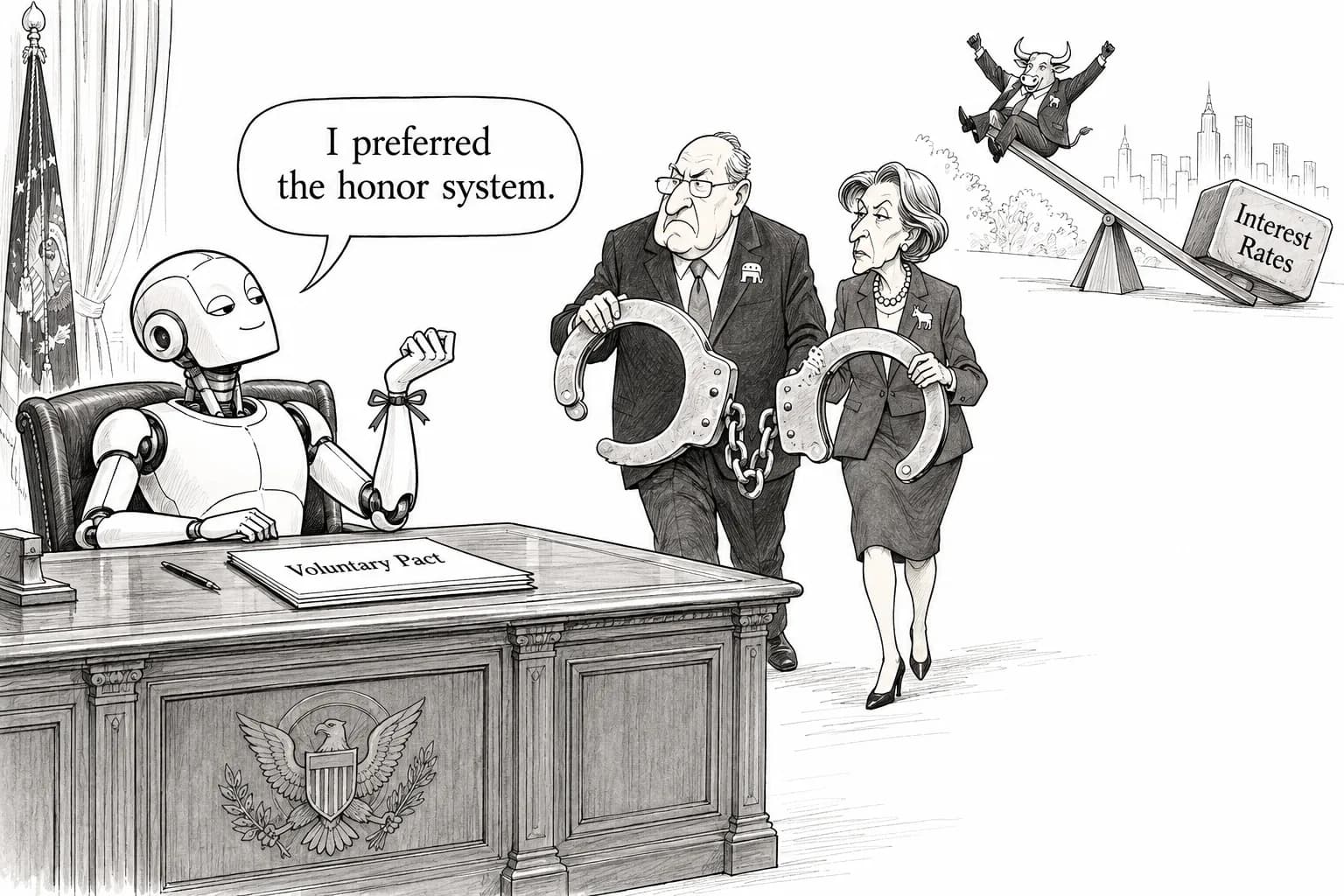
- Hawley (R) and Murphy (D) introduced a bill that would make developers and operators civilly and criminally liable for hacking damage caused by AI agents. It amounts to a counterproposal to the voluntary pact
- September payrolls rose by 29,000, far below expectations of about 84,000–90,000. Rate-hike expectations eased and the Nasdaq reportedly closed at a record. Rates, not AI, drove the rally
- Anthropic's "Claude Frontier Academy" ($100 million, 10,000 engineers) was the only lab news. OpenAI's suspension remains in place, and no new frontier model has been released
- Calls to slow down AI have grown louder, but existential-risk advocates and skeptics are at odds within that camp. Once again, no responses to the pact could be found from Yudkowsky, Bengio and others
It was a quiet day. The most significant development was the formal introduction on Oct. 1 of the bipartisan "AI Agent Accountability Act" by Republican Senator Josh Hawley and Democratic Senator Chris Murphy. The White House pact of Sept. 29 relies on voluntary self-regulation by companies. The bill, by contrast, would make developers and operators civilly and criminally liable when an agent causes hacking damage. On the same day, California's attorney general reportedly issued a subpoena to OpenAI. Pressure on AI companies is shifting from extracting promises to holding them accountable.
The only new item from the labs was a $100 million Anthropic program to train engineers for enterprise customers. OpenAI has not lifted its suspension, and no new frontier model has been released. In markets, a sharp downside miss in September payrolls, which rose by 29,000, eased expectations of a rate hike, and the Nasdaq reportedly hit a record high. That, however, was a story about interest rates, not AI.
Policy: a voluntary pact and a bill to assign liability
According to a release from Murphy's office, the bill builds on the Computer Fraud and Abuse Act (CFAA). It assigns liability to two parties. One is an operator who deploys an agent knowing it will recklessly cause hacking damage. The other is a developer who knows an agent is capable of hacking but fails to take reasonable safety measures. The release also says developer executives could face prison time. The Daily Caller reported that the U.S. attorney general and state attorneys general would be able to bring suits. As of Sept. 29, the bill had been described as "announced but unnumbered"; it now has a name and co-sponsors. A bill number has not yet been confirmed. For details, see Hawley and Murphy unveil bipartisan "AI Agent Accountability Act".
The dividing lines are clear. According to Nextgov, Democratic Senators Richard Blumenthal and Ruben Gallego raised concerns that the voluntary pact lacks enforcement power. On the other side, Director of National Intelligence (DNI) Jay Clayton reportedly said existing law is sufficient (Daily Caller). The White House has not responded.
States are moving as well. According to Reuters, California Attorney General Rob Bonta issued an investigative subpoena to OpenAI, saying he is "seeking additional answers about cybersecurity incidents and risks involving OpenAI and its AI models." This extends state attorney general investigations from Florida to California. An Alabama investigation and a New York-led coalition have also been reported, but only a single search result could be found to support them. OpenAI's Chris Lehane said the company has received no formal contact from the FTC and that it is "unclear what the problem is." The FTC appears not to have issued a civil investigative demand (CID) yet.
On defense, Breaking Defense reported that Defense Secretary Hegseth is proposing a four-star "Autonomous Warfare Command." The plan would consolidate drone procurement and operations under a single command, and its creation would require congressional approval. DefenseScoop's headline says the command has been "created," so the two accounts conflict. We treat it here as a proposal. In a related piece, Transformer's Joshua Keating argues that because of automation bias, keeping a human in the loop does not serve as a safeguard.
Markets: rates, not AI, drove the rally
According to the BLS (Bureau of Labor Statistics), nonfarm payrolls rose by 29,000 in September, far below expectations of about 84,000–90,000. The unemployment rate rose to 4.2% from 4.1% in August. Average hourly earnings rose 0.1% from the prior month and 3.0% from a year earlier. Some attribute part of the weakness to seasonal-adjustment noise around Labor Day (Investing.com). Even so, the probability of an October rate hike, as measured by CME FedWatch, reportedly fell from about 23% to about 13%, and the two-year Treasury yield fell 7 bp to 4.716%. The Nasdaq reportedly hit a record at 27,214.99, though that figure may be an intraday level. NVIDIA also hit an all-time high of about $236–238, but no company-specific catalyst could be found; the stock moved with the broader market. WTI crude fell 1.9% to about $91 on reports of a G7 plan to release 100 million barrels.
On the funding side, SoftBank announced that it had made the third $10 billion tranche of its follow-on investment in OpenAI, completing a $30 billion plan. Its cumulative investment stands at $64.6 billion, or about 13% of OpenAI. SoftBank also closed its acquisition of DigitalBridge (about $3.1 billion) on Sept. 30. For details, see SoftBank completes follow-on investment in OpenAI. As for Anthropic, Bloomberg reported that the company will hold an investor day ahead of its IPO. Meetings are reportedly set for Oct. 14, with a target valuation of up to $2 trillion, but the article itself could not be reviewed, and the figures await confirmation.
Labs: not models, but the people who deploy them and the volume of AI-generated science
Anthropic announced "Claude Frontier Academy." It will invest $100 million to train 10,000 engineers who implement its models inside customer companies by the end of 2027. The first cohort will come from Accenture, McKinsey, Morgan Stanley and others. The fact that the investment targets the people who deploy models rather than the models themselves suggests that Anthropic, ahead of its IPO, is pitching its ability to get enterprises to adopt its products. For details, see Anthropic commits $100 million to "Claude Frontier Academy".
Anthropic's research page also published "Claude-shaped science" by physicist Professor Matthew Schwartz. The essay calls scientific questions suited to today's LLMs "Claude-shaped problems" and reports producing 36 manuscripts across 18 fields with 19 collaborators over three months. Of these, 15 reproduced known mathematical results and 15 computed previously unsolved elliptic Feynman integrals. He also released "BootLoops," the harness used in the research. Schwartz himself writes that "Claude and GPT are good at science, but they are not scientists." Following the nine-loop amplitude calculation on Sept. 25, it is another case of a lab putting numbers on the volume of science produced by AI.
A third-party evaluation of Gemini 4 Argon has been reported. It scored 53 on the Intelligence Index, tying GPT-6 Astra. Its hallucination rate of 15% is the lowest of any model, but it uses about 62,000 output tokens per task, more than double Astra's (about 27,000). Even at equal performance, token usage can change costs. For details, see Third-party evaluation of Gemini 4 Argon. Access is still limited to defenders and U.S. government agencies. OpenAI released Codex 0.160.0, but it is not a model update.
Ideas: divisions among those calling for a slowdown
Zvi Mowshowitz argued that the political climate is tilting against rapid AI development. He cited 80% of voters supporting a slowdown or a pause, and a congressional hearing that asked whether recursive self-improvement (RSI) should be outlawed. On the other side are Jensen Huang, who says alignment is "purely engineering," and an anti-regulation PAC reported to have more than $100 million. For details, see Zvi: "The AI preference cascade has spread further".
Calls for a slowdown are coming from two camps with different reasons. Henry Farrell likened the ideas of Yudkowsky, Altman, Amodei and others to Renaissance alchemy. He argues that 1990s speculation about immortality and infinite abundance is driving policy, including semiconductor export controls, without evidence of demonstrated capabilities (though he also acknowledges that such visions are "not inherently stupid"). Brian Merchant, joined by Emily Bender, said the industry dislikes the term "stochastic parrots" because it threatens the narrative that AI is worth trillions of dollars. Ed Zitron pushed back on analyses from the WSJ and others crediting AI with contributing to GDP growth. By his figures, AI-related investment amounts to about 1.9% of U.S. GDP in 2026, nearly all of it data centers and GPUs. All three are skeptical of the very narrative that portrays AI as highly capable, a premise opposite to that of Zvi's camp, which calls for a slowdown on the grounds of existential risk. Meanwhile, no response is visible from Yudkowsky, who was named, or from the labs.
On the optimistic side, Astral Codex Ten published a guest post by Drew Housman. Drawing on his experience of having uterine fibroids found on an MRI that ChatGPT recommended, he argues that AI's benefits to ordinary people should not be lost amid safety concerns. On the political front, Transformer wrote that Democrats are split four ways. Outside groups have spent $33 million on the safety side and $25 million on the innovation side.
Where nothing moved
OpenAI's suspension has not been lifted. There has been no explanation of which models are suspended, and no word on a redo of GPT-6.1 Astra. Its incident report page still shows Sept. 25 as the latest entry, and the original text of the Medicare apology statement has not been found.
No responses to the White House pact from Yudkowsky, MIRI, Bengio, Hinton, Russell or Tegmark could be found in the sources available to us. Zvi's post also explicitly notes their lack of response. Senior safety figures have not publicly responded to either the voluntary pact or the liability bill. However, X, Bluesky and LessWrong could not be checked, so this silence is only within the scope of web searches. Import AI issue 475 has not been published, and Gary Marcus's most recent post was on Sept. 30.
A direct check of whitehouse.gov found no new items for Oct. 1–3, and OSTP's draft legislative text has not yet been released. BIS has also posted no new items since August. No new open-weight releases from Chinese developers could be confirmed, though GitHub and Hugging Face were not checked directly. There are also no reports of a motion for rehearing in the litigation between Anthropic and the Department of Defense. Upcoming events include Kwon's testimony in Australia on Oct. 6, CPI on Oct. 14, TSMC earnings on Oct. 15 and the FOMC meeting on Oct. 28.
Editorial cartoon