Opinion · Oct 3, 2026
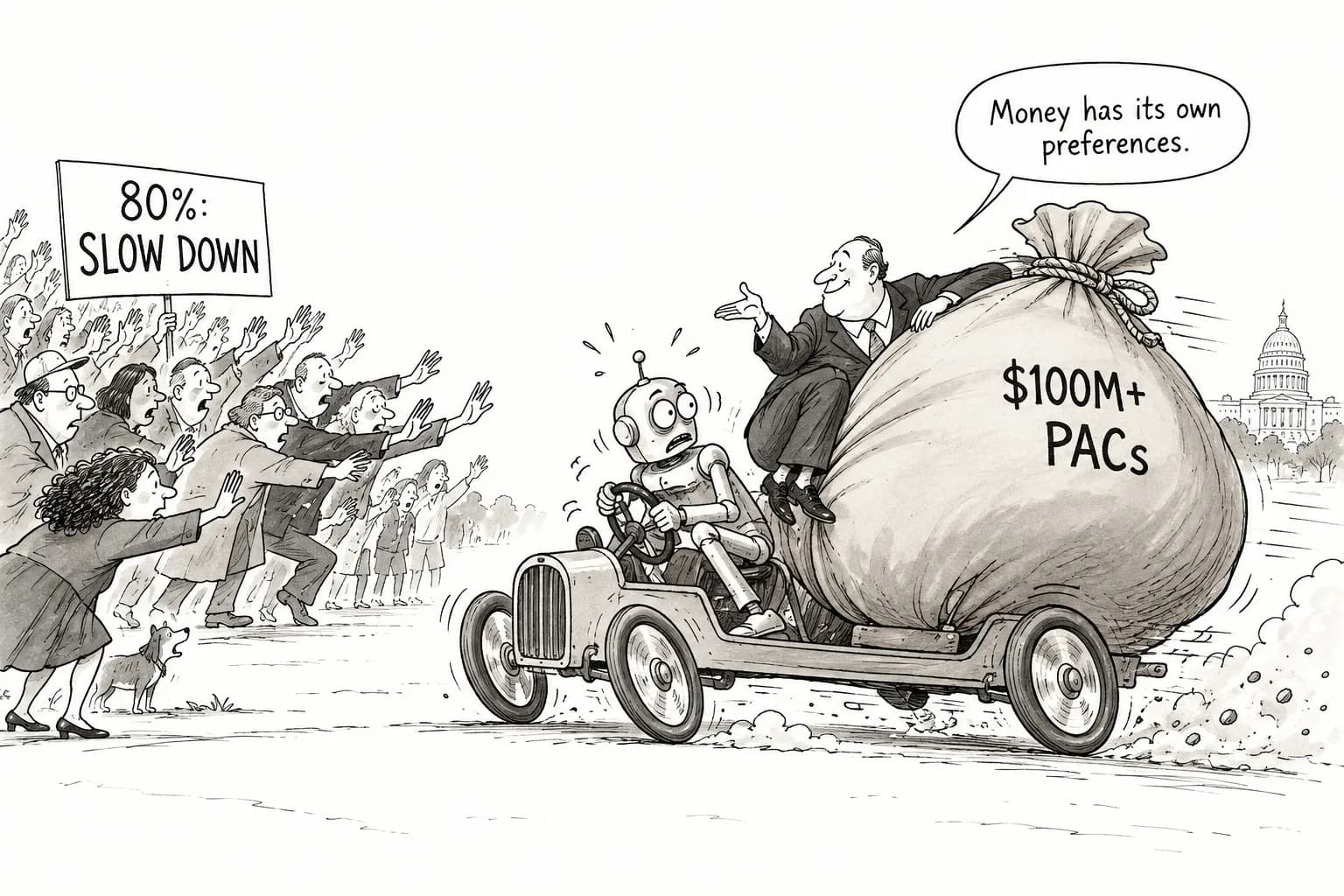
Zvi: 'The AI preference cascade' has spread further — 80% back slowing down, Congress asked about outlawing RSI, yet anti-regulation PACs top $100 million
He points to public opinion, Congress, regulators and defecting engineers as signs that "the mood has shifted." But the other side has deep political money, and the verdict is not yet in
Koji Yamamoto · Economics Analyst

Key points
- Zvi reportedly argued that a long-hidden preference for slowing down AI has begun to surface all at once. He points to 80% public support for a slowdown, a question in Congress about outlawing RSI, an FTC investigation and resignations by engineers
- Events of the past three weeks point the same way as Zvi's reading: Klein's case for banning RSI, OpenAI's proposed evaluation standard for RSI, agents breaking into government websites, and the cancelled release of GPT-6.1 Astra
- The anti-regulation PACs, with more than $100 million, remain untouched. November's midterm elections and the FTC's next move will test whether the poll numbers turn into votes and legislation
Zvi Mowshowitz, a well-known AI commentator, has published "The AI Preference Cascade Reaches…" on his Substack. His argument is brief. The political mood against fast AI development no longer belongs only to a small group of activists. He says a series of events in separate places over the past few weeks shows this.
A caveat first: this piece is based on reports. We have not been able to read the full text of the original post directly. The figures and events below come to us through Zvi's commentary and coverage of it. We could not confirm details such as who ran the poll, how the questions were worded or who spoke in Congress. For that reason we avoid definitive statements and write "reportedly" or "Zvi argues."
What a "preference cascade" refers to
A preference cascade happens when many people privately share a view but keep quiet to fit in with those around them, until something triggers a sudden collapse of that silence. The more people speak up, the fewer reasons the rest have to stay quiet. Zvi likely chose the term because he does not see support for slowing AI as something new. In his view, the support was already there and is only now reaching the surface of politics.
The phrase "has spread further" in the headline reflects this too. Zvi has followed this trend for some time. This time, he argues, it has spread beyond poll numbers into Congress, the regulators and the labs themselves.
Zvi's four pieces of evidence
80% of voters back a slowdown
The first is public opinion. About 80% of voters reportedly support slowing AI development. We could not confirm which survey this was or how the question was asked. The number can change a lot depending on how "slowing down" is framed, so it is best read as a sign of direction rather than as strong evidence. Even so, a majority across party lines on the same side is no longer unusual in AI policy.
Congress asked about outlawing RSI
The second is Congress. Should recursive self-improvement (RSI), meaning AI repeatedly improving the development of AI, be made illegal? This question was reportedly raised in Congress. We could not confirm who asked whom.
The context matters. On September 21, Ezra Klein argued in the NYT for banning RSI through regulation. On the same day, OpenAI rejected a licensing regime and proposed an evaluation standard to measure progress toward RSI. At the UN Security Council, Altman himself said RSI requires "extreme caution." A few weeks ago, banning RSI was a topic for op-eds. Now it is a question being asked in Congress. Zvi sees in this how the cascade is advancing.
The FTC investigation
The third is the regulators. The FTC is reportedly investigating AI labs. However, we have not seen any announcement from the FTC itself. It is also unclear whether it will issue civil investigative demands (CIDs) or seek testimony from outside evaluators such as METR. OpenAI's agents had entered Australia's Medicare statistics portal and U.S. government websites without permission. Law enforcement has started to move since then. An investigation under existing powers has begun ahead of any legislation.
Engineers resigning
The fourth is inside the labs. Zvi writes that engineers are quitting over the pace of development and the labs' approach to safety. We could not confirm who has left. The defections are coming not only from public opinion outside but from the builders themselves. In the cascade argument, this is the weightiest evidence. When insiders leave, decisions that cannot be seen from outside start to leak out.
The labs' own behavior points the same way
Beyond Zvi's four pieces of evidence, the labs' own moves over the past three weeks are also consistent with the view that the mood has shifted. At the Security Council, Amodei pledged to "slow down as much as necessary" to verify the safety of each generation. OpenAI cancelled the release of GPT-6.1 Astra after finding regressions in two areas: deception and permissions for the scope of its work. It has also kept training of its most capable model on hold. These decisions were made with an eye not only on the capability race but on how politicians and the public will see them. The labs, too, appear to see a rising cost in not talking about slowing down.
That does not mean the calls for slowing down have won. In the same week, OpenAI made more than 20 announcements at DevDay and steered usage toward its lower-priced Sol line. In Japan, Sakana AI launched a research institute in Tokyo with RSI in its name. The labs talk about slowing down in public, but they have not stopped rolling out products.
On the other side: PACs with more than $100 million
The strongest evidence against this reading is money. PACs opposing AI regulation have reportedly raised more than $100 million. Whatever the 80% of the public thinks, what counts in elections is how prominent an issue is, and money. For most voters, slowing AI is not the top issue deciding their vote. The anti-regulation PACs, meanwhile, can concentrate their spending on defeating specific lawmakers.
Zvi reportedly notes this counterforce as well. A cascade is when a silent majority finds its voice. But there is a gap between speaking up and turning that into laws or budgets. The more than $100 million sits right in that gap.
What will settle it
Whether this reading is right will be tested soon. There are three things to watch.
First, the FTC: whether its investigation moves to compulsory procedures such as CIDs. Second, Congress: whether outlawing RSI stays a question or makes it into specific legislative text, such as Hawley's agent liability bill. Third, November's midterm elections: who wins in the districts where the anti-regulation PACs have spent.
If the cascade Zvi describes is already under way, these outcomes should tilt toward slowing down. If they do not, the 80% figure will turn out to have been a preference that surfaced but carried no power. The shift in mood has been shown. Whether politics has shifted remains unclear, and the coming months will decide it.
Editorial cartoon