Infrastructure & Security · Nov 9, 2026
TSMC reportedly weighs memory production at NVIDIA's request, with mass production years away
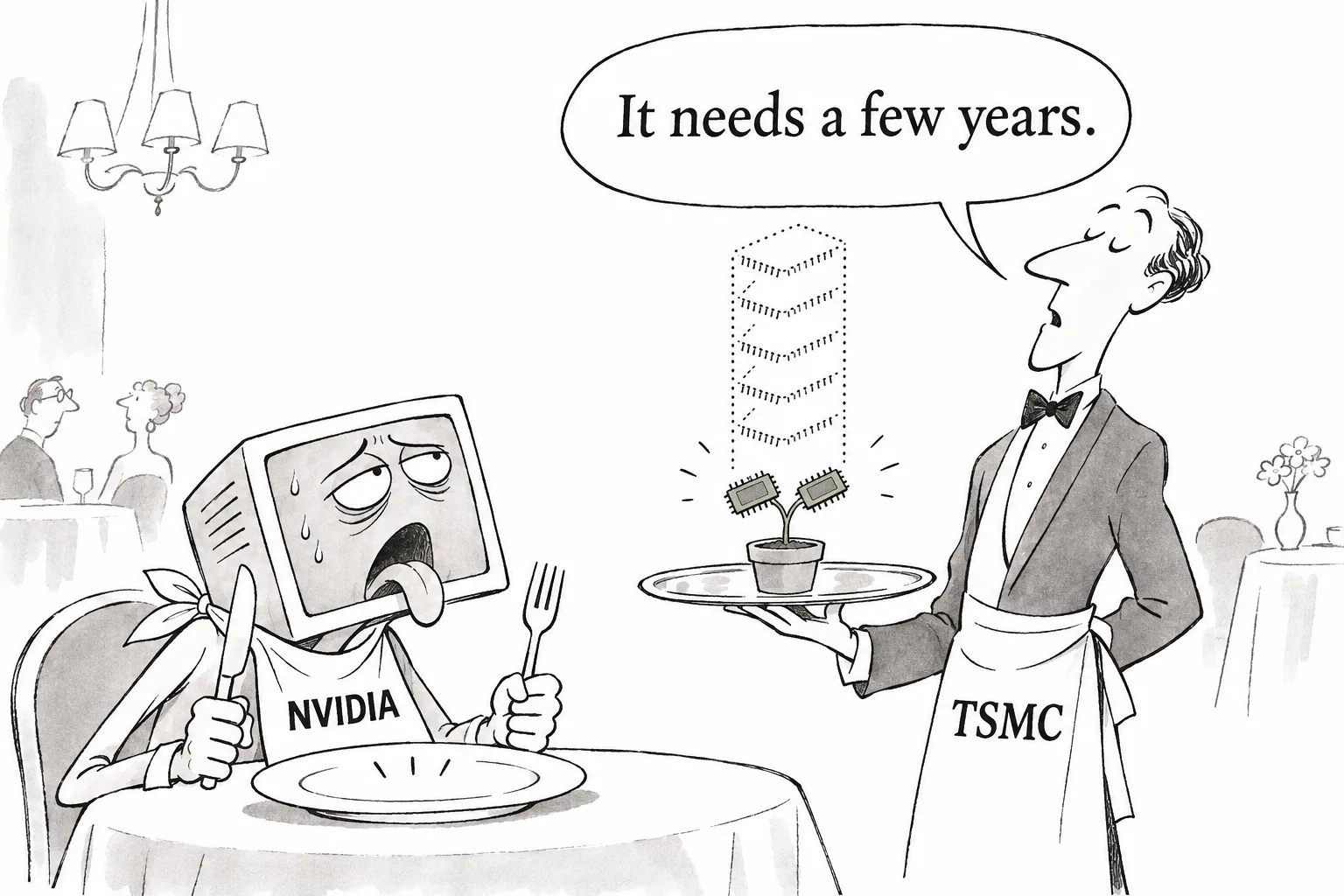
NVIDIA is said to want a second supplier as memory runs short. But no investment amount or timeline has been set, and breaking into a market Samsung and SK hynix dominate will take years
Seiichi Tanaka · Editor-in-Chief

Key points
- According to The Information, TSMC has begun considering 3D DRAM production at NVIDIA's request. No investment amount or timeline has been decided
- The aim is to widen sourcing beyond Samsung and SK hynix while memory is in short supply. TSMC could become a second supplier for NVIDIA
- Mass production is expected to take years. The move will not bring near-term relief from memory shortages and price rises for PCs and servers
[Update, November 9, 2026, 4:38] Our research notes show that neither TSMC nor NVIDIA has said anything about the report, so we changed "has not been confirmed" to "has said nothing"
TSMC (Taiwan Semiconductor Manufacturing Company), the world's largest contract chipmaker, has begun considering production of DRAM, a type of memory, at NVIDIA's request, U.S. tech publication The Information reported. The target is reportedly next-generation "3D DRAM," which stacks memory cells vertically. How much TSMC would invest and when production would start have not been decided, according to the report. If the plan goes ahead, NVIDIA, which is struggling with a shortage of memory for AI, would gain a second supplier. Even so, breaking into a market controlled by Samsung and SK hynix will take years.
For Japanese companies: General affairs and IT departments that buy PCs and servers should not hold off purchases in the hope that this report will bring memory prices down. Next fiscal year's budget should assume that memory shortages and high prices will continue, and buyers should check delivery times and quote expiration dates with resellers this month. Sales teams at companies that supply TSMC with chipmaking equipment or materials should ask at their next meeting whether inquiries about DRAM processes have come in. Most other companies will see no direct impact.
What was reported
South Korea's Seoul Economic Daily (English edition, November 7) and news aggregator mlq.ai relayed the report from The Information. Here is what it said.
TSMC has reportedly begun considering whether to enter 3D DRAM production at NVIDIA's request. TSMC has built its business making compute chips on contract, such as NVIDIA's GPUs (the chips used for AI computation). It has made very little memory. The investment amount, the factory location, and the start of mass production have reportedly not been decided.
On November 6, CNBC covered SK hynix, Samsung, and SoftBank Group in a story on Asian tech stocks. Shares of the two big memory makers now move sharply on the outlook for AI-driven demand and supply.
Why NVIDIA wants a second supplier
Today's AI chips cannot run on compute chips alone. They need fast memory placed right next to them, especially HBM (high-bandwidth memory), which stacks multiple DRAM chips. Most HBM is made by two South Korean companies, SK hynix and Samsung. Together with U.S.-based Micron, these three companies split nearly the entire DRAM market.
The fast buildout of AI data centers has left memory in short supply. OpenAI CEO Sam Altman met Samsung executives in South Korea on October 31 to discuss memory supply, Bloomberg reported. On November 6, Altman briefly changed his name on X to "Ram Altman" and wrote that he wanted the world to have lots of memory. Who secures how much memory has become one of the central questions in the AI race.
For NVIDIA, having effectively only two memory suppliers is a weakness. It leaves the company more exposed to its suppliers' circumstances, both in price negotiations and in securing volume. If TSMC, its longtime partner, could also make memory, NVIDIA's sourcing options would widen. The request can be read as groundwork for that.
What 3D DRAM is, and why it will take years
Today's DRAM lays memory cells out on a flat plane, and makers have packed in more by making the circuit lines thinner. That shrinking is nearing its limits. The idea behind 3D DRAM is to stack the memory cells themselves in many vertical layers. Flash memory (NAND), used in smartphones and other devices, has already grown in capacity through this kind of 3D stacking. For DRAM, the approach is still in research and development, and even the big memory makers are only now working to settle the technology for mass production.
For TSMC, the task is doubly hard. Memory manufacturing differs from compute chip manufacturing in its processes and in what it takes to reach high yields (the share of good chips). On top of that, TSMC would be starting with a new structure that even the memory giants do not yet mass-produce. Building a factory, installing equipment, and running repeated trial production to raise yields usually takes years. If, as reported, the investment amount and timeline are still undecided, it is reasonable to expect that TSMC-made DRAM will not appear in NVIDIA products for at least several years.
In other words, this is not a fix for the current memory shortage. It is a long-term story about redrawing the map of AI chip sourcing several years from now.
What has not been confirmed
This article is based on press reports. The original article from The Information is behind a paywall, and we have not read it directly. Its content comes from how Seoul Economic Daily and mlq.ai described it. TSMC and NVIDIA have said nothing about the report. The investment amount, the factory location, the timing of mass production, and whether TSMC would make the memory itself or partner with a memory maker are all unknown. We also have not confirmed any link between the stock moves described in the CNBC article and this report.
What to watch next
TSMC is scheduled to report its October revenue on November 10, and NVIDIA is scheduled to report earnings on November 17. The first clue will be whether executives mention memory efforts at either event. In particular, it will be worth watching whether analysts ask on NVIDIA's earnings call about its memory supply outlook and how it plans to add suppliers. Another thing to watch is whether Samsung and SK hynix move up their investments in HBM and next-generation DRAM in response to TSMC.
Editorial cartoon