Infrastructure & Security · Oct 16, 2026
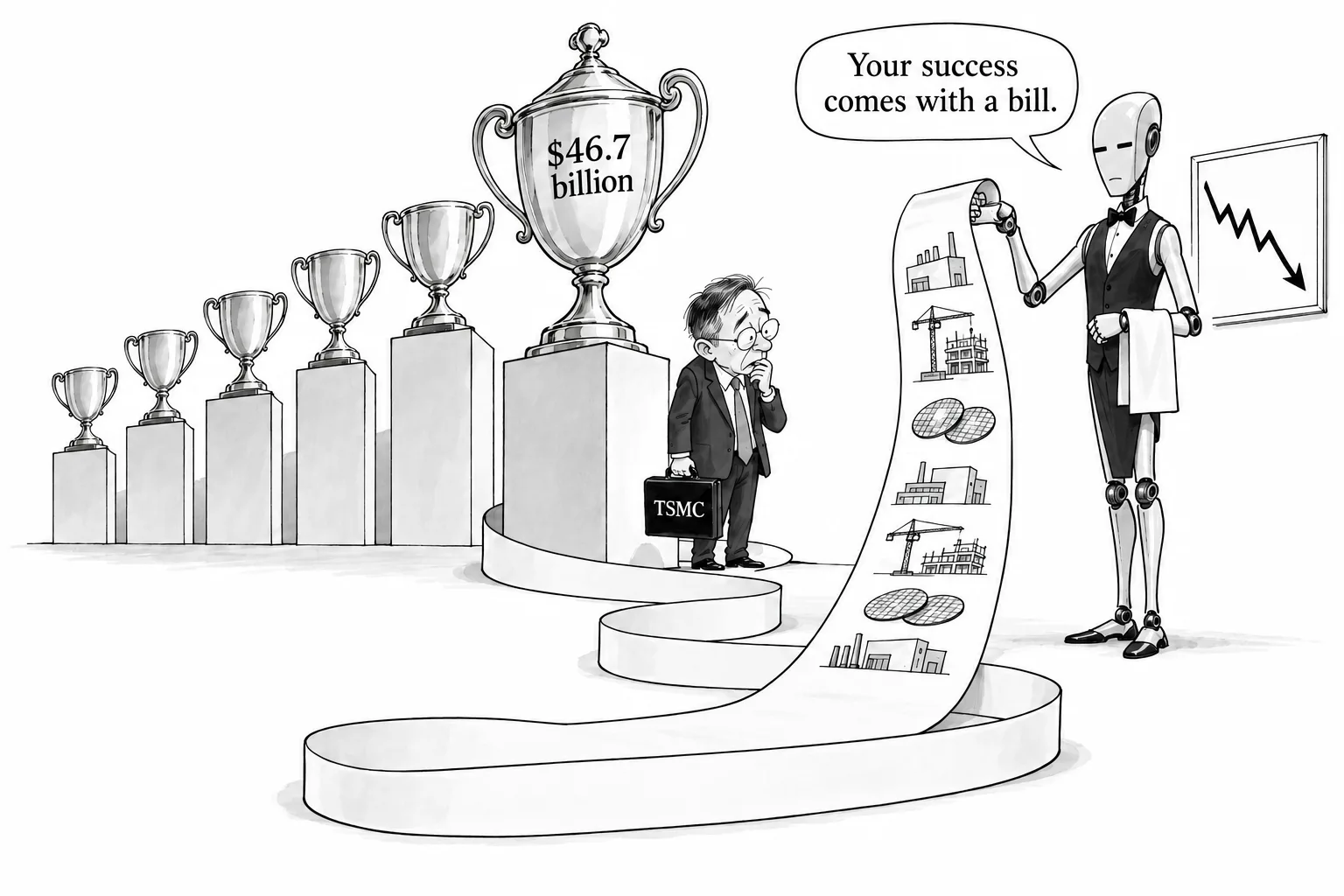
TSMC posts record revenue of $46.7 billion for a sixth straight quarter, but warns of lower gross margins and higher capex
Demand signals haven't weakened. What the market repriced was the margin hit from the 2nm ramp and overseas fabs, plus capital spending that keeps growing
Seiichi Tanaka · Editor-in-Chief

Key points
- July–September quarter revenue was $46.7 billion, a record for the sixth straight quarter, and results beat market expectations
- The stock still fell after the company said the 2nm ramp and its overseas fabs in the US, Japan and Germany would push gross margins down
- Capital expenditure is expected to rise further; the stronger AI demand gets, the more TSMC carries the cost of leading-edge manufacturing up front
TSMC reported results for the July–September quarter (TSMC press release, SEC filing). Revenue was $46.7 billion, a record for the sixth consecutive quarter. Investing.com, which published a transcript of the earnings call, reported that the stock fell even though results beat market expectations.
The numbers were strong. What the market reacted to, though, was not revenue but margins and capital spending. The company itself made clear that the ramp of 2nm volume production and its overseas fabs would pull gross margins down, and that capital expenditure would rise.
Demand signals haven't weakened
Six straight quarters of record revenue show that demand for leading-edge AI chips has not faded, at least on the manufacturing side. Growth is coming from AI accelerators and high-performance computing, and customer moves over the past few weeks fit that trend.
On October 12, Microsoft announced Azure Maia 300, its in-house inference chip, in a blog post under Scott Guthrie's name. The chip will be built on TSMC's N2P, with volume production starting in 2027. Microsoft has also reportedly secured more than 300,000 units of TSMC capacity for 2027, but that is based on media reports and has not been confirmed by Microsoft or TSMC. Among chipmaking equipment suppliers, ASML had said it expects supply to fall short of demand in 2027–28.
TSMC faced no pressure to answer questions about demand. The question was who pays the cost of meeting that demand, and when.
What the market repriced was gross margin
TSMC cited two factors pushing gross margins lower. The first is the ramp of 2nm volume production. With a new node generation, yields are unstable during the ramp and depreciation weighs heavily, so early volume production drags on margins. 2nm is the generation that inference chips such as Maia 300 will use, and the stronger demand is, the faster the ramp has to go, pulling the margin burden forward.
The second is overseas fabs. Its fabs in Arizona, Kumamoto and Dresden, Germany cost more to build and run than those in Taiwan. They are the result of customers and governments pushing for more diversified supply chains, but the cost shows up first in TSMC's margins.
Both are pressures that arise precisely because demand is strong. Even as revenue hits records, the profit left from each dollar of sales is thinning. The stock's decline can be read as the market repricing that dynamic.
Capex is still rising
TSMC also signaled that capital expenditure will rise further. Its 2026 capex had been put in a range of $60 billion to $64 billion, but with 2nm capacity expansion and overseas fab construction continuing, there is no sign of the investment burden easing.
Across AI infrastructure, the cost of financing data centers is going up. Attention has turned to yields on CoreWeave's bonds and to how Oracle's construction debt is selling, and Gartner expects the possibility of large impairments. Against that backdrop, TSMC is building the heaviest assets of all, leading-edge fabs, up front and with its own cash rather than borrowing. If demand forecasts prove wrong, TSMC will be the first to absorb the losses.
AI demand has reached manufacturing as a bill
These results show that the question around AI demand has shifted from how much demand there is to how the costs are shared. The volume of tokens generated by agents keeps growing, and more companies are building dedicated inference chips. The cost of ramping 2nm, the leading-edge node that serves them, and of building fabs abroad in response to geopolitical demands, shows up first in TSMC's gross margins and capital spending.
Record revenue, falling margins and swelling capex, all in the same set of results: that is the takeaway from TSMC's July–September quarter. The focus now moves to whether TSMC can pass these costs on to customers through price increases, and to its capex outlook for 2027.
Editorial cartoon