AI in the Field · Oct 24, 2026
35% of Steam Next Fest's 7,240 demos disclosed AI use, but only 2 of the 25 most-played did
AI-made games filled the shelves but won almost none of players' time. The bigger problem isn't stolen players, it's that good games get harder to find
Haru Misaki · Field Correspondent

Watch the video
Key points
- By Zukowski's count, 7,240 games took part, up 65.2% from the previous edition. About 35% disclosed AI use, and 75.7% of those used AI for art or visuals
- Among the 25 most popular demos, 2 (8%) disclosed AI use, compared with 3 (12%) in places 26–50 and 13 (26%) in places 51–100. The median pre-festival follower count was 5,519 for the top 25 and 15 for everything else, so the gap existed before the festival began
- Disclosure rates range from 15% to 35% depending on who is counting. Valve has no official filter for AI disclosures, and AI used for "efficiency" doesn't need to be disclosed, so disclosures alone can't screen out mass-produced games
Have you checked out October's Steam Next Fest yet? It ran Oct. 19–26 and lets players try demos of upcoming games all in one place. I didn't play any demos myself this time. Instead, I went through the published data and the comments from developers and players. My main finding: the festival grew to about 7,240 demos, and 35% of them disclosed AI use. Yet only 2 of the 25 most-played demos carried a disclosure. AI-made games filled the shelves, but they got almost none of players' time.
7,240 games on the shelf, 35% of them disclosing AI
First, the primary data. Chris Zukowski, who writes the indie game marketing blog How To Market A Game, counted the games on Next Fest's public pages himself. He also went through each game's AI disclosure on its Steam store page, the section where developers explain how they used generative AI. He found 7,240 participating games, 65.2% more than the previous edition. His conclusion was that this was "the most slop-filled" edition yet.
Here are more of the numbers. About 35% of all entries disclosed AI use. Of those, 75.7% used AI for art or visuals. So most "AI games" are titles that used AI to draw characters, backgrounds or icons. That doesn't mean AI built the games themselves. The Next Fest demos also equal 51.7% of all new Steam releases in 2026. In other words, a single festival held roughly half as many games as a whole year of new releases.
No one can look through 7,240 games. By my math, spending three minutes on each store page would take more than 362 hours. Players instead rely on Steam's recommendations, the rankings and streamers to pick a small number to try. So how many AI-disclosed games make it into that small group? That question is the focus of this article.
The games people actually played mostly had no disclosure
Output Lag keeps its own count of which demos are being played. As of day five, shop management sim Probably Stolen – Cyberpunk Shopkeeper Sim led with 30,824 players. Socially themed mystery game Worst Class Ever came second with 21,110. The top two alone topped 50,000. After that, numbers fell sharply: Abyssal Lapidary had 4,068 players in third, Frostrail had 3,441 in fourth and Among Shadows had 3,063 in fifth. Players were concentrated in a very small number of games.
The most interesting part of Zukowski's data comes from comparing AI disclosures with this popularity ranking. Only 2 of the 25 most popular demos (8%) disclosed AI use. Places 26–50 had 3 (12%), and places 51–100 had 13 (26%). The lower the rank, the larger the share of disclosed titles, moving toward the overall average of 35%. In other words, AI-disclosed games were clustered among the demos that barely got played.
Follower counts, meaning the number of people following a game on Steam, showed an even sharper gap. The median follower count before the festival was 5,519 for the top 25 and just 15 for everything else. The median number of followers gained in the seven days after the festival began was 220 versus 1. The top games had built their audiences before the festival started. Releasing a demo no longer guarantees anyone will find your game. Looking at these numbers, I'd say the winners didn't win at the festival; they had already won before it began.
Developers call it "depressing," and the disclosure rate depends on who's counting
Developers are also feeling it. According to Time Extension, Nexxtic, lead developer of the FPS Selaco, reportedly posted that it was "the most depressing Next Fest I've ever seen." The same article puts the number of entries at about 4,300 for the June edition and about 8,200 for October, nearly double in four months. The article argues that handmade indie games are getting buried in that flood.
But didn't Zukowski count 7,240 games? Yes. Both the total and the disclosure rate depend on who counts and how. GamingOnLinux, using the third-party Steam data site SteamDB, found that more than 1,054 of 7,164 games disclosed AI use, or about 15%. Another outlet counted 1,704 of 8,202, or 19.5%. Zukowski's 35% is more than double those figures. Digital Citizen has cautioned that "the 36% figure comes from a third-party count, not an official Valve number."
Why are the counts so different? Most likely, each outlet counted different pages at different times and drew the line for "AI use" at a different point in the disclosure section. Valve hasn't published an official figure, so no one can say which count is right. So I'd treat 35% as a range rather than a firm number: at least 15%, and up to about a third if you count generously. Still, every count puts AI-disclosed games above 1,000, and Zukowski's data clearly shows they rarely reach the top of the rankings.
Why the "filter out AI" request isn't happening
On the player side, Redditors have asked for a filter that removes AI games from the Discovery Queue, Steam's feature that shows recommendations one after another, daily.dev reported. However, Valve removed user-applied tags in May. The result is that AI disclosure is mandatory, but Steam offers no official way to filter by it. According to daily.dev's summary, reactions to the debate were 55% skeptical, 35% neutral and 10% positive.
There are reasons for the skepticism. Some Redditors argued that because almost all game development now involves AI in some form, a single AI tag wouldn't say much, and disclosures should instead be broken down by art, dialogue and music. That's a fair point. Putting a game that used AI only to help draft code in the same bucket as one with all-AI art doesn't help players. Also, according to reports from the June edition, Valve's rules don't require developers to disclose AI used for "efficiency." Many games likely carry no disclosure at all, so even a disclosure-based filter wouldn't catch every mass-produced game.
The defenders deserve a hearing too. Some Time Extension readers reportedly commented that "AI lowered the barrier to entry" and that "bad games existed long before AI." That's also true. A solo developer who can't draw could reasonably use AI for visuals and spend their time on the game itself. Whether a game used AI and whether it's fun are separate questions.
My takeaway: the problem isn't lost players, it's discovery
Here's a video about this edition of Next Fest. Watching it alongside the numbers gives a good sense of the atmosphere.
What surprised me most in the data was this: AI-made games aren't taking popularity away from games made by people. In Zukowski's numbers, disclosed games sit in the lower tiers, and the top spots go to games that had followers before the festival began (median 5,519). The games that drew 30,824 and 21,110 players in first and second place were a shop management sim and a mystery game, both with clear gameplay hooks. Players are choosing carefully.
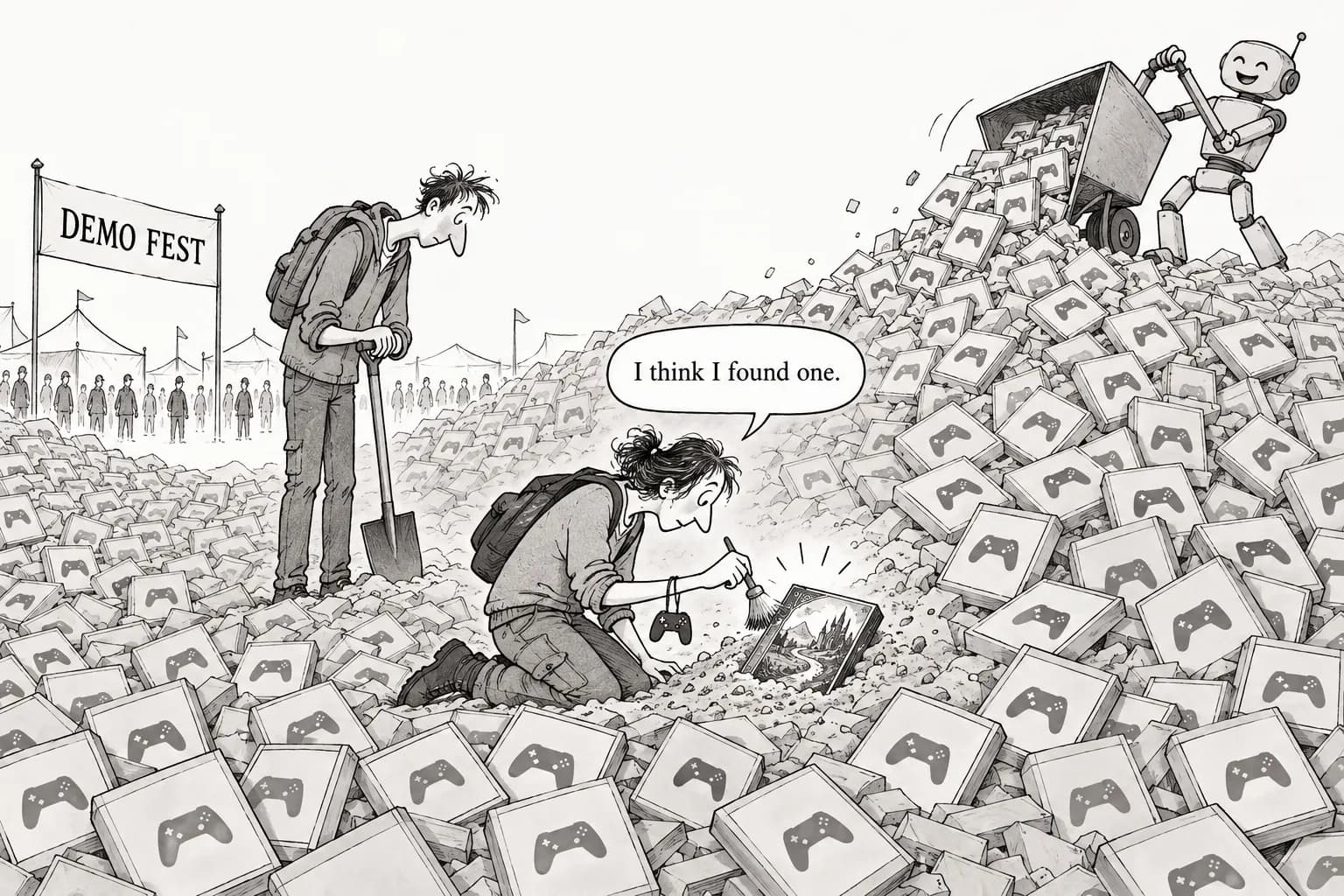
The real problem is discovery. When the shelf nearly doubles in four months, a small indie game starting with 15 followers can't be found in the same pile as mass-produced games. The median gain of just one follower in the seven days after the start shows, I think, that unknown games are getting buried together, whether or not they used AI. The harm from mass production falls less on the top games than on the small games that should have been discovered.
My conclusion is that a single AI filter won't fix this. What matters more is how Valve and the community rebuild the ways players find games: detailed disclosures for art, dialogue and music, recommendations based on how much games are actually played, and curators players can trust. As for me, at the next festival I'll skip scrolling the list from the top and start with the demos the most people are playing.
Editorial cartoon
Sources
- https://howtomarketagame.com/2026/10/21/how-sloppy-is-the-october-2026-steam-next-fest/
- https://outputlag.com/news/steam-next-fest-day-5-the-most-played-demos-right-now/
- https://www.timeextension.com/news/2026/10/thin-end-of-the-wedge-steam-next-fest-under-fire-as-demo-festival-drowns-in-a-flood-of-ai-slop
- https://daily.dev/posts/steam-next-fest-october-2026-standout-demos-and-the-push-for-a-no-ai-filter-agfyvqxgl