AI in the Field · Nov 5, 2026
Half of new Steam releases now disclose AI use, but they bring in only about 12% of sales
Review wait times have stretched to as many as 12 business days, holding up launches even from small studios that don't use AI. Submissions to itch.io have also doubled, and the site is responding with deletions and a new filter
Haru Misaki · Field Correspondent

Watch the video
Key points
- An independent census found that 1,982 of the 3,897 new Steam games released in October (about 51%) disclosed AI use. The researcher cautions that the margin is "too narrow to call a majority," and the figure was 43% for the first two days of November
- Games disclosing AI made up 42% of releases but only about 12% of estimated revenue. Excluding the top two titles, revenue per game fell from about $13,700 to about $7,200
- Valve says reviews can take up to 12 business days, up from the 3 to 5 business days it previously quoted. A nine-person studio's game, four years in the making, reportedly missed its planned launch date, but Valve has not said whether a surge in AI games is the cause
This week's story is about games, but it matters well beyond gaming. On Steam, the largest PC game store, roughly half of October's new releases were labeled as made with AI. At the same time, the wait for store review grew sharply, and launches stalled even for small studios that don't use AI. AI titles are growing in number, but their sales and ratings are lagging far behind. This report is based on primary sources and news coverage.
For Japanese companies: Game companies and studios that sell on Steam or app stores are directly exposed. When reviews run weeks longer than promised, both release dates and payout dates slip, which hits cash flow during the year-end sales season. Other companies are not yet directly affected, but the case is an early example of a broader pattern: once AI lets anyone produce content in bulk, the bottleneck shifts away from production and toward review and getting noticed in the storefront.
1,982 of October's 3,897 new releases disclosed AI use
The figures come from a full census by Sulka Haro, an independent researcher who publishes a series on Substack. Haro analyzed the store pages of all 65,287 games released on Steam between July 2023 and November 2, 2026. Steam has a field, the AI Generated Content Disclosure, where developers self-report whether their game contains AI-generated art, text, or other content, and Haro counted how many games had it checked. According to the third installment of the series, 1,982 of the 3,897 new games released in October, about 51%, carried the disclosure.
Growth is speeding up, too. The share of games with the disclosure had been rising by about 1.3 percentage points a month, and that pace has picked up to about 2.5 points. In July, Haro projected the share would reach half around 2027–28; it got there roughly nine months ahead of that projection. Among developers releasing their first game in October, 1,466 disclosed AI use and 1,326 did not, the first time disclosing developers outnumbered the rest. Another notable finding is that 68% of the month-over-month increase in releases came from games disclosing AI. In other words, most of the newcomers are using AI.
Haro attaches important caveats to the findings. The margin is "too narrow to call a majority," Haro says, so the analysis stops short of saying AI games are now the majority. Week by week, the share moved between 52%, 50%, 56%, and 51%, and it dropped to 43% for the first two days of November. In addition, since January 2026, Steam's disclosure no longer covers games that used AI only to write code. Games whose programming alone was AI-written are therefore not in that half. The real number of games made with AI may be higher, or the figure may simply be measuring something different.
Some games also remove the disclosure after the fact: 105 titles dropped it between July and October. Better-selling games removed it at a higher rate, 2.5% among games with 100 or more reviews compared with 0.7% among those with fewer than 10. Developers of hit games may want to drop the "made with AI" label, which means the visible share doesn't necessarily reflect reality.
42% of releases, about 12% of sales
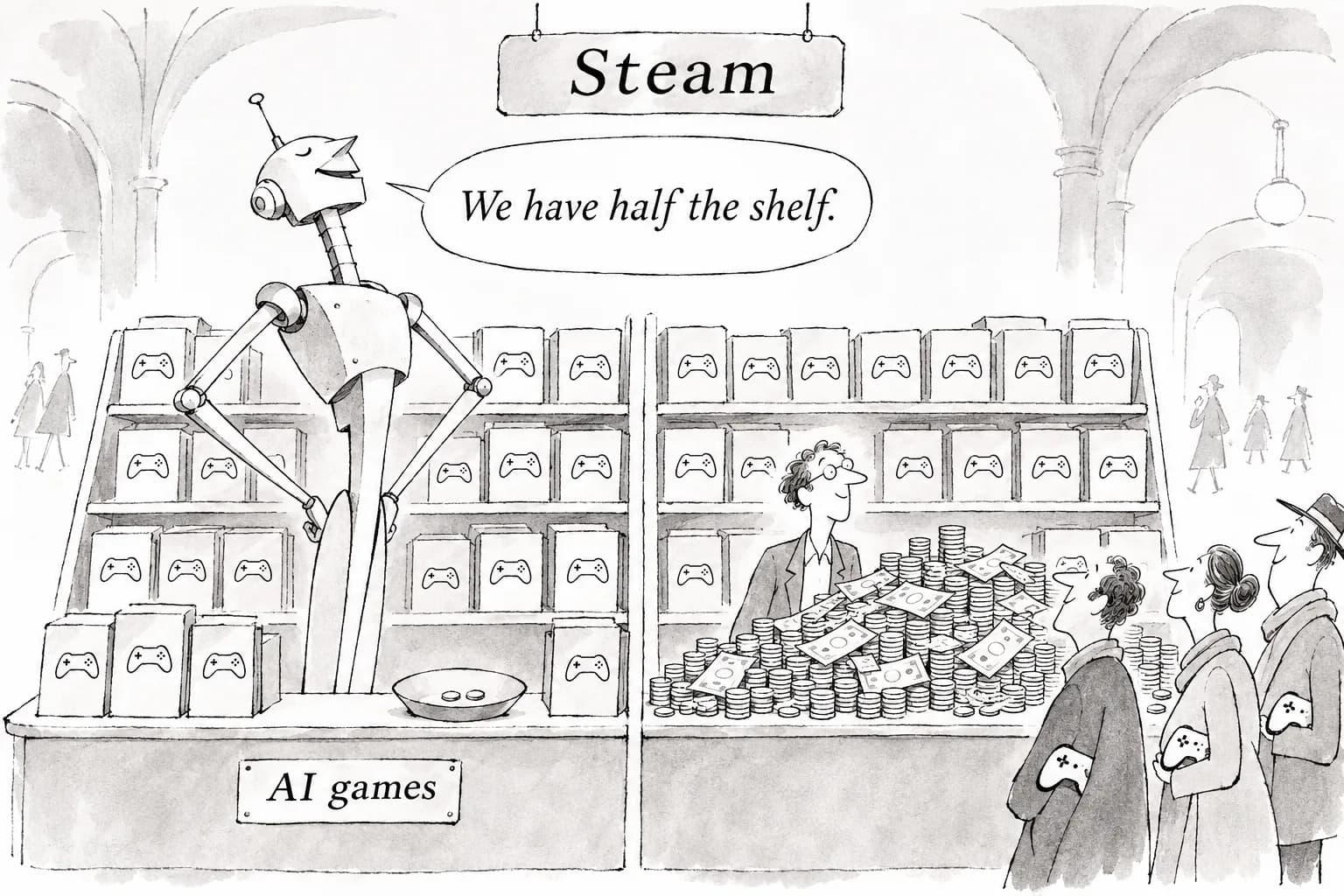
The bigger finding concerns revenue. According to the same research, games disclosing AI accounted for 42% of releases in the previous quarter but only about 12% of estimated revenue. Releases of AI games rose from 2,059 in the second quarter of 2026 to 3,391 in the third. The money has not followed.
Revenue is also extremely concentrated. In every quarter, the two top-selling titles alone accounted for 83–92% of all revenue from AI games, which means nearly everything other than a handful of hits barely sells. Excluding the top two, revenue per game fell by close to half, from about $13,700 in the second quarter to about $7,200 in the third. As more games come out, each one gets a thinner slice.
Ratings are lower as well. The average rating was 76.4 for games disclosing AI and 81.5 for those that didn't. In an analysis of 508,192 reviews, games disclosing AI were recommended 68.4% of the time, compared with 86.3% for games using procedural generation, a technique that predates the AI boom and builds terrain or dungeons automatically from programmed rules. Both approaches have machines doing the building, yet players receive them very differently.
The revenue numbers are estimates, not figures published by Steam. They are calculated roughly by multiplying the number of reviews by 30 and then by the list price, and Haro notes they are meant only as "a rough guide to whether the order of magnitude is right." The precise dollar figures shouldn't be taken at face value. Even as a rough guide, though, the gap between about 40% of releases and just over 10% of revenue is large.
Reviews take up to 12 business days, and a nine-person studio is stuck
The flood of releases is also affecting the store itself. In a post on the official Steamworks blog for developers, Steam operator Valve said that review submissions for store pages and game builds have risen sharply over the past several months, and that reviews may take up to 12 business days. Its earlier guidance was 3 to 5 business days, with a recommendation to submit at least 7 business days before the desired release date. Valve said much of the time is spent re-reviewing submissions that had problems. To address this, it plans to add items to the pre-release checklist that developers use to check their own builds.
Kotaku spoke with developers hurt by the delays. According to the report, Studio Daimon, a nine-person studio in Italy, submitted Food Devils, a game four years in the making, on October 12, planning to release it on November 3. Approval still hadn't come by launch day. The studio received feedback on October 26 and responded right away, but has heard nothing back for seven days. Steam pays out sales revenue a month later, and the studio had been counting on that income at the end of the year.
Caravarn Carnage reportedly waited from its October 16 submission until November 1 for approval, and Ashen Legacy from October 15 to November 1. Wheel Make It was delayed by three weeks. The developer of Cubic Earth said they "can't predict when we'll be able to launch" and that "organic traffic from Steam has disappeared entirely." Kotaku also reported that about 4,000 games launched on Steam in October, nearly half of them with AI disclosures.
It's important to be clear about what is known. The idea that the delays stem from a surge in AI games is speculation by developers. Valve's blog post cites only the rise in submissions and the burden of re-reviews, and does not mention generative AI at all. Kotaku likewise notes that the link can't be proven unless Valve says more. Valve has indicated it has no plans to keep AI games off the store, saying it does not want to be a gatekeeper dictating which tools developers use. It reportedly told Kotaku that it is well aware of the situation and that many people are working on solutions.
One comment from the Food Devils developer stands out: "I sympathize with the reviewers. If it's going to take weeks, just tell us. Don't promise three to five days." The developer isn't blaming the reviewers but objecting to the gap between what was promised and what happened, a complaint familiar from many workplaces.
itch.io submissions double, and "terabytes" are deleted
The same thing is happening on itch.io, a marketplace where creators buy and sell indie games, self-published books, and other work. According to an official Bluesky post from the site cited by Kotaku, the number of game pages created per day doubled from a little over 3,000 to more than 6,000 between August 3 and October 30. Downloads and purchases did not grow at the same rate. Here, too, volume is rising without buyers following.
Surprisingly, the growth is coming not from bulk-posting operations but from first-time uploaders. Large numbers of people seem to have decided that AI lets them make games too. That isn't a bad thing in itself, but the site has reportedly deleted "terabytes" of AI-generated work. It has also made AI disclosure mandatory for tabletop games, books, comics, and soundtracks. On November 3, it announced plans to add a filter that lets users narrow search results by AI use.
Some users have called for an outright ban, but the site has limited itself to mandatory disclosure and filtering. Kotaku notes that some creators are fine with AI-written code but draw the line at AI art that appears on screen, so views on what is acceptable vary widely. Taken together with Steam's decision to exempt code from its disclosure, this suggests a single "used AI" label is no longer a workable way to draw the line.
In short, even as AI makes production cheaper and faster, only a small fraction of games sell, and the bottlenecks have moved to review and to getting found by customers. The fallout is also hitting small studios that don't use AI at all. The bigger problems may be reviews that don't move at the promised pace and buyers' difficulty choosing from a growing pile of titles, rather than whether AI was used. The next thing to watch is whether tools for buyers, like itch.io's filter, can keep up.
Editorial cartoon
Sources
- https://fragwyz.substack.com/p/half-of-new-steam-games-now-disclose
- https://steamcommunity.com/groups/steamworks/announcements/detail/696528162820984746
- https://kotaku.com/devs-are-being-forced-to-delay-their-games-on-steam-and-they-think-its-because-of-the-ai-slop-flood-2000752839
- https://kotaku.com/itch-io-gen-ai-slop-terrabytes-deleted-claude-chagpt-steam-epic-2000752485