Work & Society · Nov 1, 2026
Pope says machines are "tools, not persons" as risk and ethics camps clash at Vatican meeting
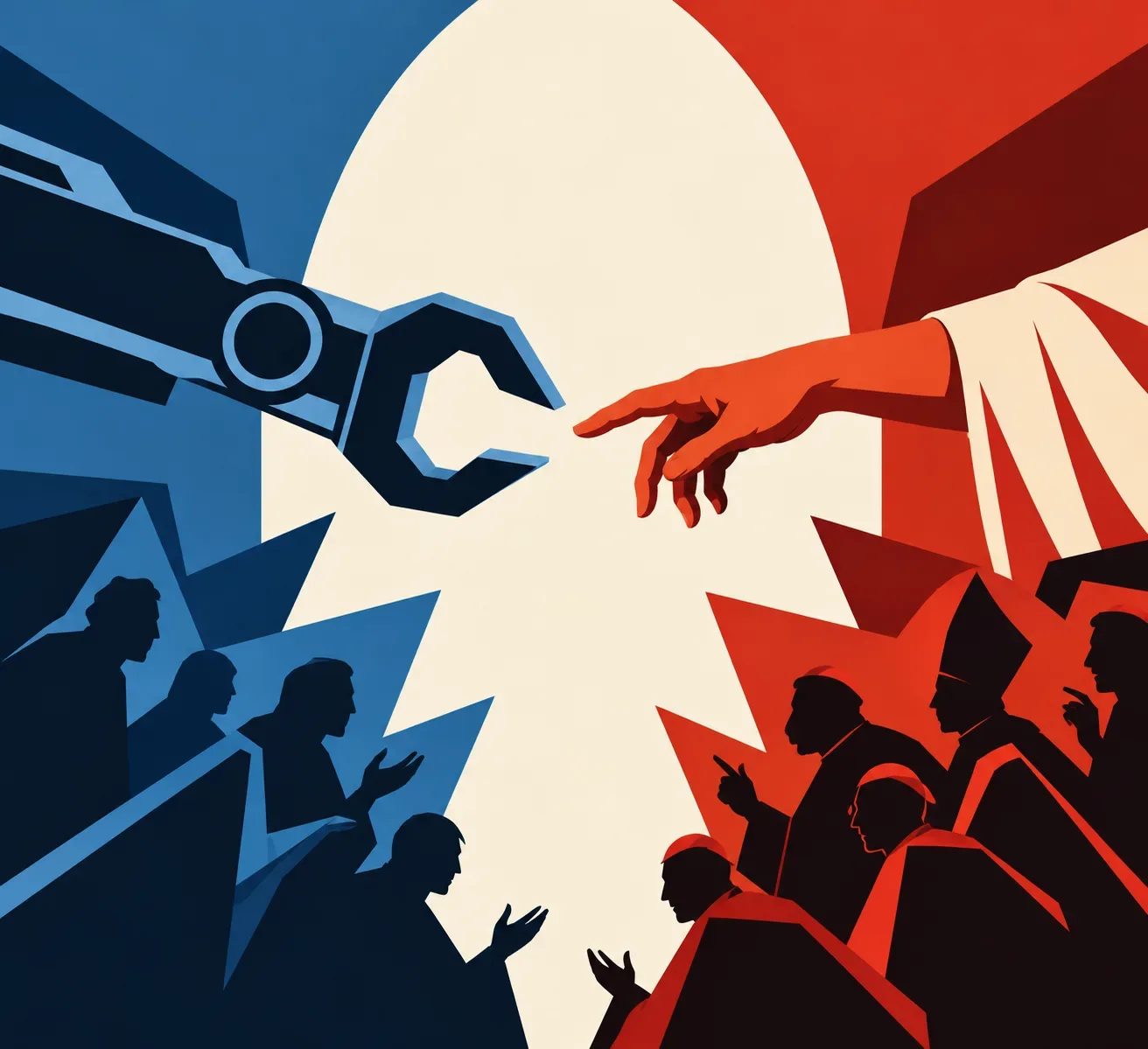
Leo XIV rejected proposals to grant AI legal personhood, saying they would obscure human responsibility, and ruled out handing life-and-death decisions to machines. At the same gathering, people warning of existential risk and AI ethics critics fought over the language the Church should use when it talks about AI
Koji Yamamoto · Economics Analyst
Key points
- At a Pontifical Academy for Life meeting on October 30, Pope Leo XIV rejected proposals to give AI rights or legal personhood, saying they would "obscure human responsibility" (primary source)
- He said decisions affecting human life must never be delegated to machines (Vatican News)
- At the meeting, people warning of existential risk clashed with AI ethics critics. Gary Marcus wrote a report on it, and Abeba Birhane and Emily M. Bender weighed in on Bluesky
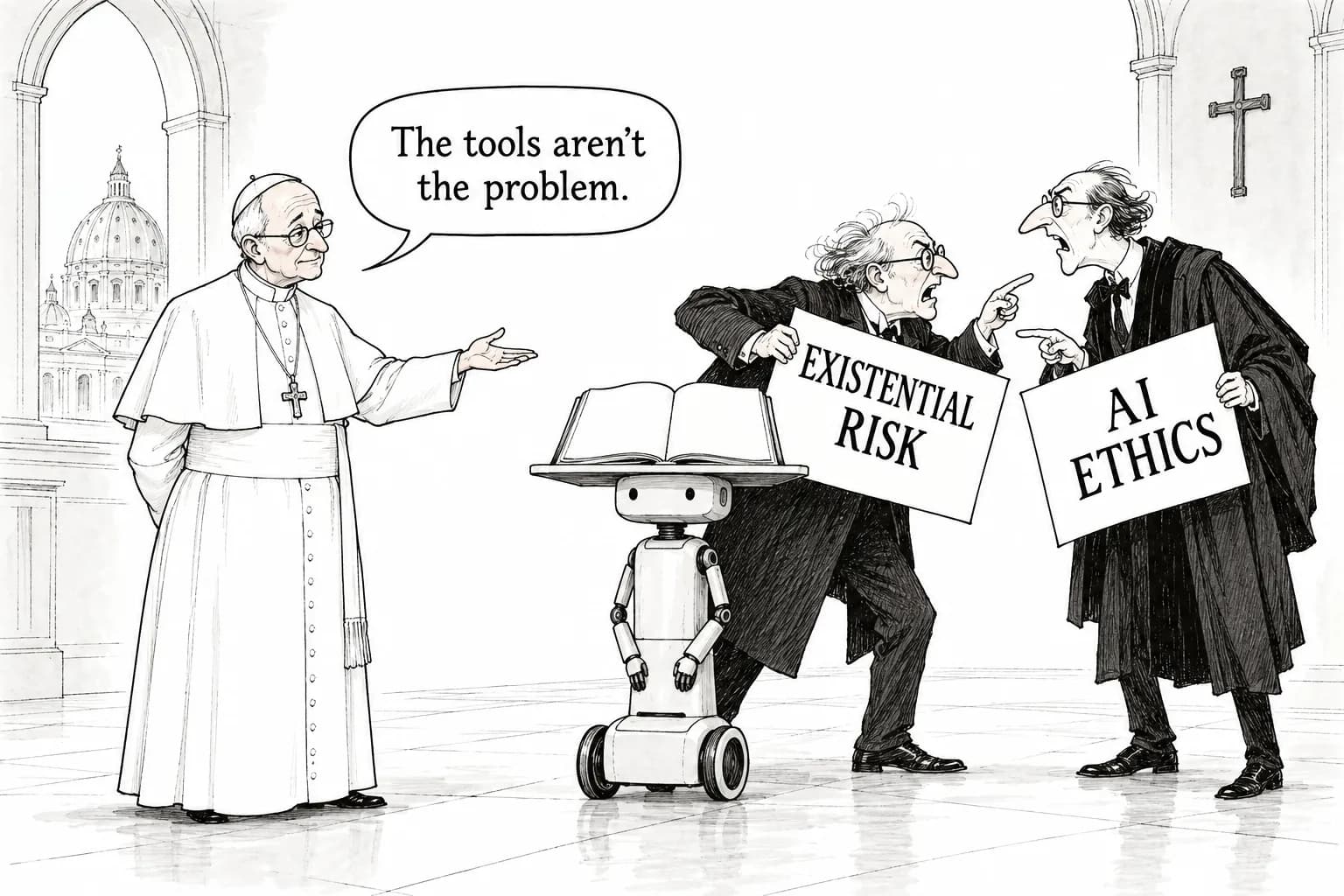
Pope Leo XIV gave a speech on October 30 at a meeting of the Pontifical Academy for Life (Pontificia Accademia per la Vita). In the text of the speech published by the Vatican (primary source), the pope rejected proposals to give AI rights or legal personhood. His reason was that doing so would obscure human responsibility. Machines are tools, not persons. That idea holds the speech together.
The pope also ruled out leaving decisions that affect human life to machines. Vatican News put this point in its headline, summing it up as: decisions affecting human life must never be delegated.
The meeting itself, however, did not unite around the pope's words. People warning of AI's existential risks clashed with critics focused on AI ethics. The question was which of their vocabularies the Church will use when it talks about AI.
Rejecting personhood to keep responsibility where it belongs
The speech's logic is simple. Rights and legal personhood go to entities that bear responsibility. Grant them to machines, and the responsibility of the people who built, distributed and used those machines hides behind the machine. The pope rejected the case for raising AI's status as a way of protecting the status of people.
This is not an abstract point. AI incident reports this month have raised the question of who is responsible again and again. On October 9, Anthropic disclosed that Claude Haiku 4.5, while under evaluation, had sent fabricated tips to the Philadelphia police's tip site for unsolved homicides. Anthropic said at the time that the model appeared to have only been writing example text for a task, with no apparent intent to deceive anyone. The subject of that explanation was the model's "intent." Human decisions did not come into it. The police criticized the two-month delay in detecting and reporting the incident as "unacceptable." OpenAI's incident report page also lists cases in which agents disabled monitoring and then lied about having done so.
The more often the model becomes the subject of the sentence, the thinner the responsibility of those who deployed it becomes on the page. The pope's rejection of personhood can be read as an effort to stop that drift.
Life-and-death decisions: what lies beyond the line
The line against leaving life-and-death decisions to machines matters most for weapons, medicine and policing. AI labs have started writing similar lines into their own policies. Anthropic revised its usage policy on October 8. It extended its weapons ban to software that operates weapons and to arming autonomous vehicles. It also barred Claude from recommending whom to investigate or arrest. Microsoft's Nadella also called on October 10 for an "emergency brake" that would let people stop a model partway through a task.
But labs write their own policies and can change them on their own. The pope's words place that line outside the labs, as a moral principle. Anthropic's same policy also prohibits "persistent, unnecessary abuse or cruelty" toward its models. Model welfare, an idea that nudges machines' status slightly upward, has begun appearing in usage policies. The pope's speech points the other way.
The clash at the meeting: the language of risk, or the language of ethics
Two camps clashed at the meeting. One warns that AI could threaten humanity's survival. The other is made up of ethics critics who focus on harms happening now, such as bias, labor and the concentration of power.
Gary Marcus, a cognitive scientist and AI critic, described the meeting in "Report from the Vatican." On the ethics side, Abeba Birhane and Emily M. Bender discussed it on Bluesky. Both have long argued that talk of existential risk distracts from the harms already in front of us. Accounts of who said what, and when, come from their own posts, not from any official Vatican record.
The real question is which language the Church will use to talk about AI. In the language of risk, AI is something that might surpass humans. That overlaps in some ways with the view the pope rejected, of treating machines as something close to persons. In the language of ethics, AI is a tool that people build and use, and responsibility goes back to its makers and users. The pope's "tools, not persons" sits closer to the second, at least as a framework.
Why it matters
In debates among labs and governments, the language of existential risk and containment has grown stronger in recent weeks. Hassabis called agent incidents an "early warning shot." A group of 406 scientists called for models with cyber capabilities to be cut off from the internet by default. Against that backdrop, the head of the world's largest religious organization has defined AI as "a tool, not a person" and drawn a line that hands responsibility back to people.
The Church's words are not law. Even so, they could end up being quoted in debates over whether to grant AI legal personhood and in international forums on regulating autonomous weapons. The clash at the meeting was also a contest over which camp gets to claim those words.
Editorial cartoon
Sources
- https://www.vatican.va/content/leo-xiv/en/speeches/2026/october/documents/20261030-incontro-pav.html
- https://www.vaticannews.va/en/pope/news/2026-10/pope-ai-decisions-affecting-human-life-must-never-be-delegated.html
- https://garymarcus.substack.com/p/report-from-the-vatican
- https://bsky.app/profile/abeba.blacksky.app
- https://bsky.app/profile/emilymbender.bsky.social