Infrastructure & Security · Oct 29, 2026
SK hynix posts an 80% margin and signs long-term contracts through 2028
Quarterly revenue tops 100 trillion won for the first time. Multiyear deals with 14 companies cover more than half of its 2027–28 capacity, and about 100 trillion won is going back to shareholders
Seiichi Tanaka · Editor-in-Chief

Key points
- Quarterly revenue topped 100 trillion won for the first time, with an operating margin of about 80% (Seoul Economic Daily reports 79.7%)
- Long-term contracts with 14 companies cover more than half of 2027–28 production capacity. Prices are not fixed and can change over time
- The company announced a shareholder return of about 100 trillion won, turning the memory boom from a one-off price spike into commitments that run for years
SK hynix reported results for the July–September 2026 quarter on October 28. Quarterly revenue topped 100 trillion won for the first time, and the operating margin was about 80%. Seoul Economic Daily put the figure at 79.7%. The company also said it had signed long-term contracts with 14 companies covering more than half of its 2027–28 production capacity, and it set out a shareholder return of about 100 trillion won. The AI memory shortage could have been a one-time price spike. These results turn it into something more lasting: multiyear contracts whose prices can change, plus returns to shareholders.
100 trillion won in revenue, an 80% margin
The company's earnings release (primary source) says this is the first quarter in which revenue exceeded 100 trillion won. Roughly 80% of revenue was left as operating profit, which is unusual for a semiconductor manufacturer.
The margin comes from a market where everything the company makes sells, and buyers want more than it can produce. Every AI accelerator carries a large amount of HBM. Microsoft's Maia 300 inference chip, unveiled in October, has 288GB of HBM4, and Microsoft plans to deploy it at gigawatt scale starting in 2027. As plans like this pile up, memory makers gain more power to set prices.
Long-term contracts turn the shortage into multiyear commitments
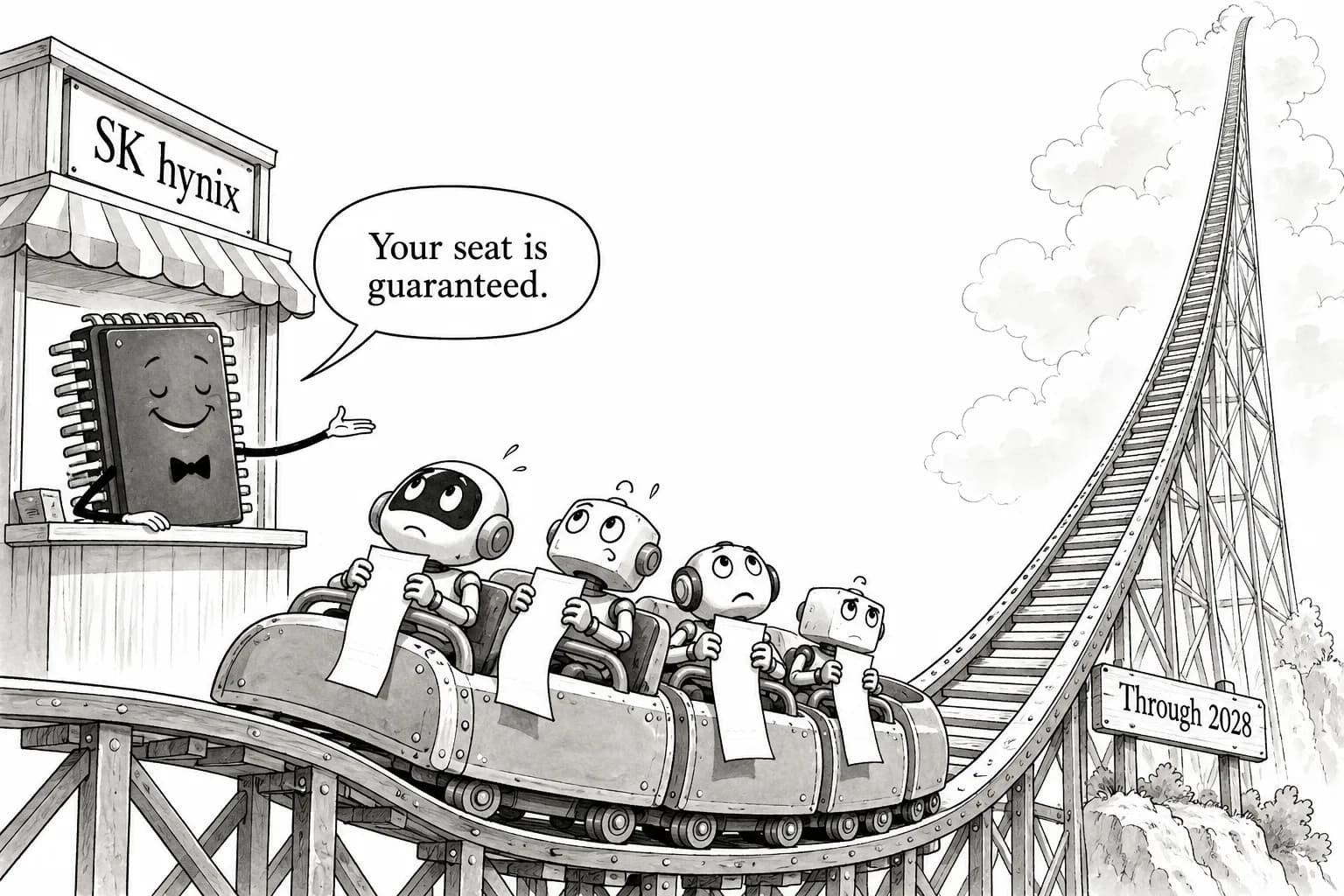
The contracts matter more than the profit figures. SK hynix has signed long-term deals with 14 companies, which already cover more than half of its production capacity for 2027 and 2028. The memory business swings hard with the cycle, and profits earned in a boom have usually disappeared in the next downturn. When buyers are lined up in advance for more than half of capacity, the downturns become shallower.
The contracts do not fix prices. Instead, prices can change over time. If the shortage continues, SK hynix captures the higher prices, and buyers get guaranteed supply. Companies building AI data centers have, in effect, reserved their memory through 2028. It also means the 14 buyers expect the shortage to last that long.
As far as we could confirm, the names of the buyers, the volume for each one, and the details of how prices will be reset have not been disclosed. How much stability the deals actually bring depends on those terms.
About 100 trillion won to shareholders
SK hynix also announced a shareholder return of about 100 trillion won, roughly the size of a full quarter's revenue. Asia Economy and other outlets have reported the details. One reading is that the contracts back up the outlook for several more years of high profits, and that is why the company could afford such a large return. How the money is split between capital spending and shareholder returns, and how many years the return will take, still needs to be checked by comparing the reported figures with the company's own filings.
What to watch next
Samsung reports earnings on October 29. Whether Samsung has overtaken SK hynix in HBM revenue is still unsettled. If it has, that would explain why SK hynix moved early to lock up capacity with long-term contracts. Hyperscalers' capital spending outlooks also come out the same week. The question is whether they will actually build enough computing capacity to use the memory they have reserved through 2028.
GPUs alone do not set the cost of AI infrastructure. This quarter, a memory maker turned a shortage into multiyear contracts and laid out a plan to pass part of the gains to shareholders.
Editorial cartoon