Money · Oct 4, 2026
Shopify opens checkout to agents while Amazon shuts out Muse — the split comes down to transaction fees versus advertising
Can browser-based agents get into the store? The answer depends less on technology or safety than on how each company makes its money
Koji Yamamoto · Economics Analyst

Key points
- On September 28, Shopify made its checkout compatible with WebMCP, allowing browser agents to proceed all the way through payment (primary source)
- One week earlier, on September 21, Amazon shut out Meta's shopping agent Muse, saying third-party apps should operate openly and respect service provider decisions
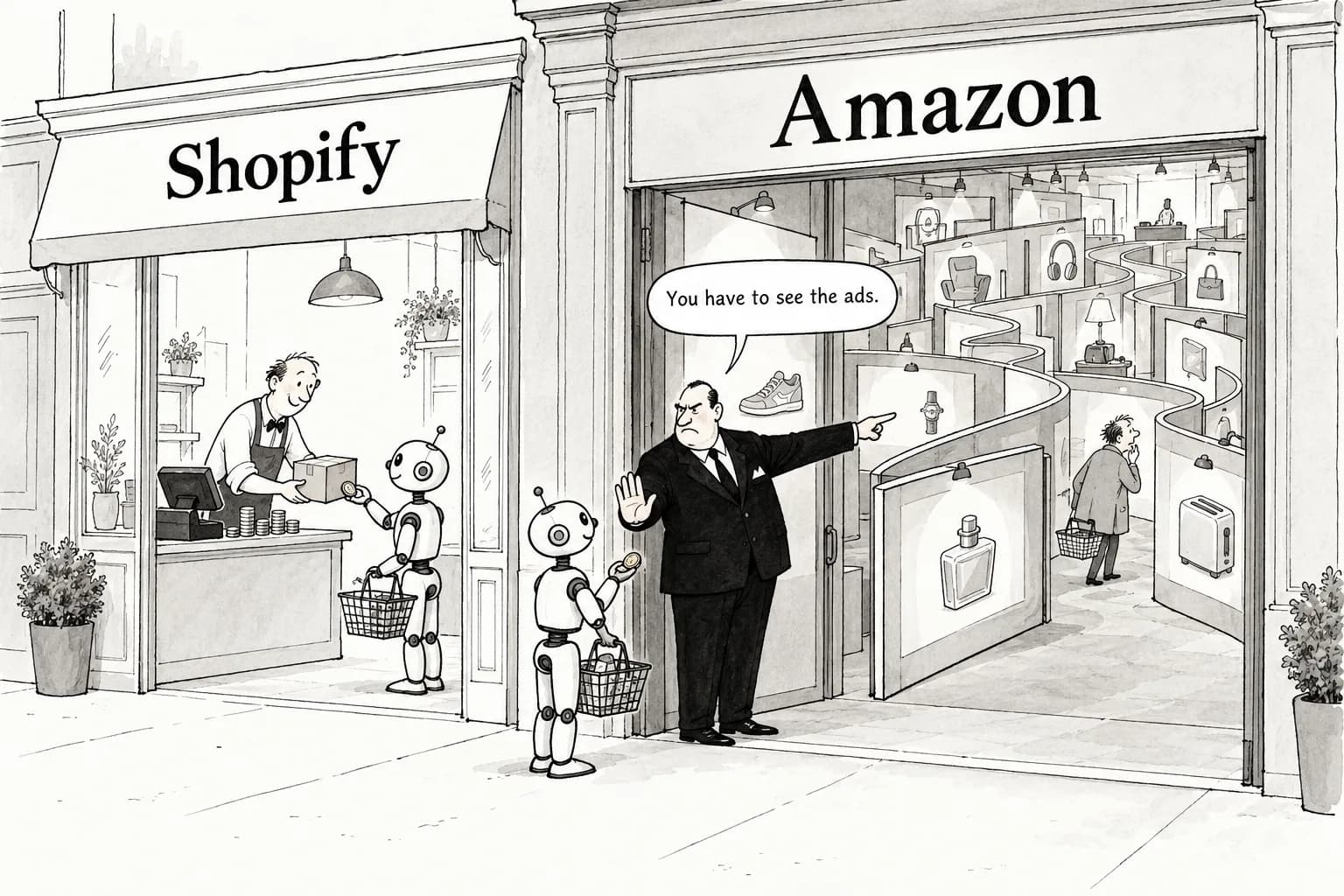
- Shopify, which earns from transaction volume, gains as more agents arrive. Amazon, which earns more than $68 billion a year from advertising, loses when customers finish shopping without seeing its ads. Whether a store opens or closes its doors is decided by this difference in business models
In the last two weeks of September, two opposite decisions were made about systems that let agents shop on a customer's behalf. On September 21, Amazon shut Meta's shopping agent Muse out of its store. One week later, on September 28, Shopify enabled browser-based agents to complete checkout at the stores built on its platform. One company closed the door; the other opened it all the way to the payment screen.
The difference between the two companies does not stem from how mature their technology is or how they think about safety. It stems from how each one makes money. Shopify's revenue comes from the transaction volume that flows through its stores and from its payment service, Shop Pay. As a result, whether the customer is a human or an agent, more purchases mean more revenue for Shopify. Amazon earns more than $68 billion a year from advertising. That ad revenue depends on customers browsing its storefront. If agents bypass search results and sponsored placements and go straight to the cart, the foundation of that revenue erodes.
What Shopify opened — WebMCP all the way to checkout
In its developer changelog, Shopify announced that it had added WebMCP support to checkout. WebMCP is a mechanism that lets a web page expose its own actions as tools to browser agents. Until now, browser agents have read the screen, guessed where buttons are, and filled in input fields one by one. On pages that support WebMCP, an agent can directly call the procedures the page provides. According to Search Engine Journal, Shopify extended this support from the storefront into the payment process.
Gil Greenberg, a staff product manager who handles agent-driven shopping at Shopify, wrote on the day of the announcement:
Shopping with an agent shouldn't feel like watching paint dry. 🥱 Today, we're launching WebMCP support for checkout.
Greenberg's concern is waiting time. While an agent fumbles its way through the screen, the customer can only watch and wait. Checkout, with its successive fields for address, shipping method and payment method, has been the step where screen-operating agents struggle most. Shopify has now offered that step in a form agents can read. TechCrunch also centered its report on the opening of checkout to browser agents.
Notably, Shopify is not choosing which agents to let in. Because WebMCP is a browser-side mechanism, any company's agent can use the same entry point as long as it runs in a supporting browser. What matters to Shopify is where the transaction is completed, not where the customer comes from.
What Amazon closed — shutting out Muse
One week earlier, Amazon made the opposite move. According to The Register, Amazon did not allow Meta's Muse to shop on customers' behalf in its store. An Amazon spokesperson explained the reasoning as follows:
We think it's fairly straightforward that third-party applications that offer to make purchases on behalf of customers from other businesses should operate openly and respect service provider decisions.
The statement makes two demands: that agents identify themselves, and that they follow the store's decisions. On the surface, it reads as a matter of transparency and rules. In substance, however, it is also a declaration that Amazon will decide which agents get into its storefront. Amazon has long had a policy of placing conditions on third-party agents' access (its agent policy), and the move against Muse is an extension of that.
Muse did not stop after being shut out. At Connect on September 23, Meta added Walmart, Best Buy, Sephora and Wayfair to the retailers Muse connects to, and added Shop Pay and PayPal as payment methods. Meta plans to keep the service free while taking a small fee from transactions. The agent Amazon turned away flowed toward retailers that compete with Amazon, and toward Shopify's payment side. It is no coincidence that Shop Pay appears there.
Why business models drive the split
When an agent shops on a customer's behalf, the time spent "browsing the store" disappears from between the customer and the store. Whether agents are a loss or a gain depends on who turns that time into revenue.
Those who earn from transaction volume — the more agents, the better
Shopify's main revenue comes from payment fees tied to stores' sales, particularly Shop Pay. It does not make money by placing ads in search results at the stores on its platform. Even if the browsing experience is lost, Shopify has little to lose. Conversely, if an agent stumbles at checkout and the purchase is abandoned, the fee on that transaction vanishes entirely. When Greenberg says customers shouldn't be kept waiting, it is because waiting time translates directly into lost sales. The AI Insider framed Shopify's move as a contrasting play at a time when rivals are blocking agent-driven shopping.
Those who earn from advertising — being bypassed hurts
Amazon's advertising depends on customers seeing sponsored placements in search results and related-product slots on product pages. Its more than $68 billion a year in ad revenue is payment for customers hesitating, comparing and wandering on Amazon's screens. If a third-party agent puts a matching product straight into the cart, that wandering never happens. Even if the sale is the same, no one sees the ad slots. For Amazon, a third-party agent is both a customer bringing in sales and something that wipes out its ad inventory.
That is why Amazon is not rejecting agent-driven shopping itself. Amazon has its own shopping assistant, Rufus. With its own agent, it can decide what to recommend and which placements to show. The problem arises when another company's agent — one like Meta's, with its own entry point to customers — uses Amazon's storefront as nothing more than a counter for inventory and delivery.
A fight among those who own the entry point
It is also worth noting that Meta intends to take a small fee from transactions through Muse. Muse is trying to become the entry point that first receives a customer's intent. If it secures that position, Muse can decide which store the customer buys from. For Amazon, which earns from advertising, that means losing the first point of contact with the customer. Since Meta is itself an advertising company, Amazon's wariness is only natural.
OpenAI is aiming for the same entry point. On October 1, ChatGPT added virtual try-on for clothes to its shopping interface. If even trying things on happens inside ChatGPT, customers will open a store's site only at the moment of payment. Those who own agents are pulling the steps that come before a purchase onto their own screens, one after another.
In this landscape, stores split into two camps. Stores that are fine with agents taking over the entry point, as long as the transaction is completed with them, open their doors as Shopify has. Stores that have turned the entry point itself into revenue close their doors as Amazon has, or let in only their own agents. The millions of stores on Shopify belong to the former; Amazon belongs to the latter.
What to watch next
There are three indicators of whether this split will hold. First, whether Shopify releases figures on how many transactions WebMCP-enabled browser agents actually complete at its stores. Second, how far Amazon opens its doors, with conditions, to agents that identify themselves. Whether those conditions include displaying ads or paying fees will reveal what Amazon is trying to protect. Third, which side retailers growing their own advertising businesses, such as Walmart, will take. Walmart is listed among Muse's connected retailers, but the more its own ad revenue grows, the closer it comes to Amazon's calculation.
Whether to open stores to agents is, for now, often discussed as a question of safety or technology. But lay the decisions of these two weeks side by side, and it is the balance sheet that is determining the answer. Companies that earn from transaction volume welcome agents as customers. Companies that earn from advertising treat agents as passers-by who walk through without looking at the store.
Editorial cartoon
Sources
- https://shopify.dev/changelog/webmcp-support-for-checkout
- https://techcrunch.com/2026/09/28/shopify-opens-checkout-to-browser-based-ai-agents/
- https://www.searchenginejournal.com/shopify-extends-webmcp-into-checkout-for-browser-agents/591478/
- https://theaiinsider.tech/2026/09/30/shopify-opens-checkout-to-browser-based-ai-agents-as-rivals-block-agentic-shopping
- https://www.theregister.com/ai-and-ml/2026/09/21/amazon-shows-metas-muse-ai-shopping-agent-the-door/5297777
- https://techcrunch.com/2026/10/01/chatgpt-can-now-virtually-try-on-clothes-for-you/