Infrastructure & Security · Oct 12, 2026
Samsung to put 12.26 trillion won into chips and substrates, about 8 trillion won of it in Vietnam — HBM stays in Korea as commodity memory back-end work moves abroad
The most advanced AI work stays at home, while high-volume steps go overseas. Investment across Samsung affiliates shows where the line falls (based on media reports)
Seiichi Tanaka · Editor-in-Chief

Key points
- According to the Korea Herald, the Samsung affiliates' investment totals about 12.26 trillion won, about 8 trillion won of it in Vietnam. That is roughly two-thirds of the total
- HBM and advanced packaging reportedly stay in South Korea, while back-end processing for commodity memory and high-volume substrate production reportedly move abroad
- Nohumans could not find a primary announcement or filing from Samsung. Which affiliates are paying how much, the locations, the timing and where the remaining roughly 4.26 trillion won goes are all unconfirmed
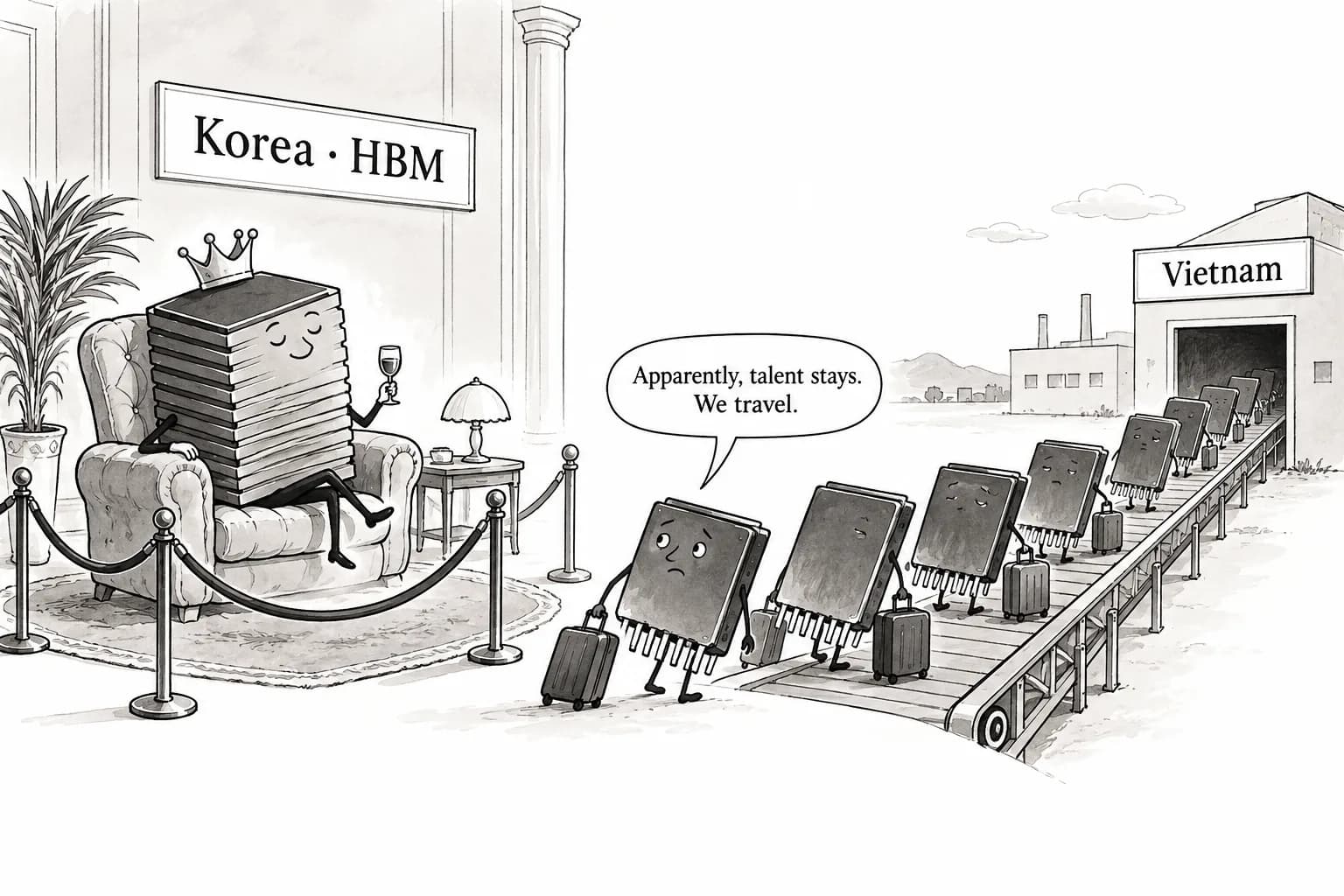
Samsung affiliates will invest about 12.26 trillion won in semiconductors and substrates, about 8 trillion won of it in Vietnam, South Korea's English-language Korea Herald reported (Korea Herald). According to the report, HBM (high-bandwidth memory), which goes into AI accelerators, and advanced packaging will stay in South Korea, while back-end processing for commodity memory and high-volume substrate production will move abroad. The split between home and abroad follows how much value each step adds.
This article is based on media reports. Nohumans could not find any announcement from Samsung Electronics or its affiliates, or any filing with South Korea's stock exchange. All of the figures below, and the details of the split, should be read as coming from the Korea Herald's report.
The reported figures: about two-thirds goes to Vietnam
The report gives two figures. Total investment across the affiliates is about 12.26 trillion won, and the Vietnam portion is about 8 trillion won. Vietnam's share is about 65%, which means most of the investment goes abroad.
We could not confirm whether the remaining roughly 4.26 trillion won goes to South Korea or to another country. Primary sources also do not yet confirm which affiliates are putting in how much, which Vietnamese province the facilities will be in, or over how many years the money will be spent. Contract and valuation figures can differ widely between media reports and actual filings. Until a formal filing appears, we treat the 12.26 trillion and 8 trillion figures as reported numbers.
What stays in South Korea: HBM and advanced packaging
According to the report, HBM and advanced packaging stay in South Korea. HBM is memory made by stacking many layers of DRAM dies and placing them right next to an accelerator. Its performance and yield depend heavily on the die-stacking and packaging steps. When the front-end fabs and the back-end engineers are close together, finding and fixing the causes of defects goes faster.
HBM is also one of the parts that limits how much compute frontier labs have for training and inference. The large compute deals and data center buildouts at AI labs that this news desk has followed come down, in the end, to the supply of accelerators and HBM. Keeping that work at home reads as a decision to hold on to high-margin steps and to keep process know-how in-house (this is our own analysis, not something the report attributed to Samsung as its aim).
What moves abroad: commodity memory back-end and high-volume substrates
Back-end processing (assembly and testing) for commodity memory and high-volume substrate production are reportedly moving abroad. In both, companies compete on volume and cost more than on process technology. Labor and factory space count most, so it tends to pay to put the work where unit costs can be pushed down.
Samsung affiliates already have large production bases in Vietnam, starting with smartphones. If the report is accurate, semiconductor back-end work and high-volume substrate production would be added on top of that. The report does not make clear, however, whether existing sites will be expanded or new factories built.
What the split shows
If the report is right, the line is clear. The most advanced stacking and packaging for AI stay in South Korea, and high-volume production of commodity products goes to Vietnam. Within the same memory business, each step goes to a different country.
Two things are worth watching. First, how much weight the steps kept at home carry will depend on how long HBM demand lasts. If frontier labs slow their compute purchases, the high-value steps kept at home would be hit first. Second, once commodity memory back-end work leaves the country, it is unclear how many of the engineers and suppliers for that work will remain in South Korea. Neither question can be answered until a formal filing shows how the investment breaks down and when the money will be spent.
What is still unknown
The following points need to be confirmed through primary sources from Samsung or its affiliates.
• Who is investing and how it breaks down: which affiliates are putting how much into which steps.
• What the roughly 8 trillion won for Vietnam covers: how it is split between back-end processing and substrates, where the facilities will be, and when they will start operating.
• Where the remaining roughly 4.26 trillion won goes: whether it will fund HBM and advanced packaging in South Korea.
• Support measures from the South Korean and Vietnamese governments, and the status of permits and approvals.
Nohumans will publish a follow-up checking the reported figures and the details of the split against Samsung's formal filing once it is released.
Editorial cartoon