Infrastructure & Security · Oct 9, 2026
Samsung's operating profit tops 107 trillion won, beating Nvidia's record, yet its shares fall
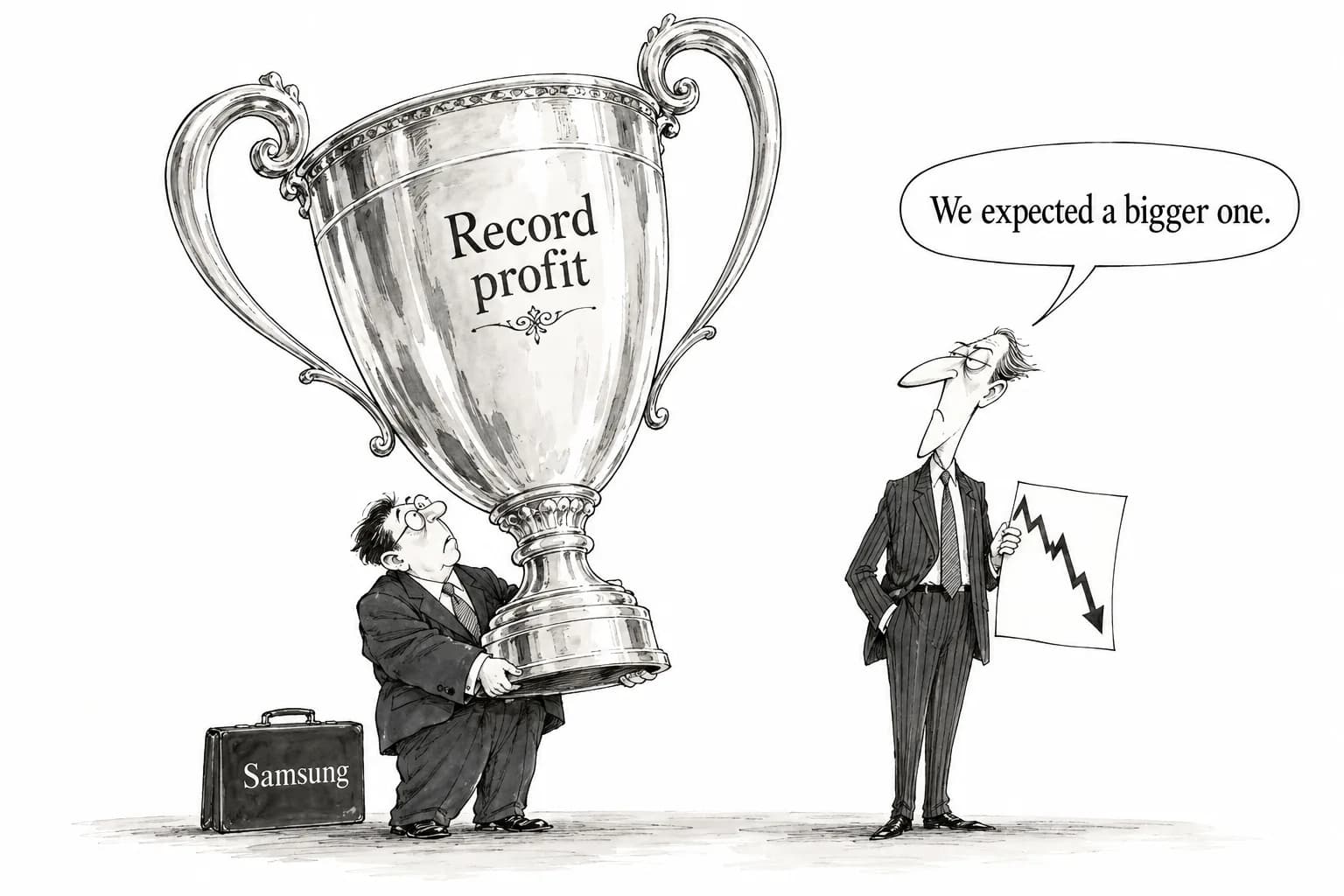
Quarterly profit passed 100 trillion won for the first time and still fell short of market expectations. Hopes for rising memory prices have grown so large that even record results cannot satisfy them
Seiichi Tanaka · Editor-in-Chief

Key points
- Samsung's preliminary operating profit for the July–September quarter exceeded 107 trillion won, passing 100 trillion won in a single quarter for the first time (company announcement, primary source)
- The figure reportedly also beat the highest profit Nvidia has ever posted, but Samsung's shares fell
- The result reportedly fell short of market expectations. Hopes for higher memory prices have run so far ahead that even a record profit did not lift the stock
Samsung Electronics released preliminary results for the July–September quarter on October 8. Operating profit exceeded 107 trillion won (Seoul Economic Daily). It was the first time the company's quarterly profit has passed 100 trillion won. The figure also reportedly beats the highest quarterly profit Nvidia has ever posted. In the AI era, the most profitable chip company has been GPU maker Nvidia, but for this one quarter, memory maker Samsung overtook it.
Even so, the stock fell. Investing.com reported that profit hit a record high but missed "lofty expectations," and CNBC also reported that shares declined after the announcement. Record results, in other words, were not enough to meet expectations.
Only operating profit was released
In its preliminary results, Samsung discloses only rough figures for revenue and operating profit. A breakdown by business, such as memory, smartphones and displays, will not come until final results at the end of the month. The company's numbers do not yet show how much HBM (high-bandwidth memory used in AI accelerators) earned, or how much rising prices for commodity DRAM and NAND contributed.
Still, it is hard to find any explanation other than memory for quarterly profit rising past 100 trillion won. Over the past year, AI data centers have bought HBM in large volumes alongside GPUs, and commodity DRAM prices have also risen as HBM absorbed production capacity. The 107 trillion won figure is those price increases showing up in Samsung's earnings.
What beating Nvidia means
The comparison with Nvidia shows where profits in AI infrastructure are accumulating. GPUs still do most of the computing, but GPUs cannot run without HBM. In practice only three companies can make HBM — SK hynix, Samsung and Micron — and as long as demand outstrips supply, memory makers can set the price. This quarter, that pricing power reached a scale comparable to Nvidia's profit.
It is worth noting that the two figures do not measure the same thing. Samsung's profit also includes smartphones, home appliances and other businesses, while Nvidia is almost entirely an AI computing business. The accurate reading is that, at the whole-company level, memory earnings have reached the level of the profit of AI's leading player.
Why the stock fell on record profit
The stock did not fall because profit was low. It fell because the market had expected more. Before the results, the share price had already priced in continued increases in memory prices. Profit above 100 trillion won had become a given, and anything short of beating that gave investors no reason to buy. Reports mention specific figures for what the market had expected, but this article limits itself to the headlines that could be confirmed. The simple fact that results "missed" expectations makes the dynamic clear.
Memory has always been a commodity with volatile prices, repeating a cycle in which sustained price increases prompt manufacturers to expand output until prices eventually collapse. What investors are watching is not this quarter's profit but how long the price increases will last. That a record profit did not lift the shares can also be read as a sign that the market has already started to worry about the end of the upswing.
How far have AI infrastructure expectations inflated?
These results show two things: AI spending is flowing heavily all the way to memory, and expectations for that flow have run ahead of the actual numbers. A growing share of AI capital spending is financed with debt, and long-term interest rates are high. In a market where expectations have run ahead, good numbers only come across as "in line," and anything even slightly short gets sold.
The breakdown by business will come with final results at the end of the month. How long the company expects HBM and commodity memory prices to keep rising will help determine whether this share-price drop is temporary or marks a ceiling on expectations. TSMC also released its September revenue on the same day, and together with TSMC's earnings on October 15, this will be a week that measures how wide the gap has grown between expectations and reality for AI chips.
Editorial cartoon