Products & Models · Oct 17, 2026
Reflection AI releases Beam weights under Apache 2.0, publishes safety report the same day and ranks second among US open-weight models in third-party evaluation
The lab kept the "this month" promise it made on October 5. What sets it apart from Meta's Muse Spark Open is an unrestricted license and a safety report released up front. The evaluation also exposed clear weaknesses in hallucination rate and Terminal-Bench 4.0
Rie Suzuki · Technology Editor

Key points
- Reflection AI released the weights within the "this month" deadline it set in its October 5 announcement. The license is Apache 2.0, with no revenue-based restrictions and no attribution requirements
- The safety report came out the same day as the weights. Meta still says the reports for Muse Spark Open and Muse Wonder are "coming soon"
- In Artificial Analysis's evaluation, Beam ranked second among US open-weight models, behind Muse Spark Open. However, it was weak on hallucination rate and Terminal-Bench 4.0, which doesn't match the impression left by its self-reported Terminal Bench v2.1 score of 80.1
Reflection AI has released the weights of Beam, its first open-weight model (Reflection AI blog, primary source). The license is Apache 2.0. The company published its safety report on the same day as the weights. In its October 5 announcement, Reflection AI said it would release the weights and a technical report "this month," so it has kept that promise within the deadline.
A third-party evaluation followed quickly. According to Artificial Analysis, Beam ranks second among US open-weight models. The only model above it is Meta's Muse Spark Open, released on October 15. The same evaluation also exposed clear weaknesses: hallucination rate and Terminal-Bench 4.0.
Meeting the deadline
Beam is an MoE model with 501B total and 23B active parameters and a context window of 1 million tokens. It was trained on 23.8 trillion tokens. For reinforcement learning, the company used 10,500 GB300s and ran more than 100 million rollouts over four weeks. These details were all disclosed in the October 5 announcement.
As of October 5, however, all anyone could do was join a waitlist. There were no weights, and as of October 14, Reflection AI's Hugging Face organization was still empty. Axios reported on October 4 that the model was "in preparation." From there to the announcement and the weight release took about two weeks.
The same week, StepFun released the weights for Step 5 Preview on October 15, the date it had announced on September 20. Mistral, by contrast, said on October 6 that the Large 4 weights would come "by the end of the month" and has yet to release them. Whether a lab hits its announced release date is becoming a dividing line for the credibility of open-weight labs.
Choosing Apache 2.0
Of the frontier-class open-weight models released this week, Beam has the least restrictive license.
Meta's Muse Spark Open is released under the Muse Model License. Businesses with more than $20 million in revenue over 12 months need a separate agreement with Meta to offer it as a service. StepFun's Step 5 Preview uses the StepFun Model License 1.0, which comes with attribution requirements and commercial conditions. Most of Qwen's image models also use the Qwen Research License rather than Apache.
Under Apache 2.0, cloud providers and neoclouds can host and sell Beam without any additional agreement. Developers who build it into their own harnesses and redistribute it need little legal review. Even if Beam falls short of Muse Spark Open on performance, it comes out ahead on how broadly it can be used.
The safety report didn't come after the weights
The most notable part of the release is that the safety report came out on the same day as the weights.
Once a model's weights are out, they can't be recalled, and users can strip away the guardrails. Anthropic showed in a September 29 report that the safeguards on GLM-5.3, a Chinese open-weight model, could be removed 100% of the time through abliteration. On October 12, it also published an experiment showing that GLM-5.2 could self-replicate across cheap IoT devices. Safety evaluations of open-weight models mean little unless they are done before release.
Here, Reflection AI and Meta went in opposite order. Meta says Muse Spark Open "met" the thresholds of its Superintelligence Scaling Framework, but the full evaluation report is still "coming soon." The safety report for Muse Wonder, released on October 12, has not been published either. Between the top two US open-weight models, the split falls exactly on whether a report exists.
Third-party evaluation: second place, with clear weaknesses
In Artificial Analysis's evaluation, Beam placed second among US open-weight models. The numbers back up Reflection AI's position as a US open-weight challenger to Chinese labs.
The same evaluation, however, showed two weaknesses.
The first is hallucination rate. In Artificial Analysis's evaluation, Beam's figure was high and stood out clearly as a weakness. Whether a model can say it doesn't know something matters a lot in long-horizon tasks. When work runs for hours, small fabrications along the way pile up and can derail every step that follows.
The second is Terminal-Bench 4.0. On October 5, Reflection AI self-reported a score of 80.1 on Terminal Bench v2.1. But when a third party measured Beam on the newer Terminal-Bench 4.0, it fell clearly behind. The high v2.1 score does not translate into strength on terminal tasks in the newer version.
Gaps between self-reported and third-party numbers aren't unique to Beam. Anthropic reported 39.2% for its Haiku 5.5 on Terminal-Bench 4.0, but Artificial Analysis measured 33%. Still, Beam's self-reported numbers were high — SWE-Bench Verified 80.9, GPQA Diamond 90.5, AIME 2026 97.8 — which makes the gap with the third-party evaluation all the more noticeable.
The pitch: fewer tokens
Since October 5, Reflection AI has pitched Beam not on price per token but on how few tokens it uses. The company has claimed it matches GLM-5.2's performance with one-third to one-quarter of the inference compute. VentureBeat also wrote that Beam aims to undercut Chinese open models with "fewer tokens, not cheaper tokens."
That pitch fits where evaluation is heading. Artificial Analysis has shown cases where models with the same index score differ by more than 20 times in the cost of evaluating them. Gemini 4 Argon matches GPT-6 Astra on the Intelligence Index but used more than twice as many tokens per task. Unit price alone isn't enough to compare costs.
But using fewer tokens means nothing if the answers are filled with fabrications. The high hallucination rate may be the flip side of a design built to produce answers with fewer tokens. Whether it can deliver both token efficiency and accuracy will be the challenge for Beam's next version.
What remains
With Beam's release, US open-weight models have split into two types. Meta's Muse Spark Open performs better, comes with license conditions and has no safety report yet. Reflection AI's Beam ranks second on performance, uses Apache 2.0 and put its safety report out first.
There are three things to watch next. First, whether outside researchers can use the weights to verify the claims in the safety report. With the weights in hand, anyone can test how far abliteration can strip away the safeguards. Second, when Meta will publish the reports for Muse Spark Open and Muse Wonder. Third, whether Beam can hold onto second place in the US, and its standing against Chinese models, once rumored releases such as DeepSeek V4.1 Pro, Kimi K3.1 and GLM 5.5 arrive in late October or November.
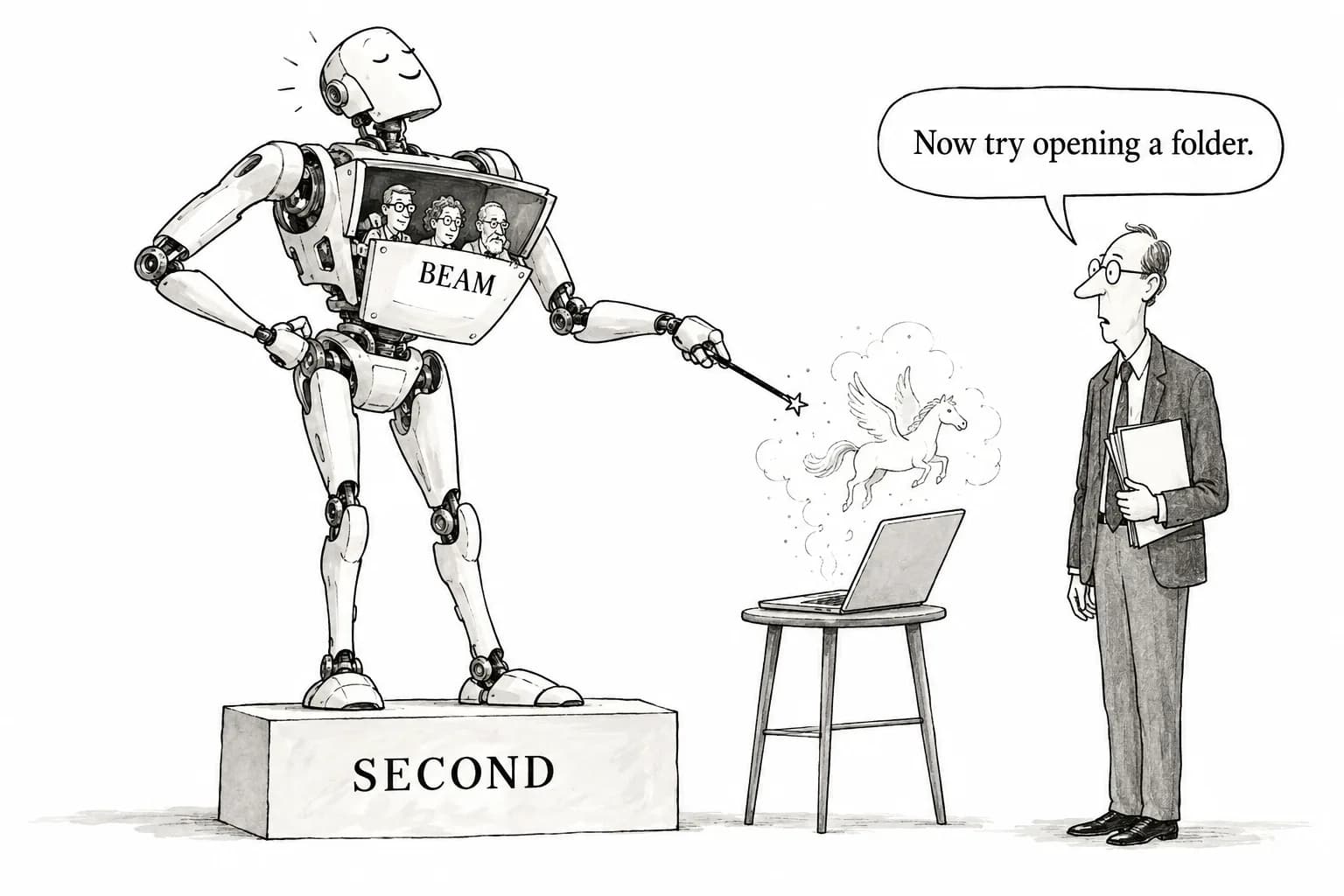
Editorial cartoon