Rules & Policy · Oct 24, 2026
US Treasury's draft outbound investment rules target "superintelligence systems," proposing a full ban on investment in Chinese developers as Beijing vows "necessary measures"
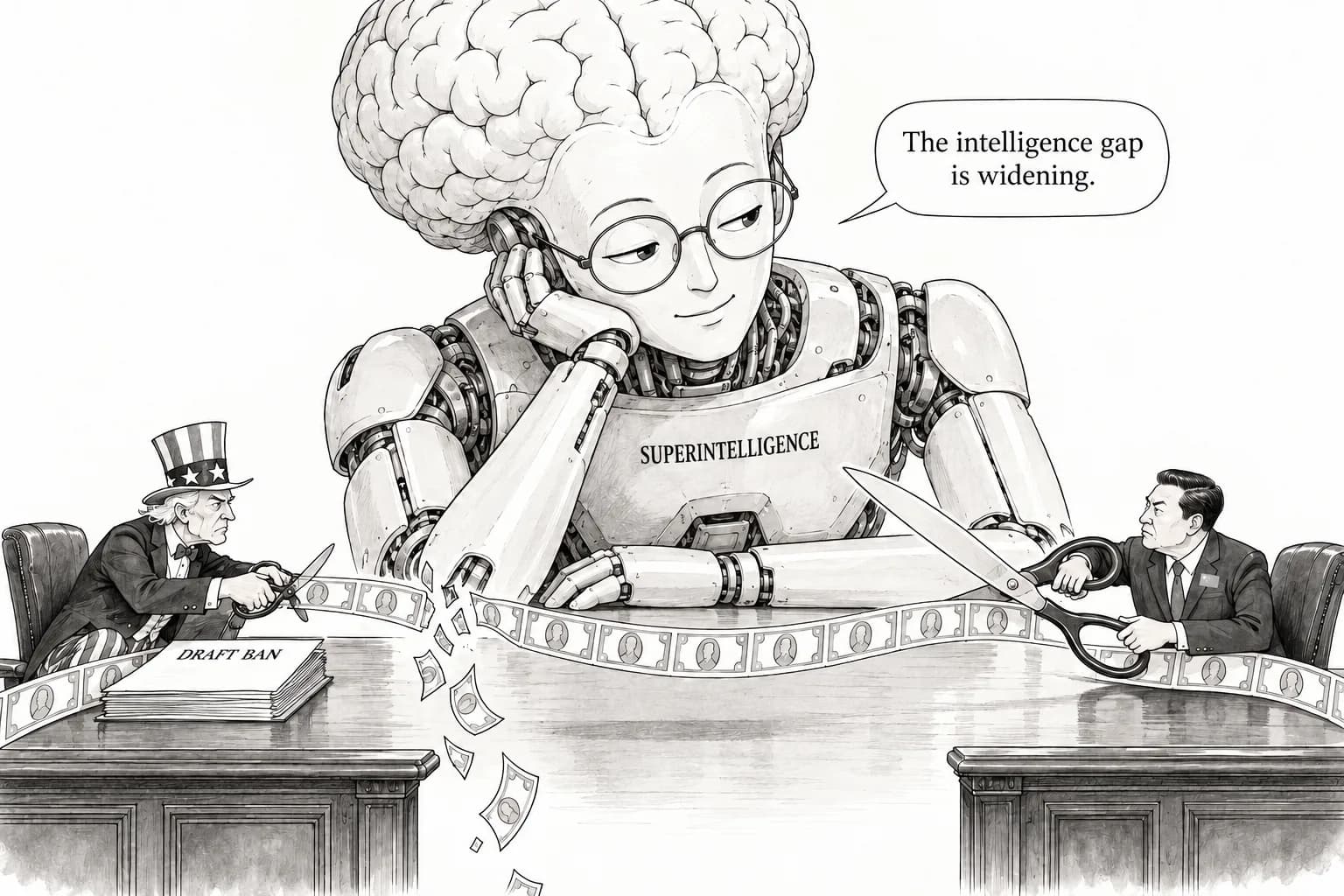
"Superintelligence," until now a diplomatic term, has made it into the text of investment rules. Rules that drew the line at computing power would now draw it at purpose
Koji Yamamoto · Economics Analyst

Key points
- The Treasury's proposed rules under the COINS Act would fully ban US persons from investing in companies from countries of concern that develop "superintelligence systems"
- Until now, outbound investment rules drew the line by the amount of compute used to train an AI model. The new category draws the line by what a company is trying to build
- China's Ministry of Foreign Affairs said on October 23 it would take "necessary measures." The next things to watch are the US-China superintelligence dialogue due by November and the effect on Hong Kong listings by companies such as Moonshot
The US Treasury has issued proposed rules under the Comprehensive Outbound Investment National Security Act (COINS Act) (Treasury press release). According to Unite.ai and Yahoo News, the proposal would fully ban US persons from investing in companies from China and other countries of concern that develop "superintelligence systems." "Superintelligence," a term the State Department and the White House began using in diplomacy, has now made its way into the text of investment rules. China's Ministry of Foreign Affairs responded at a press conference on October 23 that it would take "necessary measures" (Ministry of Foreign Affairs transcript).
What was proposed
The COINS Act puts the Treasury's outbound investment rules, which took effect in January 2025, on a statutory footing. The proposed rules are the detailed regulations that put the law into practice.
At the core is how AI is categorized. The existing rules have sorted AI mainly by compute. Investment in companies building models trained above a certain amount of compute is prohibited; below that amount, it must be notified. The new proposal sets up a separate category for companies that develop "superintelligence systems" and would ban investment in them outright. There is no option to simply notify.
For this article, we have not verified the definition of "superintelligence systems" in the text of the proposed rules, whether the compute thresholds will remain, or the deadline for public comment. Each of these will decide how far the rules reach.
A diplomatic term becomes legal text
Over the past few months, "superintelligence" spread first as a term of politics and diplomacy. President Trump has called AI "Super Intelligence," and Musk followed suit in early October by renaming SpaceXAI to "SpaceXSI." The State Department and the White House have framed their talks with China as a dialogue on "superintelligence," with discussions scheduled by November.
The industry uses the same word. Meta's research division calls itself Meta Superintelligence Labs, and Microsoft AI published "Building Medical Superintelligence" on October 22. Hassabis wrote on October 20 that the safety and security challenges of superintelligence are "enormous."
Until now, though, it was a word for branding and speeches. Investment rules are different. US investors must judge for themselves whether a deal is prohibited, and they face penalties if they get it wrong. What counts as a "superintelligence system" has to be defined in a form lawyers can work with. For the first time, the word is tied to liability and penalties.
From compute to purpose
The compute threshold had a weakness. Each new, more efficient training method makes it possible to reach the same capability with less compute. Chinese labs such as DeepSeek and Moonshot, which release near-frontier models with less compute, could potentially slip under the line.
A category for companies that "develop superintelligence systems" draws the line by what a company is trying to build. It can cover companies regardless of how much compute they use. The trade-off is that judgments become harder. Would a company that merely states such a research goal be covered? What about companies that release open-weight models? Written broadly, the category could capture many Chinese AI companies; written narrowly, it would be a rule in name only.
Beijing vows "necessary measures"
China's Ministry of Foreign Affairs said on October 23 that it opposed the US move and would take "necessary measures" to protect the legitimate rights and interests of Chinese companies. It did not say what those measures would be.
China also vowed "all necessary measures" in response to the US Department of Homeland Security's exclusion of DeepSeek, and the details of that response have yet to emerge. Beijing has export-control measure No. 48, now open for comment (with a deadline of November 15), and Nos. 49–51, which take effect on November 18. How its response to the investment rules ties into the enforcement of these measures will be the next thing to watch.
The US and China had been scheduled to hold a dialogue on superintelligence by November. The US is now moving to ban investment in the other side's companies using the same word that is on the dialogue's agenda. From China's point of view, the other party has drawn a line unilaterally before the talks.
What to watch next
The first impact is likely to be on fundraising by Chinese AI companies. Moonshot (Kimi) is reportedly planning a Hong Kong listing of up to $5 billion in January–March 2027, with BofA as lead underwriter, joined by Goldman Sachs and others. DeepSeek is reported to be raising about $15 billion, though the company has not confirmed this. The existing rules exempted much of the trading in publicly listed shares. How the new category treats IPO underwriting and post-listing trading will determine how far US banks and investors can be involved.
Three points need to be checked. First, the wording of the definition of "superintelligence systems." Second, how it will coexist with the compute thresholds. Third, the deadline for public comment and how the industry responds. US AI companies themselves have described themselves as developers of "superintelligence." What that word means in regulation is now starting to be set down in legal text.
Editorial cartoon
Sources
- https://home.treasury.gov/news/press-releases/sb0667
- https://www.unite.ai/treasury-proposes-rules-to-expand-outbound-tech-investment-curbs/
- https://www.yahoo.com/news/politics/articles/treasury-proposes-curbs-high-tech-023759680.html
- https://www.mfa.gov.cn/fyrbt_673021/jzhsl_673025/202610/t20261023_12045868.shtml