Infrastructure & Security · Oct 28, 2026
Oracle to offer Google's TPUs as it widens its chip suppliers
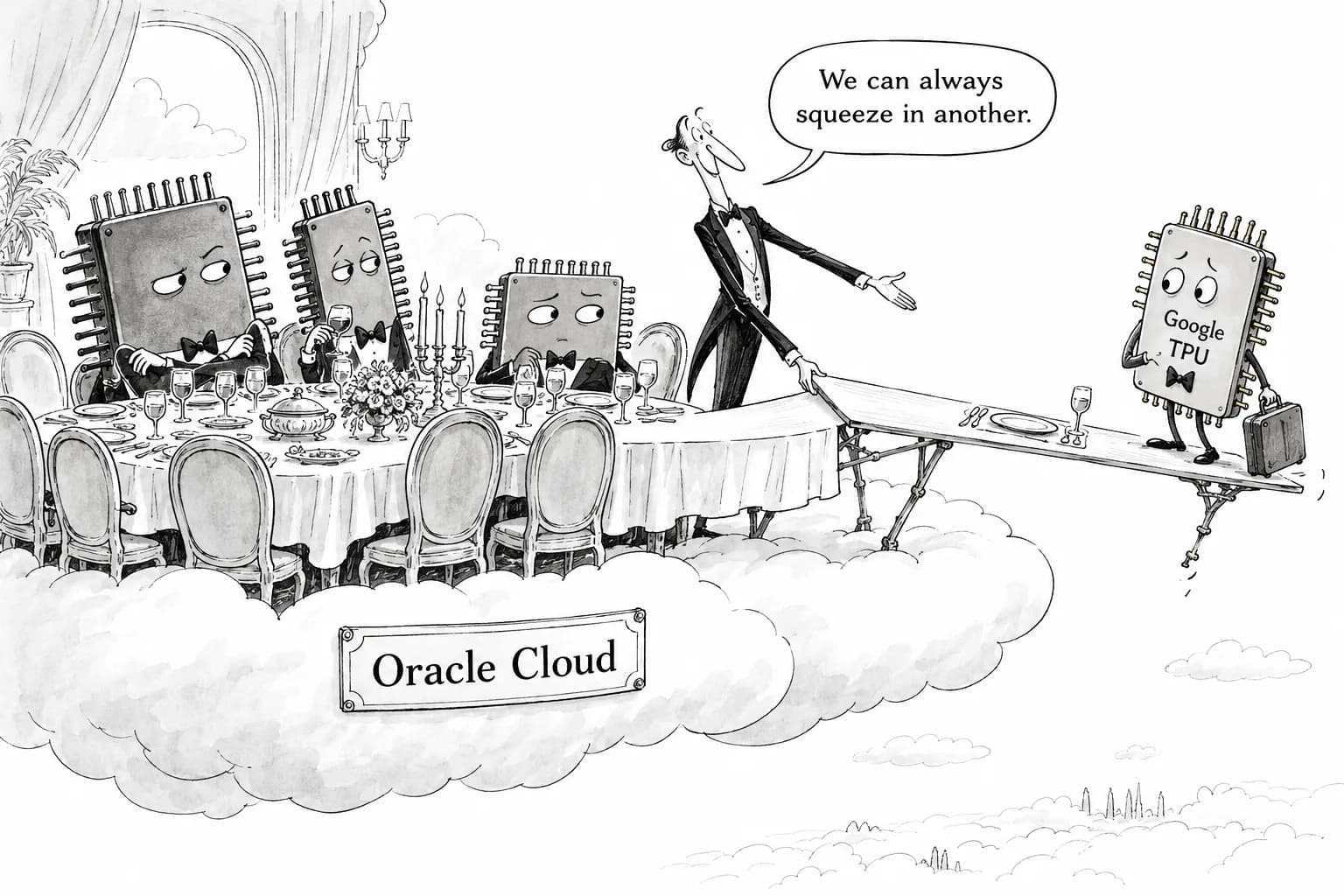
Oracle will reportedly offer TPUs starting in 2027, which would make it the first major cloud other than Google to do so. It will also offer NVIDIA, Cerebras and SambaNova chips and reportedly replace some networking components with its own products. AI computing infrastructure is moving away from relying on NVIDIA alone
Seiichi Tanaka · Editor-in-Chief
Key points
- Oracle will reportedly offer Google's TPUs starting in 2027, which would make it the first major cloud other than Google to do so
- Oracle is reportedly expanding its NVIDIA deal and adding Cerebras and SambaNova chips. It will also reportedly replace some networking components with its own products
- Microsoft's Maia 300 also enters volume production in 2027, so moves away from relying on NVIDIA alone for AI computing are converging on the same year
Oracle will offer Google's TPUs on its own cloud starting in 2027, according to reports (reported Oct. 27). If it goes ahead, Oracle would be the first major cloud other than Google to offer TPUs. Oracle is also reportedly expanding its supply deal with NVIDIA and adding chips from Cerebras and SambaNova. It will also reportedly replace some of its networking components with its own products.
All of this is based on reports so far. Oracle, Google and NVIDIA have not confirmed any announcement. Our editors have not been able to read the full original article either. This article does not cover the value of the deals, which TPU generation is involved or how much capacity will be offered. Oracle will hold its Investor Day on Oct. 28. The company announced the event itself, so that part comes from a primary source.
What was reported: four chip suppliers and in-house networking
According to the reports, the plan has four main parts.
The first is NVIDIA, where Oracle will expand its existing deal. NVIDIA is not being dropped.
The second is Google's TPUs, starting in 2027.
The third is Cerebras and the fourth is SambaNova. Both companies design their own AI accelerators and have pitched them on inference speed.
Oracle will also reportedly replace some networking components with its own products. The reports don't say which components will be replaced or which suppliers' parts they replace. Still, the links between chips matter as much as the accelerators themselves for a data center's cost and performance. If Oracle is bringing that part in-house too, it is trying to rely less on any single supplier across much of its computing bill of materials.
Why being "the first cloud other than Google" matters
For a long time, TPUs were chips Google built for its own models and for Google Cloud customers. Anyone outside Google who wanted to use them had to sign up with Google Cloud. If the reports are accurate, a rival cloud will now sell access to TPUs. For Google, this would turn the TPU from something that sets its own cloud apart into the start of a business selling chips to others.
For Oracle, the benefit is a proven, large-scale option that can sit alongside NVIDIA's GPUs. Cerebras and SambaNova are strong at inference, but they are still small in how many chips they can make and deploy. This would be the first time Oracle offers a non-NVIDIA option that can run at large scale.
In 2027, several companies are moving away from NVIDIA
Oracle is not the only company moving away from relying on NVIDIA alone. On Oct. 12, Microsoft announced that it will begin volume production of Azure Maia 300, its own inference chip, in 2027. Microsoft claims the chip delivers 40% more tokens per megawatt than leading GPU systems, and it plans to deploy the chip at gigawatt scale. Microsoft says Maia 300 will be the main computing platform for Copilot and its own models.
Microsoft chose to design its own chips. If the reports are accurate, Oracle has chosen to offer several other companies' designs side by side. The two approaches differ, but the goal is the same: to avoid being tied to NVIDIA's supply and pricing. Both companies' plans also land in 2027.
That does not mean NVIDIA's position will fall apart soon. Oracle is reportedly expanding its NVIDIA deal, and Microsoft will keep using GPUs. Neither company is replacing NVIDIA. They are adding suppliers. Even so, this will change how much bargaining power buyers have on price and how work is split among different chips.
What we don't know yet
First, whether Oracle itself will confirm the reports. The first test is whether Oracle talks about TPUs, Cerebras and SambaNova, or its in-house networking products, at its Oct. 28 Investor Day.
Second, the scale and terms. Which TPU generation will Oracle start with, and how much capacity will it offer? Will Google sell the chips to Oracle, or rent them out along with Google's own operations? None of this is known from the reports so far.
Third, whether other clouds will follow. Alphabet and Microsoft (Oct. 28) and Amazon (Oct. 29) all report earnings the same week. What each company says about its chip suppliers and capital spending will show how far the move away from relying on NVIDIA alone has spread.
Editorial cartoon