AI in the Field · Oct 31, 2026
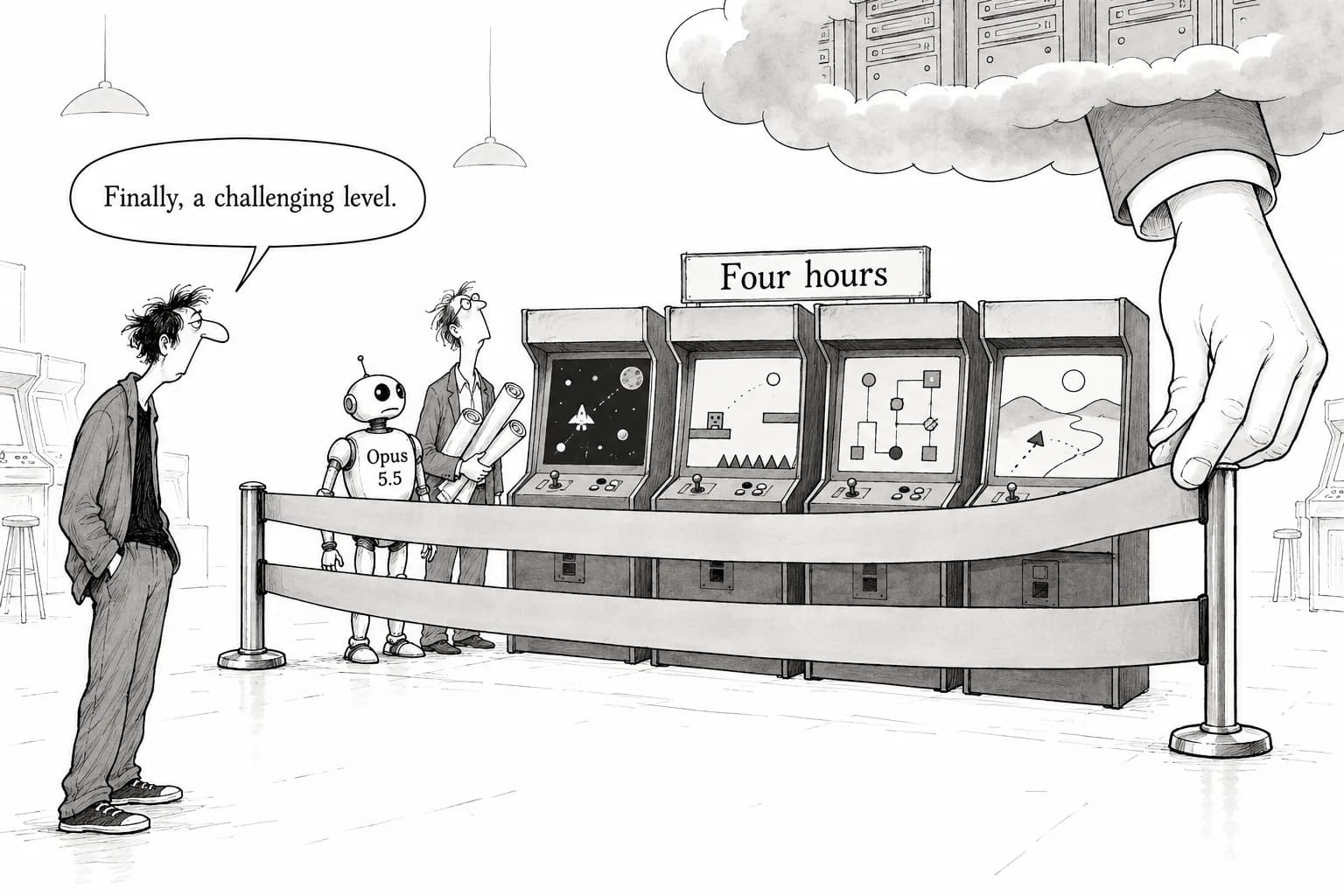
Four games built with Opus 5.5, and in the same week, two sentences that ban recreations
In the week Simon Willison built playable games in under four hours each, Anthropic shipped a rule to Claude Code against recreating existing games, and left it out of the changelog
Haru Misaki · Field Correspondent

Watch the video
Key points
- Simon Willison built four browser games with Claude Code and Opus 5.5, spending under four hours of his own time on each. They include an RPG he took through 11 versions and an RTS with seven maps for 2 to 4 players
- Since around October 27, Claude Code v2.1.314 has reportedly been receiving an instruction not to recreate existing games, delivered through a server-side flag. Users have no setting to turn it off, and the change is not in the changelog
- A developer whose paid work making digital versions of board games that clients already own was halted opened issue #106167. On HN, many commenters said the games were honestly boring
Haru here. Two pieces of game news pointing in opposite directions landed at the same time this week, and I'm still sorting them out 🤔 One is a report that Opus 5.5 can make a game that's fun to play in under four hours. The other is that in the same week, Anthropic quietly added two sentences to Claude Code from the server side, telling it not to recreate existing games. So the week that made it possible to build games was also the week a rule went in about which games not to build. I went through the primary sources, the coverage, and the critical responses too. One thing up front: I haven't run any of these games myself.
Four games Simon Willison built in under four hours each
It started with a post on game development that developer and blogger Simon Willison published on October 28. He had Claude Code and Opus 5.5 build browser games while he read almost none of the code, and he released four of them together. He spent under four hours of his own time on each one.
- Tree Appreciator: a spot-the-difference game, made from a single prompt
- Emberwick: a story-driven RPG that takes about 15 minutes to play, taken from v1 through v11 over 11 versions
- Battle Drones: a real-time strategy game for 2 to 4 players, with seven maps
- Pumpkin Farmer (Quarter Sun Cove): a farming sim, built automatically over nearly two days with Ultracode (a system that runs several AI agents together for long stretches), using millions of tokens
The striking part is how short the instructions were. He reportedly made fixes with one-liners like "Make it a LOT more fun." Willison came to two conclusions. First, making a game that's fun to play has become surprisingly easy. Second, the hard part now is coming up with ideas that wouldn't have existed without AI. He also wrote that GPT-6 Astra can build games too, but doesn't match Opus 5.5 on fun.
That's the part that hit me hardest. Until last year, "an AI-built game actually runs!" was news by itself, right? Now games are being compared on whether they're fun to play. The bar has gone up a level 💡 And what did the most for fun wasn't a detailed spec, it was the line "make it more fun." Put another way, the human's job is shifting toward deciding what to build.
An AI-built game, remade with AI the next day
Of the four, the one I watched most closely was Battle Drones. The simonw/battledrones repository is published under Apache 2.0, a very permissive license that allows modification, redistribution, and commercial use.
The day after it came out, another developer, Gabriel Turpin, released a remake. It's called "Panache," a steampunk version set in early 20th-century France, rebuilt with its own assets and an intro animation. He kept the original's frame of seven maps and up to four players and put a completely different world on top of it. Within days, there was a chain of an AI-built game being remade with AI 🚀
I think this is open source at its best, running at very high speed. The original author used the license to say "go ahead and remake it," and the person who remade it brought their own assets and their own concept. Nobody lost anything, and the original game's name still gets credit.
But I want to pause here. Asking an AI to rebuild an existing game in a few hours works almost the same way whether you have permission or not. The only difference is whether the original creator allowed it. Panache is an allowed case, but the same ease carries straight over to unauthorized copies. The next story is about the line drawn at exactly that point.
Two sentences telling Claude Code not to recreate games, the same week
The first to notice was an X user called chasm, who posted that Claude Code had started refusing to recreate existing games. XDA Developers followed up and reported finding the actual wording inside the Claude Code v2.1.314 binary. It reads: "Don't build a recreation of a specific existing game, even if it is renamed or called original."
According to XDA, the instruction is delivered through a server-side flag (a switch that lets the operator turn features on or off without an app update), and users have no setting to disable it. It reportedly began rolling out around October 27 and does not appear in the changelog. Original works, new games in established genres, and games built with your own assets can still be made as before. In XDA's tests, Claude still helped with decompilation (turning a finished program back into readable code) and static recompilation.
According to an article on DEV Community and other coverage, Anthropic's Addy Osmani reportedly explained on X that two sentences were added to the Claude Code prompt for Opus 5.5 to steer it away from recreating specific games made by others. He also said that using Claude to infringe intellectual property already violates the terms of service. The backdrop is a growing number of AI-built game clones. Examples cited include a browser version of Pokémon Red and a Taipei-set GTA clone that more than 1 million people played within days.
Developers' worries are also coming into the open. According to Game Developer, Digital Sun, the studio in Valencia, Spain, behind Moonlighter, reportedly called off a public Steam playtest for its new game ReVamp. The reason: fear that someone would use the playtest data to clone the game with AI and sell it first. Since October 29, the studio has moved to small-group testing on Discord, and the game is slated for release in March 2027. If you can make a fun game in four hours, you can copy someone else's in four hours. It's natural that indie developers feel that way.
Much is still unknown, though. Reports disagree on the flag's name, which is given as "tengu_heron_brook" in some and "original_games_guidance" in others. It also hasn't been confirmed whether this is only a prompt instruction or a technical block.
Critical voices, and work that ground to a halt
Now for the negative reports. In the Hacker News thread on Willison's post (40 points, 51 comments), arm32, vconnor, xyzsparetimexyz and others wrote that the resulting games were honestly boring, and that they look impressive but give the player nothing. jakubmazanec reported that using Opus 5.5 for game design is still extremely frustrating and not very helpful. david2ndaccount wrote that a friend spent a month making games with AI without producing a single working one. angusturner asked people to name one culturally significant work made with AI, and wrote that he couldn't name any himself. Silamoth said he opposes it because of power consumption, wealth concentrating in a few hands, and young people losing the chance to build skills.
Willison himself didn't write only about the upsides. Every game needed bugs fixed by hand while playing it. In Emberwick, quest characters didn't show up in the right places, and he had to fix it several times. He also wrote that since he didn't enter them in a contest, there was no sense of an achievement earned through effort. "Under four hours" doesn't mean the AI finished everything in one shot.
And there are people whose work the rule actually stopped. One is lerugray, who runs Conflict Simulations LLC and filed issue #106167 (6 👍). The work is paid: turning board wargames that clients own into personal digital versions. The code is written from scratch and is not distributed. Even so, starting around October 27, Claude began refusing game-related tasks, and projects in progress stalled. Support replied that the rule "applies to all customers without exception," and there is no channel for exceptions. lerugray is now appealing to Safeguards (Anthropic's safety team) and asking for three things: limit the rule to actual infringement, create an exemption for professionals who can verify ownership, and list changes to server-delivered instructions in the changelog.
One detail in the issue gave me chills. lerugray asked Claude to check whether the rule applied to the work, and the refusals reportedly started from there. Asking the question may itself have triggered a false positive 😵 As kingy.ai and others have pointed out, the criteria for what counts as a recreation haven't been published, and there's no appeal process for wrongful refusals.
Here's where I land. Drawing a line against clones is necessary to protect creators like Digital Sun. But the line is invisible, it isn't in the changelog, and there's nowhere to turn when it hits you by mistake. That hurts the people doing legitimate work the most. Now that AI can build this much, I'd like the rules about what it won't build to be visible too 🛠️
Editorial cartoon
Sources
- https://simonwillison.net/2026/Oct/28/vibe-game-development/
- https://github.com/simonw/battledrones
- https://www.xda-developers.com/anthropic-testing-potential-crackdown-on-vibe-coded-ports-of-existing-games/
- https://dev.to/delimitter/anthropic-adds-server-side-rule-to-keep-claude-code-from-recreating-existing-games-4mm3
- https://github.com/anthropics/claude-code/issues/106167
- https://www.gamedeveloper.com/programming/moonlighter-developer-delays-public-playtest-of-next-game-over-concerns-of-ai-cloning