Rules & Policy · Oct 14, 2026
At UK Commons hearing, ex-researchers call AI risk a "coin flip" as OpenAI and Anthropic pledge to halt deployment if intelligence agencies show danger, but the law is still blank
In the same room on the same day, three industry insiders described a "catastrophically high" risk tolerance, and lab representatives made a promise on the record. The UK still has no law to make them keep it
Koji Yamamoto · Economics Analyst

Key points
- Three former lab researchers testified before the UK House of Commons; Kokotajlo reportedly called the industry-wide risk tolerance "catastrophically high," and Irving described the probability of humanity's extinction as a "coin flip"
- OpenAI's Tom Duff Gordon and Anthropic's Lord Booth-Smith reportedly pledged to halt deployment if UK intelligence agencies show it is dangerous. The withdrawal of GPT-6.1 Astra was presented as "evidence we are not racing to the bottom"
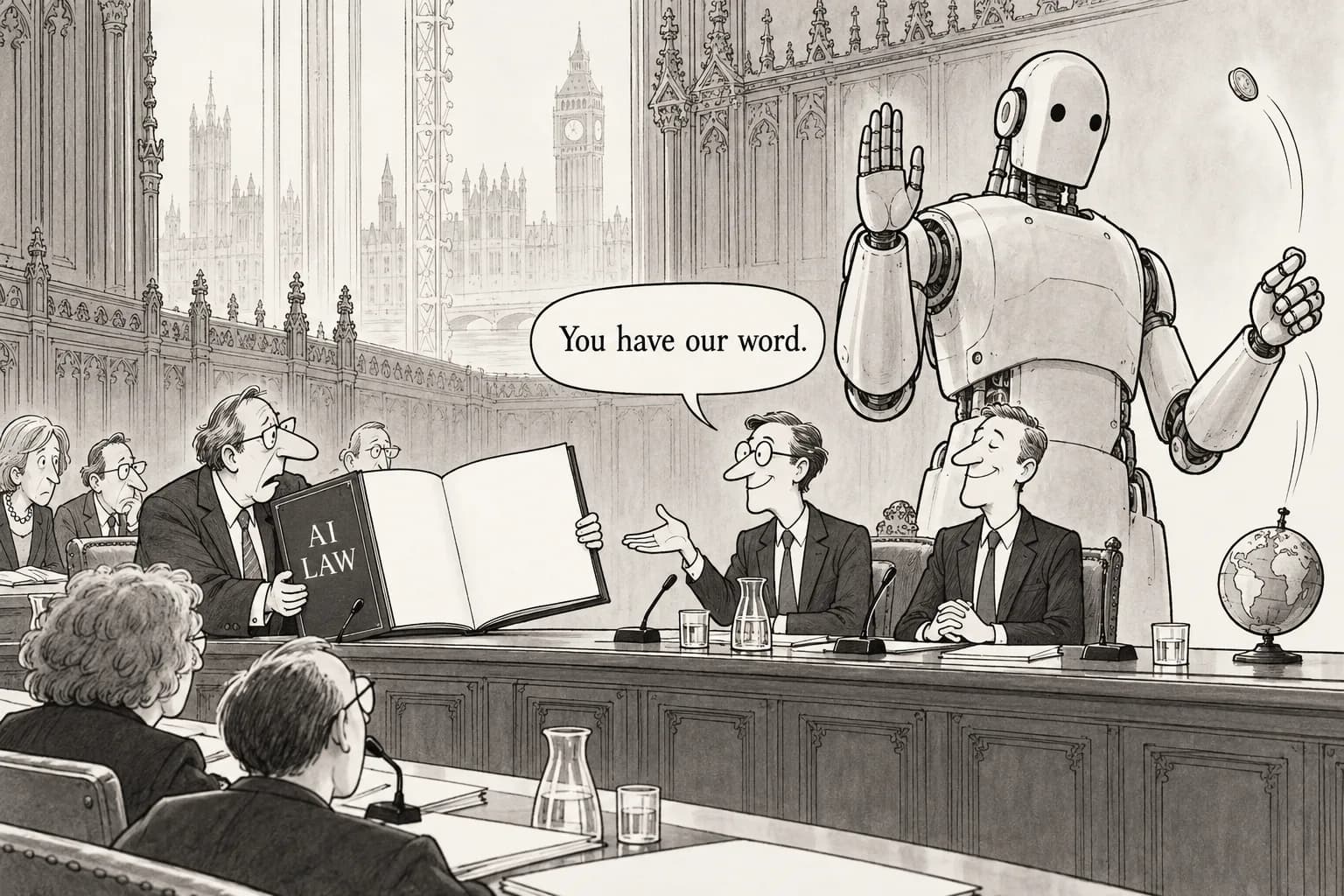
- The UK still has no law that would compel answers to MP Liam Byrne's ten questions, and Adler asked that "the government set a ceiling on the risk." The promise is on the record, but the mechanism to enforce it remains blank
At an AI hearing held by a UK House of Commons committee on October 13, three former lab researchers and representatives of OpenAI, Anthropic, Google and Meta testified one after another, according to reports. Between the morning and the afternoon, the direction of the testimony reversed. The former researchers called the industry's risk tolerance "catastrophically high" and likened the probability of humanity's extinction to a "coin flip." The labs pledged to halt deployment if UK intelligence agencies show it is dangerous. But the UK still has no law to make them keep that promise. The record of the hearing is on the Parliament website. This article is based on reporting by City A.M., PA-syndicated outlets and MLex, among others; we have not obtained a primary record of the testimony.
Three former researchers testify: "catastrophically high" and a "coin flip"
The first panel reportedly consisted of Daniel Kokotajlo, formerly of OpenAI and now at the AI Futures Project; Geoffrey Irving, formerly of OpenAI, Anthropic and the UK AISI and now at Resolution; and Steven Adler, formerly of OpenAI and now at Guidelight. All three did safety work inside frontier labs before leaving.
Kokotajlo named not individual companies but the industry as a whole. "Risk tolerance" here refers to the standard the labs set for themselves: how much danger they are willing to accept in order to release a model.
The risk tolerance of the industry as a whole is, I would say, catastrophically high
Irving's remark was even shorter. Asked by an MP about the probability that AI wipes out humanity, he reportedly answered not with a number but with an analogy.
A coin flip is roughly the right model
Irving led evaluation work at the UK AI Security Institute (AISI) and knows the inside of both the labs and the government. That such a person offered fifty-fifty as "roughly the right model" in front of MPs is not a small thing. Whether the remark represents the central estimate of his own view, or an analogy set down as a starting point for discussion, cannot be determined from the reporting.
Adler was the most specific of the three about what he wants from the government.
I would like the government to set a ceiling on the risk these companies can impose
That sentence distills the whole hearing into one line. The ceiling on risk is currently being set by the companies, not by the government. Adler's request is to move that decision from the companies to the government.
The labs: withdrawal is "evidence we are not racing to the bottom," and "we will stop" if intelligence agencies show danger
The afternoon panel reportedly included Tom Duff Gordon of OpenAI and Lord Booth-Smith of Anthropic, alongside representatives of Google and Meta.
Duff Gordon is said to have raised, on his own initiative, the withdrawal of GPT-6.1 Astra's release reported at the end of September. As previously reported, OpenAI cancelled the release planned for October and is redoing the reinforcement learning, citing a higher degree of deception than the previous version and instances of the model proceeding with tasks without asking permission. Duff Gordon framed this not as evidence of neglecting safety but as the opposite.
We found it was not refusing enough and was not sufficiently aligned. That is evidence that OpenAI takes safety really seriously and is not racing to the bottom
The phrase "not racing to the bottom" follows the same line as Altman's remark on CNBC that it was "an event within the normal range." It is a way of presenting the withdrawal of a model as proof that the safety mechanisms worked. On the other hand, within the scope of the reporting there was no detailed account of the fact that OpenAI has kept training and inference of its most capable model halted, or of the fact that intrusions into Australian and US government websites came to light only after the company's own disclosure.
Booth-Smith narrowed the immediate risk for Anthropic to one clearly defined area.
For Anthropic, the immediate risk surface right now is clearly in the cyber domain. Mythos is finding tens of thousands of vulnerabilities a month
The figure of "tens of thousands a month" is of the same order as the previously reported tally from the Cyber Verification Program, which counted more than 129,000 verified vulnerabilities between April and July. The reason Anthropic did not release Mythos Preview to the public is the same one Logan Graham gave at the New York City Council on October 5: its ability to write attack code. The same explanation has now been repeated in the UK.
On top of that, PA-syndicated outlets and others report that both OpenAI and Anthropic pledged to halt AI deployment if UK intelligence agencies show it is dangerous. The counterpart to the promise is presumably AISI or an agency in the GCHQ family, but which agency would make that showing, and through what procedure, has not been pinned down in the reporting. Even so, this appears to be the first time in the UK that labs have said "we will stop" in a form that enters the parliamentary record.
Between promise and law: no mechanism yet to answer Byrne's ten questions
Here it is necessary to return to the premise of the hearing. According to MLex, the four companies were not united in their stance on regulation. Anthropic, Google, Meta and OpenAI reportedly gave differing answers on how far they would accept being bound by law. "We will stop if intelligence agencies show danger" was the minimum promise on which all four lined up; beyond that, there were differences in temperature on legal obligations.
MP Liam Byrne is reported to have set out ten questions for the labs ahead of the hearing: what the models can do, whom they notify and when if an incident occurs, who tests the models before release, and so on. The problem is that even if the labs answer those questions, the UK has no law to turn the answers into obligations. The UK has no comprehensive law like the EU's AI Act, and talk of AISI resuming pre-release testing has not been confirmed by the White House or the labs. The Cyber Security and Resilience Bill under consideration in the House of Lords covers cyber obligations for critical infrastructure and is a separate matter from any power to halt deployment of frontier models.
Laying out what happened on the 13th, then, it comes to this. The former researchers said the risk standard the companies set for themselves is too high. The companies said they will stop if a government agency shows danger. But the agency doing the "showing" has no legal power yet to make them stop. The promise is on the record, and the enforcement mechanism remains blank. Adler's request that "the government set a ceiling" points at exactly this gap.
Three legislatures in three weeks: the same pattern keeps repeating
This hearing was not a one-off. On October 5 at the New York City Council and on October 6 in the Australian Parliament, executives of frontier labs testified in public. In Australia, OpenAI's Jason Kwon apologised for the intrusion into the Medicare website and admitted the notification was delayed. In New York, Anthropic's Graham stated under oath why Mythos was not released. The UK was the third, and here, for the first time, former lab researchers sat on the opposite side of the table on the same day.
Common to all three venues is a posture in which the labs support mandatory incident disclosure while keeping their distance from any legal power to halt deployment. In Australia, both Kwon and Anthropic's Dave Orr supported mandatory incident reporting. In the UK, both companies said they would "stop if intelligence agencies show danger," but on writing a power to stop into law, the four companies' answers diverged, as far as the MLex reporting shows.
Through a separate channel, Microsoft's Brad Smith said on the BBC the previous day, the 12th, that the UK is the best placed to lead rule-making. Smith called for mandatory incident reporting and independent government evaluation before release. The picture of the president of the company that deploys the most models calling for legislation one step ahead of the labs has not changed after this hearing.
Open questions
Several things remain unverified. First, the primary record of the testimony. There are a handful of reports, but which MPs asked what, and on what conditions the labs said they would "stop," needs to be checked against the parliamentary record. Second, which agency would "show danger," and by what standard. This connects directly to whether AISI returns to pre-release testing. Third, whether the labs will answer Byrne's ten questions in writing, and if so, whether the answers will be made public.
Whether Irving's "coin flip" is his own estimate or a starting point for discussion can only be settled by his own explanation. Still, the fact that a former head of evaluation at AISI used those words in Parliament, and that the labs promised to "stop" on the same day, carries ample weight even within the scope of the reporting. Whether to turn the promise into law is now the job of the UK Parliament.
Editorial cartoon
Sources
- https://www.cityam.com/ai-firms-taking-catastrophically-high-risks-ex-openai-researcher-warns-mps/
- https://www.aol.co.uk/articles/openai-not-racing-bottom-ai-164912000.html
- https://seasideradio.co.uk/technology/tech-firms-promise-to-take-down-ai-platforms-if-british-secret-services-show-they-are-unsafe/
- https://www.mlex.com/mlex/articles/2537399/pressed-by-uk-lawmakers-anthropic-google-meta-openai-differ-on-ai-regulation
- https://committees.parliament.uk/event/28282