Money · Oct 9, 2026
OpenAI revenue reportedly $20 billion below expectations; Oracle, CoreWeave and chip stocks slide
A single FT report triggered a broad sell-off in stocks that have used debt to build up computing capacity. The base under AI capital spending leans heavily on one company's revenue figure
Koji Yamamoto · Economics Analyst
Key points
- According to the FT, OpenAI's annualized revenue is about $20 billion below the level previously presented to investors. OpenAI has not published the figure itself, and the number is based on media reports
- On October 8, CoreWeave (down about 7%), Nebius (down about 6%) and Oracle (down about 5%), which rely on contracts with OpenAI and have expanded computing capacity with borrowed money, were reportedly sold off. Chip stocks also fell
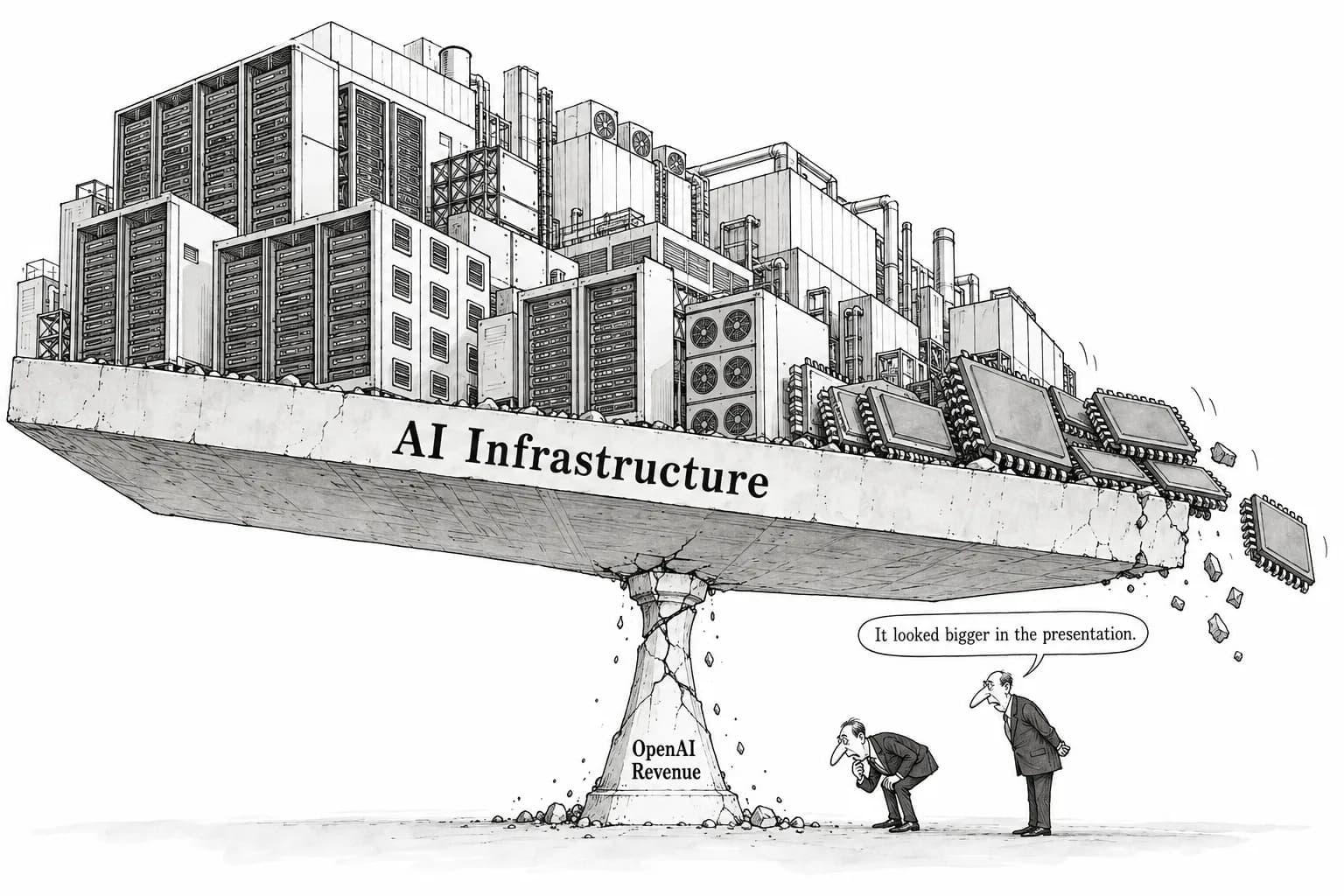
- Compute contracts, data center borrowing and chip orders all assume that OpenAI's revenue will keep growing. A single report shook the figure behind that assumption and showed how fragile the chain is
OpenAI's annualized revenue is about $20 billion lower than the figure that has been widely reported and presented to investors, the Financial Times (FT) reported, according to TechCrunch and MarketScreener on October 8. OpenAI is privately held and does not officially disclose its revenue. This figure also comes from media reports, not a primary source.
The market still reacted quickly. In U.S. trading on October 8, stocks of companies that have used debt to expand capacity on the expectation of OpenAI's computing demand were sold off together. According to 24/7 Wall St., CoreWeave fell about 7%, Nebius about 6% and Oracle about 5%. Chip stocks were also reportedly sold. One report about a single company's revenue was enough to send the stocks that support AI capital spending lower together.
What was reported: a gap of about $20 billion
According to the reports, the FT's focus is the gap between OpenAI's current annualized revenue and the level previously presented to investors. MarketScreener described the gap in its headline as "$20 billion below earlier investor signals." TechCrunch wrote that it is "$20 billion less than previously projected."
Two points call for caution. First, the "original figure" being used for comparison was never officially released by OpenAI either; it circulated through media reports and investor materials. Second, it has not been confirmed whether OpenAI has confirmed or denied the report. Reported valuations and contract values have differed sharply from actual disclosures before. The $20 billion gap cannot be treated as a settled figure until OpenAI releases primary information.
The market likely moved anyway because the direction of the number mattered more than its precision. OpenAI's revenue has served as a proxy for demand across AI infrastructure as a whole, and that proxy has reportedly come in below expectations.
Why Oracle and CoreWeave were sold first
CoreWeave, Nebius and Oracle, the hardest-hit stocks, have something in common. Each has built up data centers and GPUs with borrowed money, backed by long-term compute contracts with large customers. 24/7 Wall St. groups these companies together as "financed AI buildout" names.
In this model, the customer's ability to pay is what the collateral really consists of. OpenAI is among the largest customers of both Oracle and CoreWeave and has been seen as a large share of their order backlogs. If OpenAI's revenue is smaller than expected, it raises the question of whether it can pay for compute contracts that run for years. That would directly affect the outlook for repaying the debt taken on against those contracts.
According to 24/7 Wall St.'s headline, the selling did not spread to cloud software stocks. That suggests the market was not turning against AI in general, but against the model of owning capacity financed with debt and betting on the growth of particular customers.
Why chip stocks fell too
The decline in chip stocks is further down the same chain. The money compute providers use to buy GPUs comes from borrowing and from prepayments and long-term contracts with customers such as OpenAI. If the revenue at the source wavers, so does the outlook for chip orders.
Other data make this assumption look even more fragile. Epoch AI estimated on October 6 that the combined AI revenue of the six largest Chinese AI companies is only about one-tenth of the combined total for OpenAI and Anthropic. That means a large share of global AI revenue is concentrated in a very small number of U.S. labs. A small move in the revenue figure of the top company can sharply shake the capital spending calculations built on top of it.
OpenAI's push to make money, and the weight of its costs
OpenAI has been trying to add more sources of revenue. On October 5, it announced it would expand advertising in ChatGPT, saying it would test ads shown during image generation in the U.S. in October. At DevDay, it launched Pro 500 at $500 a month, and on October 7–8 it extended the GPT-6 family to all plans, including the free plan. It says it has more than 1.2 billion weekly users.
Costs are heavy as well. According to OpenAI's own report, cited by Epoch AI, the company's internal inference costs in mid-August reached a median of $601 per researcher per day. On pricing, the race to cut unit prices continues: after price cuts to GPT-6 Sol and Luna, Anthropic's Claude Haiku 5.5 reportedly matched Luna's price. A scenario in which user numbers grow but revenue per user rises less than expected is consistent with these trends.
The real question: where the demand figures come from
The price moves showed that the base of the AI capital spending chain is surprisingly thin. Data center borrowing, GPU orders and power contracts all assume that frontier labs' revenue will keep growing. The figures behind that assumption were not official disclosures from a private company, but numbers that circulated through media reports and investor materials.
What to check next is clear: whether OpenAI discloses its actual revenue; whether Oracle and CoreWeave say more about their OpenAI-related backlogs and the terms of their borrowing; and whether TSMC and ASML, which report earnings in mid-October, change their outlook for AI demand. For Anthropic, which is preparing to go public, the question of how far AI companies' revenue figures can be trusted is also a direct concern.
Editorial cartoon
Sources
- https://techcrunch.com/2026/10/08/openais-revenue-is-reportedly-20-billion-less-than-previously-projected/
- https://finance.yahoo.com/technology/ai/articles/openai-revenue-20b-below-previous-181839907.html
- https://www.marketscreener.com/news/openai-annualized-revenue-20-billion-below-earlier-investor-signals-ce785ddfda81ff22
- https://finance.yahoo.com/markets/live/stock-market-today-thursday-october-8-dow-sp-500-nasdaq-080537884.html
- https://247wallst.com/investing/2026/10/08/coreweave-sinks-7-as-financed-ai-buildout-names-sell-off-apart-from-cloud-software-nebius-drops-6-oracle-falls-5/