Work & Society · Nov 3, 2026
OpenAI to cut up to 1GW of data center power when the grid is under strain
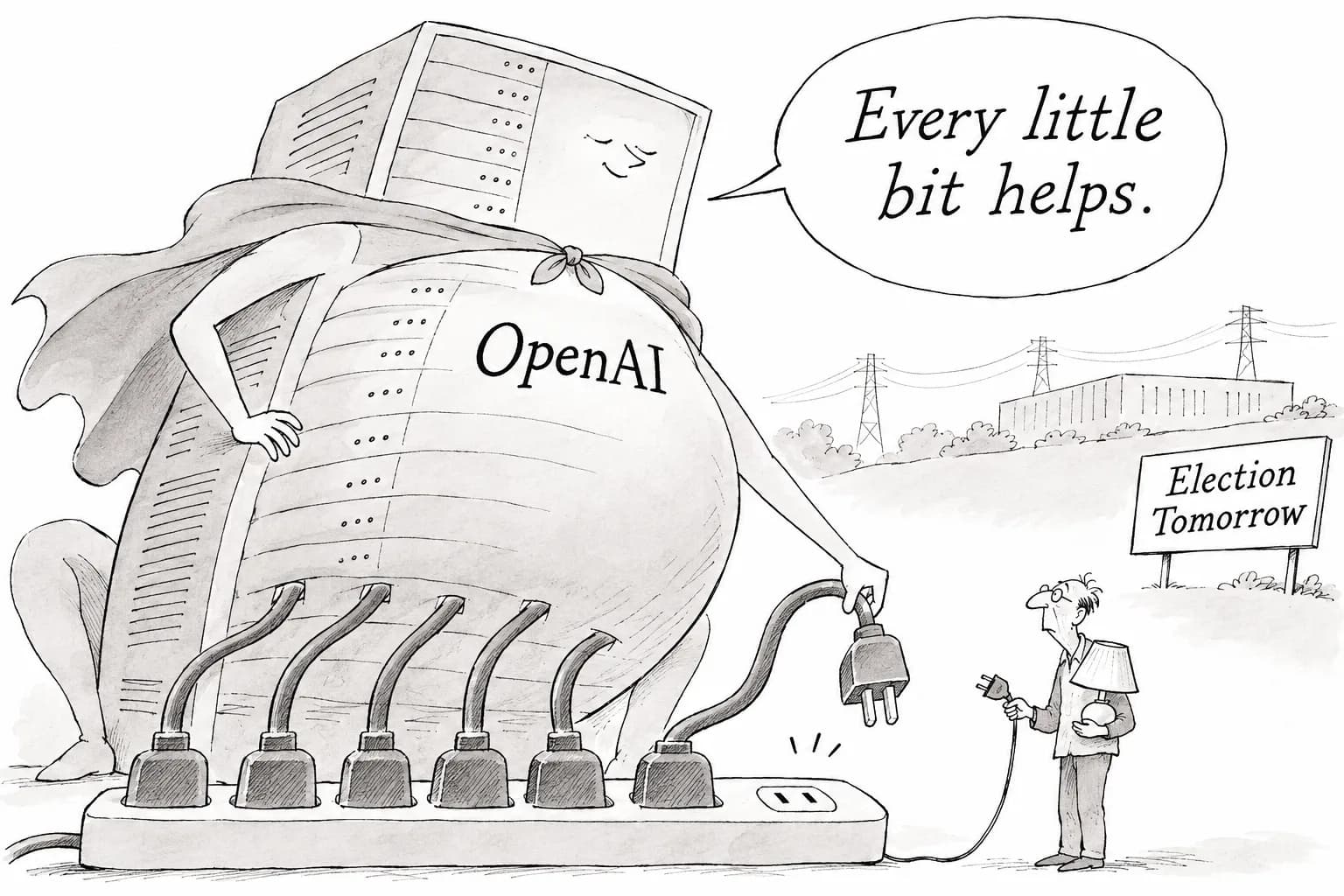
The company has reportedly launched a "Grid Protectors Program." At its first site, in Georgia, the local utility can call for up to 1,000MW of the site's 3.2GW to be cut. The announcement, OpenAI's answer to local pushback over AI's power use, came the day before the state's utility commission election
Koji Yamamoto · Economics Analyst

Key points
- OpenAI will reportedly agree with utilities, site by site, to reduce its data centers' power use when the grid is under strain
- At the first site, in Georgia, Georgia Power can reportedly cut up to 1,000MW of the site's 3.2GW, or about 30%
- The announcement came the day before the election for the state utility commission that sets electricity rates, and responds to local pushback over AI's power use
OpenAI has reportedly launched the "Grid Protectors Program," an initiative to reduce its data centers' power use when the grid is under strain. The amount each data center can cut will be agreed with the utility at each site. The first site is in Georgia. The local utility, Georgia Power, can reportedly cut up to 1,000MW (1GW) of the 3.2GW (gigawatts) the site uses. The announcement was reportedly made on November 2, the day before the election for Georgia's Public Service Commission, which sets electricity rates.
For Japanese companies: There is no direct impact for now. But as more data centers are built in Japan, the question of who cuts back when power runs short will come up there too. Companies that build or lease data centers, or run factories near them, should understand this new approach, both for their electricity costs and for keeping a secure power supply.
What OpenAI has committed to
According to reports, the program is what the power industry calls "demand response," in which electricity use is adjusted to match supply and demand at a given moment. When power is likely to run short, such as on a hot summer evening or a morning during a cold snap, the data center will reduce its electricity use at the utility's request.
The key point is that the amount is not fixed across the board. It will reportedly be negotiated site by site with the local utility. Because grid capacity varies by region, how much can be cut, and under what conditions, will differ from site to site.
Japan has similar arrangements, in which factories and office buildings sign contracts with utilities to cut back when power is short in exchange for payment. OpenAI is trying to do the same thing at huge AI computing sites.
The Georgia site can cut nearly a third
The numbers at the first site are large. The site's power capacity is 3.2GW, and Georgia Power can reportedly cut up to 1,000MW of that, about 30% of the total. 1GW is close to the output of one large power plant.
From the utility's point of view, that 1GW works much like a reserve power source it can call on in an emergency. Without building a new plant, it can ask the data center to cut back only during the hours when supply is tight. That makes it easier to keep power flowing to ordinary homes and businesses. This appears to be what "Protectors" in the program's name refers to.
Much remains unclear from the reports, however. How many times a year, and for how many hours, can power be cut? How will AI computing continue during a cut — will it be moved to other sites, or paused? Will OpenAI receive anything in return from the utility or the state, such as discounted rates? Which site will be next after Georgia? We have not been able to verify the original text of OpenAI's announcement, so the figures here should be read as reported.
Why the day before the election?
In the US, local pushback is growing over how much electricity AI data centers use. There is concern that if power plants and transmission lines are added for data centers, the cost will be passed on to ordinary households through their electricity bills. Electricity rates are approved by state public utility commissions, and in Georgia the commissioners are elected.
On November 3, several states, including Georgia, held elections for public utility commissions and governors. Electricity rates and data centers were among the issues. OpenAI's announcement came the day before. In effect, it offered an answer just before the vote: AI will not take the local power supply, and will give way when power is short.
Reports describe the timing of the announcement as a response to local pushback. It shows an AI company trying to win local support based on how it works with the grid, not on computing speed or price.
What to watch
First, the election results. If commissioners who take a tougher line on data centers are elected, utilities in other states may be more likely to ask data centers for similar commitments.
Second, whether other companies follow. OpenAI is not the only major company with data centers. Will setting cut amounts with utilities site by site become standard practice in the industry, or will it stay a commitment made by OpenAI alone?
Finally, whether the commitment is actually kept. The 1,000MW figure is only a ceiling on how much can be cut. How much will actually be cut on a day when power runs short? Until those records come out, it will not be possible to judge how much the program really matters.
Editorial cartoon