Rules & Policy · Nov 4, 2026
NVIDIA asks partners to sell at least 51% of capacity outside China, FT reports
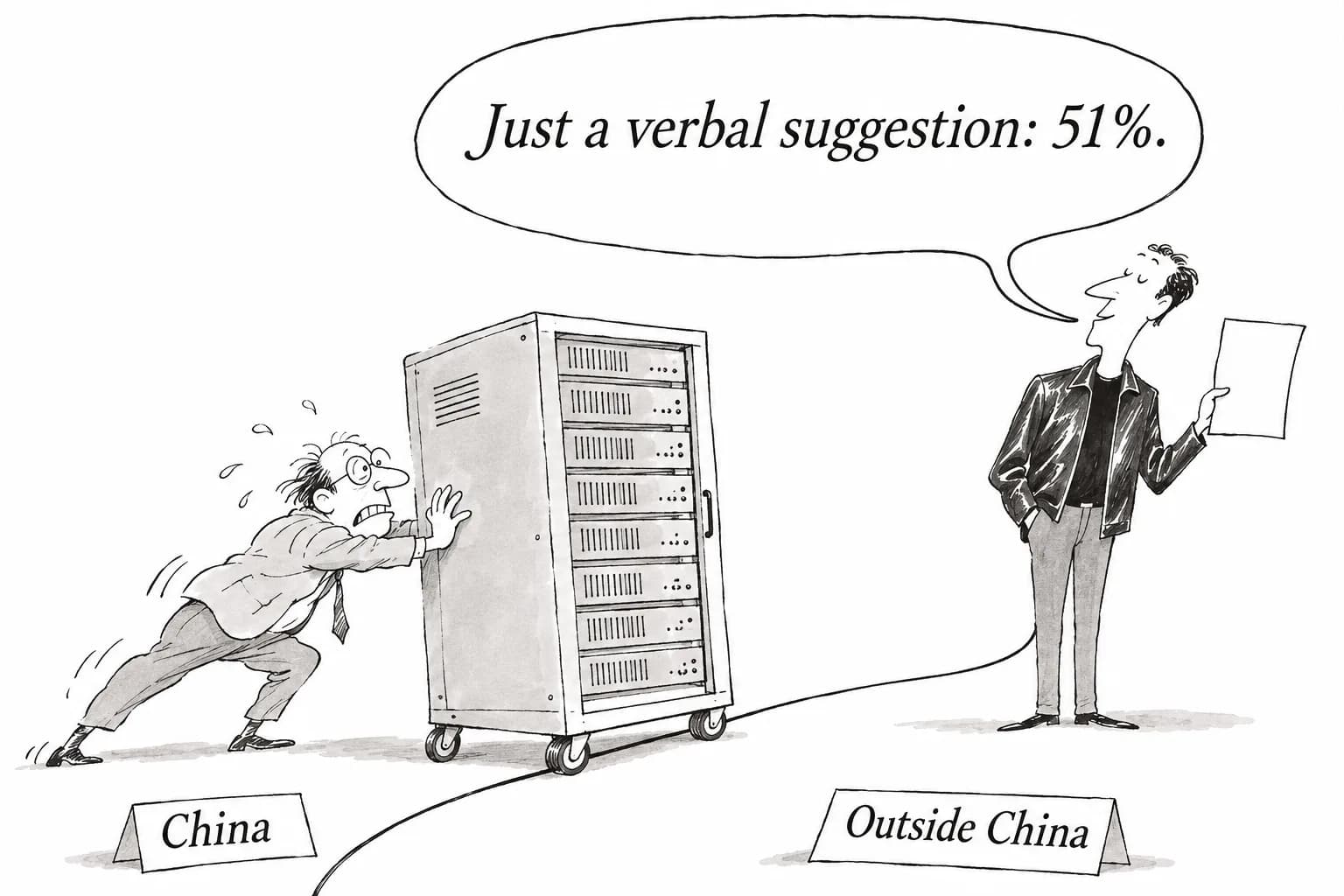
The company reportedly told customers verbally that Chinese clients should account for no more than 49% of capacity under new contracts. GPU clouds in Japan and Southeast Asia may be drawn into an export control drawn by a private company
Koji Yamamoto · Economics Analyst

Key points
- According to the FT, NVIDIA has asked partner cloud providers to allocate at least 51% of capacity under new contracts to customers outside China, capping Chinese customers at 49%
- The request was reportedly made verbally, not written into contract terms. NVIDIA has made no formal announcement, and everything rests on media reports
- Rather than a government export control, the chip seller itself would be dictating who its cloud customers can serve. GPU rental providers in Japan and Southeast Asia could end up having to verify their customers' nationality
Chipmaker NVIDIA is asking data center operators that buy its chips to allocate at least 51% of capacity under new contracts to customers outside China, the UK's Financial Times (FT) reported. Put another way, no more than 49% of total capacity could be rented to Chinese customers. The request was reportedly communicated verbally rather than written into contract terms. US outlets Tom's Hardware and TechXplore relayed the FT report in early November. This article is based on media reports and has not been verified against primary sources. We found no official NVIDIA announcement acknowledging the policy.
What it means for Japanese companies: Companies that rent GPUs from domestic cloud providers, or that plan to contract for AI compute, may face more detailed questions at signing about their ownership and the nationality of their business partners. Companies with a Chinese parent or major Chinese business partners could see changes in how much capacity they can rent and on what terms, so they should check when their current contracts come up for renewal.
What was reported
The reports can be summarized as follows.
• Who: Data center operators and cloud providers that buy NVIDIA GPUs and rent them out as compute. The reports do not single out any one region, describing it as a new restriction aimed at partners worldwide.
• What: Under new contracts, no more than 49% of capacity may go to Chinese customers; at least 51% must go to customers outside China.
• How: A verbal request. It has not been reported as a written contract condition.
Much remains unclear. Does "Chinese customers" mean only companies headquartered in China, or does it also cover overseas subsidiaries and Chinese-owned firms? Is "capacity" measured in number of GPUs or in revenue? Does it apply to contracts already signed? None of this can be confirmed from the reports. A transcript of the Chinese Foreign Ministry's regular press briefing on November 3 is also listed among the sources, but this article could not confirm what was said there.
Why it amounts to a "private export control"
The US already uses export controls to block direct sales of the most powerful AI chips to China. But those controls apply to "selling" chips, and critics have long pointed out that Chinese companies "renting" chips housed in overseas data centers over the internet could be a loophole. Data centers in Southeast Asia in particular have been named as possible sources for such rentals.
If the report is accurate, NVIDIA would be weighing in on the "customer mix" of the cloud providers it sells to, without waiting for government regulation. It would be a line drawn not by law but by a single chip supplier as a condition of doing business. And because the request is verbal rather than written, outsiders cannot see how strictly it will be enforced or what happens if partners fail to comply. From a partner's point of view, it could work as pressure: comply if you want your next allocation.
What could happen to GPU clouds in Japan and Southeast Asia
In Japan, too, telecom carriers, data center companies and new GPU cloud startups are buying NVIDIA GPUs in bulk and renting them out. In Southeast Asia, data center construction continues in Malaysia, Singapore and elsewhere. When these operators sign new contracts with NVIDIA or its distributors, they could face the same request. The reports do not say whether any individual company has actually received it.
If that happens, GPU rental providers would take on new work.
• Customer checks: They would need procedures to verify where a customer is headquartered, who owns it and who the end user is, much like a bank's know-your-customer process.
• Ratio management: They would need to keep tallying contracted volume so that Chinese customers do not exceed 49% of the total.
• Customer selection: Providers with heavy demand from Chinese customers would have to find non-Chinese customers to maintain the ratio. Some may compete for Japanese customers on price or terms.
Most Japanese providers already serve mainly domestic customers, so they seem unlikely to hit the 49% cap any time soon. Even so, if verification procedures are written into contracts, Japanese companies on the renting side would also face more paperwork. Manufacturers and trading houses that do a lot of business with China could be especially affected when they rent AI compute.
What to watch
This story is based on reports of a verbal request, and there is as yet no written document or official explanation from NVIDIA. Readers should watch the following.
• Whether NVIDIA confirms or denies the report. If it confirms, how it defines "Chinese customers" and "capacity."
• Whether the US government later turns this private line into formal regulation, or whether NVIDIA moved preemptively ahead of tighter rules.
• Whether GPU cloud operators in Japan and Southeast Asia disclose that they have received the request, and whether it shows up in contract terms or pricing.
• How the Chinese government and Chinese companies respond. It could give them another reason to speed up a shift to domestic chips.
AI compute is becoming a foundation for business, much like electricity or network connectivity. It may be that a single chip seller, not a government, has begun deciding who gets to rent that foundation, and how much. Nothing can be stated definitively until the report is confirmed, but Japanese companies that rent GPUs would do well to prepare for the day new items appear in their contract paperwork.
Editorial cartoon
Sources
- https://techxplore.com/news/2026-11-nvidia-center-clients-china-exposure.html
- https://www.tomshardware.com/tech-industry/data-centers/nvidia-tells-data-center-operators-to-limit-business-from-chinese-customers-with-new-global-restrictions-report-claims-allegedly-restricted-to-49-percent-of-the-total-ensuring-51-percent-are-non-chinese-outfits
- https://www.fmprc.gov.cn/mfa_eng/xw/fyrbt/202611/t20261103_12052547.html