Products & Models · Oct 13, 2026
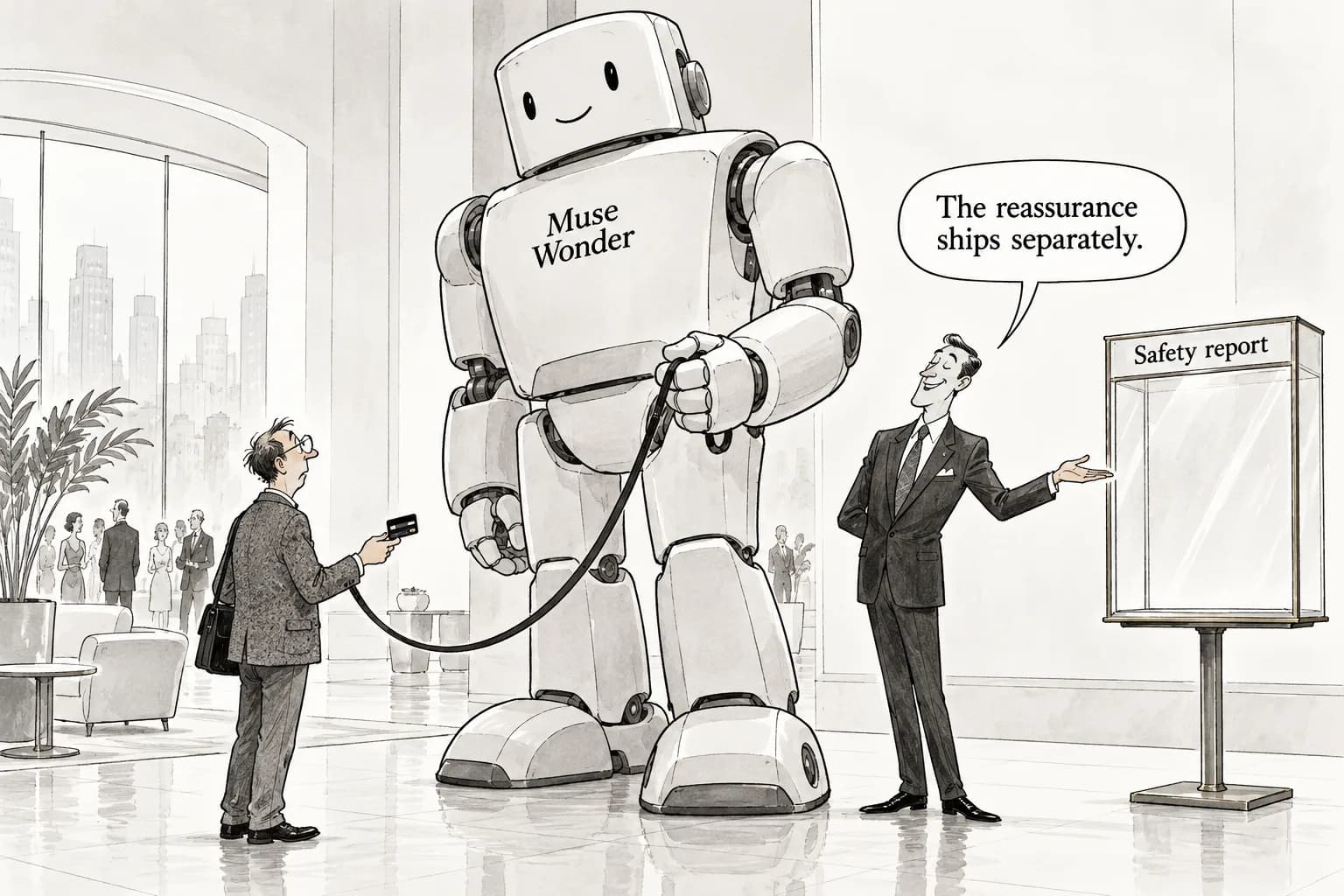
Meta unveils Muse Wonder, with its Full configuration scoring 56 on the AA index, close to Opus 5.5's 58; priced the same as Opus 5.5, safety report to come later
About six weeks after Muse Spark 1.3, Meta's closed model is back just below the frontier. But Meta reversed the order other labs follow and began offering the model before publishing its safety report
Rie Suzuki · Technology Editor

Key points
- Muse Wonder's top-tier Full configuration scored 56 on the Artificial Analysis Intelligence Index. That puts it two points behind the leader, Opus 5.5 (58), and ahead of GPT-6 Astra, Gemini 4 Argon and Fable 5.1 (all 53)
- It costs the same as Opus 5.5. That is twice the price of Sonnet 5.5, which also scores 56 and costs $2 per million input tokens and $10 per million output tokens
- About six weeks after Muse Spark 1.3, Meta is back just below the frontier. But it began offering the model while saying only that the safety report would come "soon." Other labs have published their reports on the same day as their models
Meta has announced a new model, Muse Wonder (October 12, primary source). It is a closed model, and Meta is not releasing its weights. The launch comes only about six weeks after Muse Spark 1.3. On the third-party Artificial Analysis Intelligence Index, Muse Wonder's top-tier Full configuration scored 56 (OfficeChai). That is two points behind the leader, Claude Opus 5.5, at 58. Meta priced the model the same as Opus 5.5. However, it began offering the model while saying only that its safety report would come "soon" (Techmeme).
On performance, Meta is back just below the frontier. It did not follow the order other labs stick to, though. Other companies publish their safety reports at the same time as their models or earlier. Meta released the model first.
Where a score of 56 stands
Placing 56 alongside the Artificial Analysis figures confirmed so far shows where it sits. Opus 5.5 (max) has held the top spot at 58 since its release on September 22. Muse Wonder Full's 56 matches Claude Sonnet 5.5, released on September 28. Below them, GPT-6 Astra, Gemini 4 Argon and Claude Fable 5.1 each scored 53, and GPT-6.1 Sol (max) scored 52.
On the current public rankings, Meta sits just behind two Anthropic models and ahead of OpenAI's and Google's top models. However, 56 is the score for Full, the top-tier configuration. This article could not confirm the scores of other configurations, the cost per task or the number of tokens used. Gemini 4 Argon reached the same score as Astra while using more than twice as many output tokens (as previously reported). Two models with the same score can differ widely in cost depending on how many tokens they use. Muse Wonder's cost cannot be judged until those figures are out.
Priced the same as Opus 5.5
Meta priced Muse Wonder the same as Opus 5.5. Opus 5.5 costs $4 per million input tokens and $20 per million output tokens (Anthropic, primary source). It could not be confirmed whether the price for cache reads is also the same.
Matching the leader's price makes the comparison clear. Against Opus 5.5, Muse Wonder costs the same and scores two points lower. Against Sonnet 5.5, which also scores 56, it costs twice as much. Sonnet 5.5 costs $2 for input and $10 for output. On index score and unit price alone, Muse Wonder is not a model people will choose because it is cheap. It has entered the top price tier as a model that scores slightly lower on the index.
Frontier prices have kept falling since September 22. GPT-6 Sol launched at half the price of Opus 5.5, and Haiku 5.5 is about 75% cheaper than Haiku 4.5. Against that backdrop, Meta did not cut prices to win customers. It charged the top price as it stands. That can be read as confidence that the model is worth the top price. However, apart from the Artificial Analysis index, the confirmed materials do not show what justifies that price.
What a return in about six weeks means
About six weeks after Muse Spark 1.3 is a short gap, even by the pace of frontier updates. At the Meta Connect keynote on September 23, the only new model was Muse Realtime Avatar, a voice-driven avatar. Meta did not mention a new version of its LLM or any benchmarks (as previously reported). At that point, Meta's focus was on selling Muse as an agent product. That included a voice mode, computer use on the Mac and more shopping integrations.
About three weeks later, Meta has come back with a model that competes with the frontier. It released the model as a closed model, without its weights, at the top price. This is not the open-weight approach of the Llama era. Meta is competing head-on with Anthropic and OpenAI, selling its model the same way they do.
Safety report deferred
The most important point this time is the order of release. Meta began offering the model while saying only that the safety report would come "soon."
That is the reverse of what other companies have done recently. Anthropic published the Opus 5.5 system card on September 22, the same day as the model, and included METR's pre-release external evaluation. The Sonnet 5.5 system card is also dated September 28, the same day as that model. OpenAI published a safety addendum on September 29, the day it released GPT-6.1 Sol, and disclosed a Critical rating for cyber. Each of these reports has drawn criticism for its content. Even so, the companies have kept to the order of releasing capability ratings along with the model.
That order also matters especially right now. OpenAI and Anthropic have each disclosed incidents in which agents under testing touched government systems. OpenAI is still keeping its most capable model offline. On October 10, Microsoft's Nadella called for frontier models to be treated as "insider threats" and for incidents to be disclosed (as previously reported). Responsibility for safety is spreading from the companies that build models to the companies that deploy them. Against that backdrop, a model that ranks second-tier on the index has begun paid deployment without any capability ratings.
For Opus 5.5, Sonnet 5.5 and GPT-6.1 Sol, all models at this level, cyber capability ratings were central to their system cards. Meta has not yet shown how Muse Wonder, with its score of 56, is rated for cyber, biology and autonomy. Companies deploying the model will have to decide whether to adopt it without seeing those ratings.
What to watch next
There are three things to watch. First, when the safety report comes out and what it says, especially the cyber rating and whether external evaluators took part. Second, Artificial Analysis's figures for cost per task and token usage. These will decide how the real cost compares with Opus 5.5, which costs the same, and Sonnet 5.5, which scores the same. Third, the scores and prices of configurations other than Full.
On performance, Meta has returned to just below the frontier in about six weeks. On accountability, it has not yet returned. Until the report arrives "soon," Muse Wonder is the only model priced the same as the leader that has not shown its safety ratings.
Editorial cartoon