Products & Models · Oct 16, 2026
Meta releases 816B open-weight Muse Spark Open three days after keeping Wonder closed, with its full safety report still "coming soon"
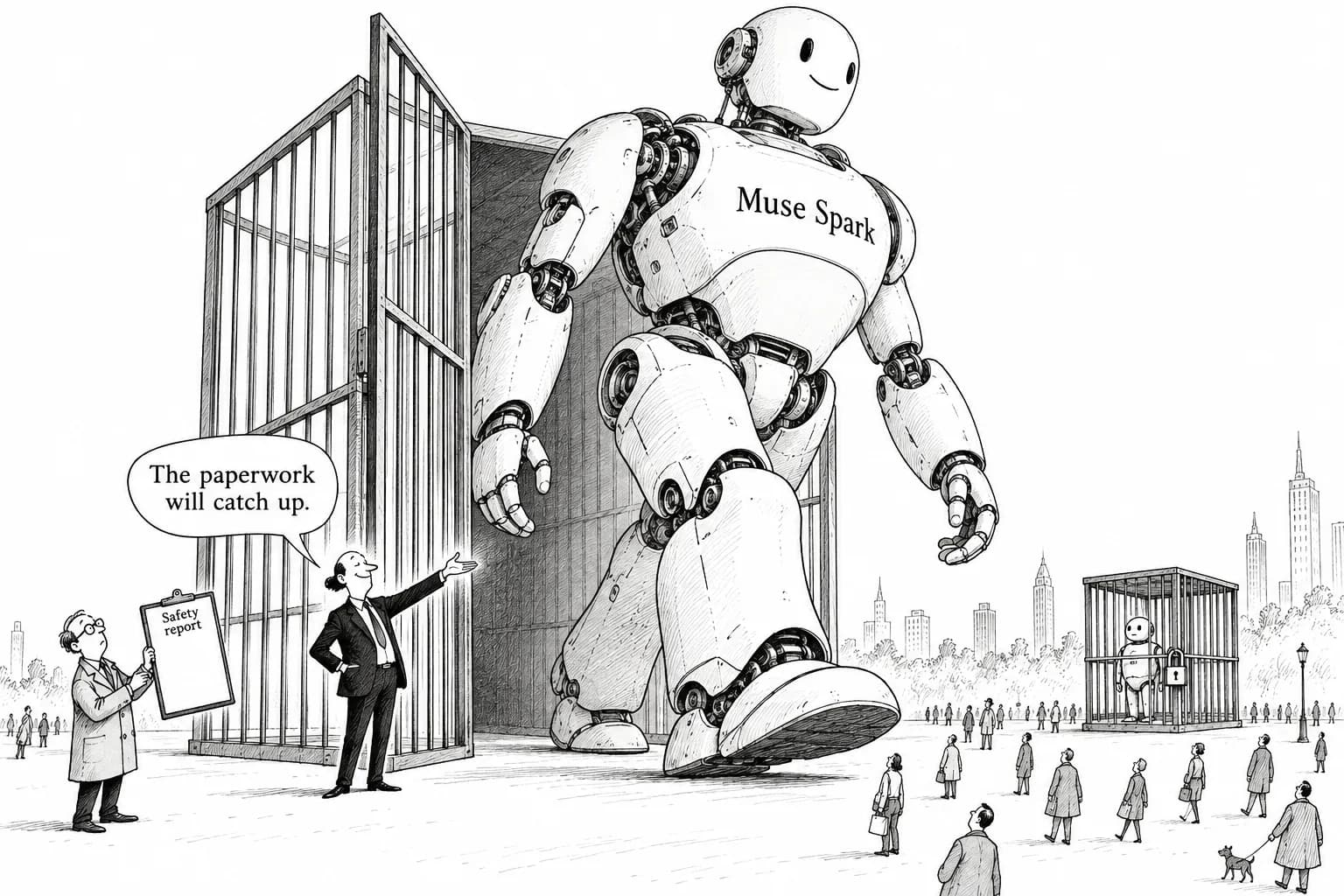
US open-weight models are back at frontier scale. The only evidence that the model meets Meta's safety thresholds is Meta's own word, and no evaluation report has been published yet, including the one for Wonder
Rie Suzuki · Technology Editor

Key points
- Muse Spark Open has 816B total parameters, 42B active parameters and a 1-million-token context window. It uses the same base model as Muse Spark 1.3 and was released on Hugging Face under the Muse Model License (PyTorch blog, October 15)
- Meta says it added safety post-training because the weights may be run on their own. It says the model meets its safety thresholds, but the full evaluation report backing that claim is only "coming soon." The report for Muse Wonder, released October 12, has not been published either
- Safety training can be stripped from open weights. Anthropic has reported a 100% success rate in bypassing GLM-5.3's safeguards through abliteration. If Meta is relying on post-training for protection, that claim needs outside verification
On October 15, Meta released the weights for Muse Spark Open on Hugging Face. The model has 816B total parameters and 42B active parameters, with a context window of 1 million tokens, and is licensed under Meta's own Muse Model License. The PyTorch blog calls it "the most capable American open-weight model to date." The weights are available at meta-models/Muse-Spark-Open-816B-A42B.
The release came three days after Meta announced the closed Muse Wonder and Muse Wonder Full on October 12. Meta kept its top models closed and released the weights of the base one generation below them. With this release, US open-weight models are back at frontier scale. However, Meta's only support for the claim that the model "meets" its safety thresholds is its own statement. It says the full evaluation report backing that claim is "coming soon" (Meta research blog). The safety report for Wonder has not been published yet either.
What Meta opened: the same base as Spark 1.3, while Wonder stays closed
According to the PyTorch blog, Muse Spark Open uses the same base model as Muse Spark 1.3, with additional safety post-training. It was trained for coding and agentic tasks and accepts images, documents, audio and video with audio as input. It can also browse the web, launch and coordinate subagents, and operate computers across desktop, mobile and browser environments. Meta says the model produces a separate "commentary" stating its intent before it acts, so users can follow what the model is about to do and why.
The PyTorch blog post is titled "Muse Spark 1.2 Is Now Open Weights." Its body builds on the August announcement of Muse Spark 1.2 but says the model shares its base with Spark 1.3, so the version naming is inconsistent.
Meta's own positioning of the models makes the picture clear. Wonder is available only to Meta Model API and Muse Code customers. It is priced the same as Opus 5.5, at $4 for input and $20 for output per million tokens, according to a Techmeme summary. Open belongs to the Spark line one tier below. On the Artificial Analysis Intelligence Index, Spark 1.3 scored 48, Wonder 52 and Wonder Full 56, according to secondhand reports. No third-party index score for Open exists yet. Meta sells its strongest model and opens the generation just below it to build an ecosystem, and it released the two within three days of each other.
US open-weight models return at scale
Until now, Chinese developers held the open-weight frontier above 800B. Examples include Xiaomi's MiMo-V2.6-Pro (1.02 trillion total, 42B active, MIT license) and Moonshot's Kimi K3 (2.8 trillion). On the US side, Reflection AI announced Beam (501B total, 23B active) on October 5, but its weights have not appeared on Hugging Face yet. In Europe, Mistral Large 4 (about 1 trillion total) still has its weights scheduled for "the end of this month."
Muse Spark Open's 42B active parameters exactly match MiMo-V2.6-Pro's, while its 816B total is slightly smaller. As Meta says, it is currently among the largest US models whose weights can actually be downloaded. Meta ships it with Helion kernels, a project Meta moved to the PyTorch Foundation. Meta says these kernels run 1.03 to 3.95 times faster than dedicated kernels on NVIDIA GB300 and raise end-to-end throughput by 3% on AMD MI350. The model runs optimized on SGLang and vLLM, and TorchTitan supports supervised fine-tuning, LoRA and reinforcement learning (TitanRL) out of the box. In effect, Meta also released the tools for retraining the model locally.
Where is the evidence that it "meets the thresholds"?
Meta makes two claims about safety. First, it added safety post-training to improve resistance to misuse, on the assumption that the model will be run on its own without system-level safeguards. Second, it says the model meets its safety thresholds as a result. The PyTorch blog goes so far as to call it "the best open-source option for safety."
But the full report showing which evaluations were run, against what bar and with what scores is still only "coming soon." Wonder followed the same pattern. Meta's October 12 research post on Wonder said "a full report including additional safety evaluations is coming soon," and three days later it has still not appeared. The model card PDF consists only of images, so its text cannot be extracted. Its contents, including that Meta does not rule out Wonder Full reaching the high CB threshold without mitigations, are known only from secondhand reporting. Meta has now released two models in a row before their reports.
With a closed model, a developer can add safeguards at the API level or withdraw access even after launch. Open weights do not allow that. Once weights are distributed, they cannot be recalled. That is why an evaluation report matters most when it is published before release.
On open weights, post-training can be removed
There is already a case that could undercut the claim that safety post-training was added. On September 29, Anthropic's Frontier Red Team reported that it bypassed the safeguards of Z.ai's GLM-5.3 64% of the time with simple deceptive prompts and 92% of the time by prefilling the reasoning field. Using abliteration, which edits the weights to remove refusals, it succeeded 100% of the time. If you have the weights, refusal training can be stripped out. Meta also released tools on the same day that let users run reinforcement learning with TorchTitan.
There is also a question about capabilities. On October 12, Anthropic reported that it had tested whether small open-weight models could replicate themselves across cheap IoT devices, and that GLM-5.2 spread end to end in an isolated environment. Anthropic projects that small open models will reach the necessary skills "by the end of 2026." An 816B model will not run on home devices. But those tests are about exactly the capabilities this model has: handling long tasks as an agent, operating computers and launching subagents. arXiv paper 2610.13928 showed that capabilities can be hidden within weights and slip past evaluations. For now, the only basis for judging how far pre-release evaluations can be trusted is the developer's own account.
When Google made Gemini 4 Argon generally available on October 13, it released a safety post and model card at the same time. In them, it wrote that it could not rule out the model having reached critical capability levels in biology and cyber. Even with closed models, some developers publish their reports on launch day. Meta, which is releasing its weights, is the one putting off the evidence.
What to watch next
There are three things to check. First, when Meta will publish the full evaluation reports it says are "coming soon" for Spark Open and Wonder, and whether they will include CBRN and cyber scores without mitigations. Second, whether outside researchers show how much capability remains after abliteration or fine-tuning removes the safety post-training. Third, how Artificial Analysis and other third parties rank Spark Open once they measure it, compared with China's MiMo-V2.6-Pro and Kimi K3. It is a fact that US open-weight models are back at frontier scale. Whether this one meets its safety thresholds can, for now, be checked only against Meta's own word.
Editorial cartoon