Money · Oct 24, 2026
Meta's off-balance-sheet commitments reach about $825 billion as it withholds a capex figure, creates nonvoting shares and sees CDS hit a record
The 10-Q disclosed the total of Meta's long-term commitments but not next year's investment figure. Meta opened a way to raise money without adding shareholder votes, and credit markets took the most pessimistic view
Koji Yamamoto · Economics Analyst

Key points
- According to the 10-Q (primary source), Meta's off-balance-sheet commitments, including leases that have not yet commenced and purchase commitments, total about $825 billion. Meta did not give a numerical outlook for 2027 capital expenditures
- Meta created a new class of nonvoting Class C stock. Reports describe it as a way to raise money for AI investment without diluting Zuckerberg's control
- Along with free cash flow turning negative, Meta's five-year CDS reportedly rose to a record high. The next question is whether the same pattern shows up in earnings from Alphabet, Microsoft and Amazon
Meta's quarterly report for the third quarter of 2026, filed with the SEC (10-Q), contained one striking number and left out one that should have been there. The striking one is that future commitments not recorded on the balance sheet amount to about $825 billion. The missing one is a figure for 2027 capital expenditures. In the same period, Meta created a new class of nonvoting Class C stock, and its free cash flow turned negative. Credit markets responded clearly: Meta's five-year credit default swaps (CDS), the price of insurance against a company failing to repay its bonds, rose to a record high.
These four developments are connected. Meta disclosed how much it has committed to pay for years to come, but not how much it will spend next year. Its cash on hand is shrinking, and it has opened a way to raise outside money without giving up voting control. Read together, they suggest that paying for AI computing capacity has reached the point where Meta's own cash is no longer enough.
About $825 billion: commitments off the balance sheet
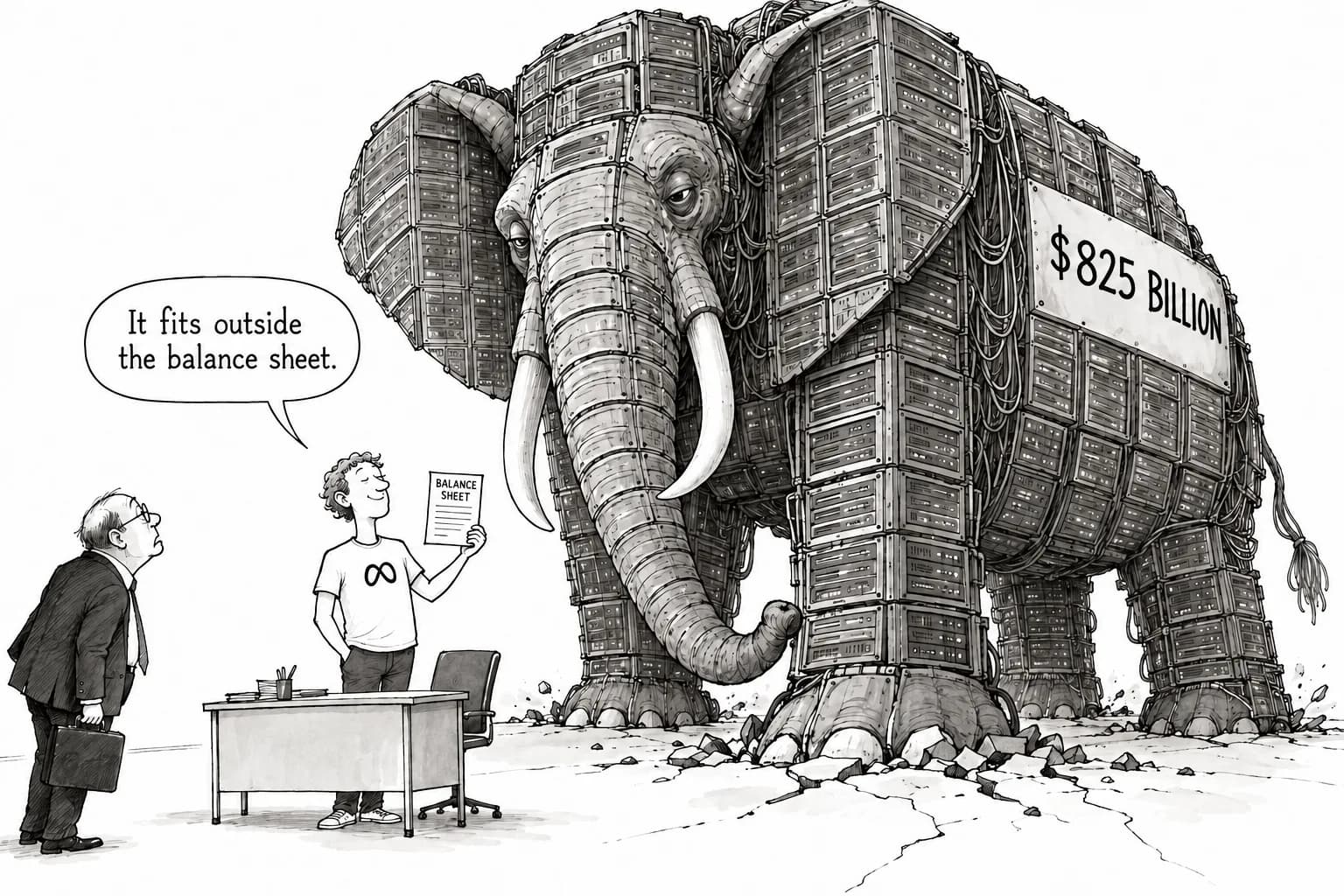
The roughly $825 billion in the 10-Q covers commitments that are already under contract but not yet recorded as liabilities on the balance sheet. They are future payment obligations, such as data center and other leases that have not yet commenced, and commitments to buy equipment and computing capacity. They are not counted as current liabilities, but there are counterparties on the other side, and if the contracts proceed as written, Meta has to pay.
The key is the scale. $825 billion is several years' worth of Meta's annual capital expenditures. In a Stripe podcast on October 12, Zuckerberg reportedly said capex is on the order of $50 billion to $60 billion and that running a gigawatt-scale cluster costs about $15 billion a year (this comes from a secondary source; we have not been able to read the original page). Even next to those figures, the total commitments shown in the 10-Q are an order of magnitude larger. The core of Meta's AI investment is becoming payments locked in by contract over many years, not the capex figure for any single period.
Leasing means the cost of building data centers does not show up upfront as the company's own borrowing, so the debt visible on the balance sheet looks lighter. The obligation to pay remains, though, and credit markets are watching the total of these obligations, not the debt on the face of the balance sheet.
No number for 2027 capex
While disclosing the total of its commitments, Meta gave no numerical outlook for 2027 capital expenditures. For investors, this is the biggest gap. How much of the $825 billion in commitments will turn into cash payments next year? How far will that push down free cash flow? Neither can be estimated without a capex figure for next year.
Withholding a number is not unusual in itself. This time, however, it came in the same quarter that free cash flow turned negative. AI spending has started to exceed the money Meta earns from its core advertising business. If Meta also gives no ceiling for next year's investment, outsiders have little choice but to assume spending will keep rising. That combination is why bond investors braced themselves early.
Nonvoting Class C stock: raising money without diluting control
Meta also created a new class of nonvoting Class C stock. Until now, Meta has been structured so that Zuckerberg controls the company through Class B shares carrying 10 votes each. Shares with no votes now join that structure.
Investing.com reported that the new stock serves two purposes: keeping Zuckerberg in California and funding a large AI spending push. That is a reported interpretation, and no detailed plan for how the shares will be used has been disclosed. Still, what the mechanism means is clear. Because the shares carry no votes, issuing them or using them for compensation does not reduce Zuckerberg's share of voting power. For shareholders, it means a class of stock that adds to their investment without adding to their say.
Meta is locking in computing capacity through borrowing and leases, with nonvoting shares available to cover any shortfall. Widening its funding options shows that Meta is preparing for situations in which its own cash cannot cover its AI investment.
The credit market's answer: CDS at a record
According to a Newsquawk headline, Meta's five-year CDS rose to a record of about 114.5bp (this figure is as stated in the headline; we have not verified the detailed trading data). Capp Notes, which summarized markets on Thursday, October 22, also covered the moves after Meta's earnings.
The level itself is still low. CDS on CoreWeave, which also deals in AI computing capacity, stand at about 1,115bp, roughly ten times Meta's. Meta is not struggling to repay its debts. What is new is the direction. A company that earns heavily from advertising and has funded its investment with very little borrowing now has a higher price on its credit than at any point in its history. Putting together the $825 billion in commitments, negative free cash flow and the missing figure for next year's investment, credit markets have begun to see Meta as a future large-scale bond issuer.
What to watch next
The question now is whether the same pattern appears at other hyperscalers. Alphabet reports on October 27 or 28, Microsoft on October 28 and Amazon on October 29. There are three things to watch: how fully they disclose the total of leases that have not yet commenced and purchase commitments, whether they give a number for next year's capex, and whether free cash flow is nearing negative territory.
For Meta, the open question is when and where it will give a 2027 capex figure. Until it does, the roughly $825 billion in the 10-Q will be the most reliable measure markets have for Meta's AI investment.
Editorial cartoon
Sources
- https://www.sec.gov/Archives/edgar/data/0001326801/000162828026066773/meta-20260930.htm
- https://www.investing.com/news/stock-market-news/metas-new-class-c-stock-to-keep-zuckerberg-in-california-fund-ai-spending-spree-4966480
- https://www.newsquawk.com/headlines/metas-meta-5yr-cds-hits-an-all-time-high-at-1145bps
- https://cappnotes.substack.com/p/closing-look-thursday-october-22