Opinion · Oct 21, 2026
Meta says it will 'generally not' open its most powerful models, five weeks after Zuckerberg warned about holding them back. With Muse Spark Open, the open-versus-closed line now runs inside Meta
The weights Meta released belong to an 816B coding-focused model one tier down. Its strongest model, Muse Wonder, stays closed, and the reason Meta gave was safety
Koji Yamamoto · Economics Analyst

Key points
- The weights Meta released are for Muse Spark Open, which has 816B total and 42B active parameters. It scores 39 on the AA index, a tier below the closed Muse Wonder (52) and Wonder Full (56)
- According to The Next Web, Wang said Meta will generally not open-source its most powerful models, citing safety and capabilities. That points the opposite way from Zuckerberg's Sept. 10 warning about control concentrating in a few labs
- A staged release makes sense in itself. But Meta has not yet published the criteria for where it draws the line, or a safety report for Muse Wonder
On Oct. 15, Meta released on Hugging Face the weights of Muse Spark Open, a mixture-of-experts (MoE) model with 816B total and 42B active parameters. Meta calls it the most capable American open-weight model to date. It is not, however, the most powerful model Meta has. Muse Wonder and Muse Wonder Full, released three days earlier, still have closed weights.
The Next Web reported the following remark from Alexandr Wang, Meta's chief AI officer, explaining where the line was drawn.
Because of both safety and capabilities, we will generally not open-source our most powerful models.
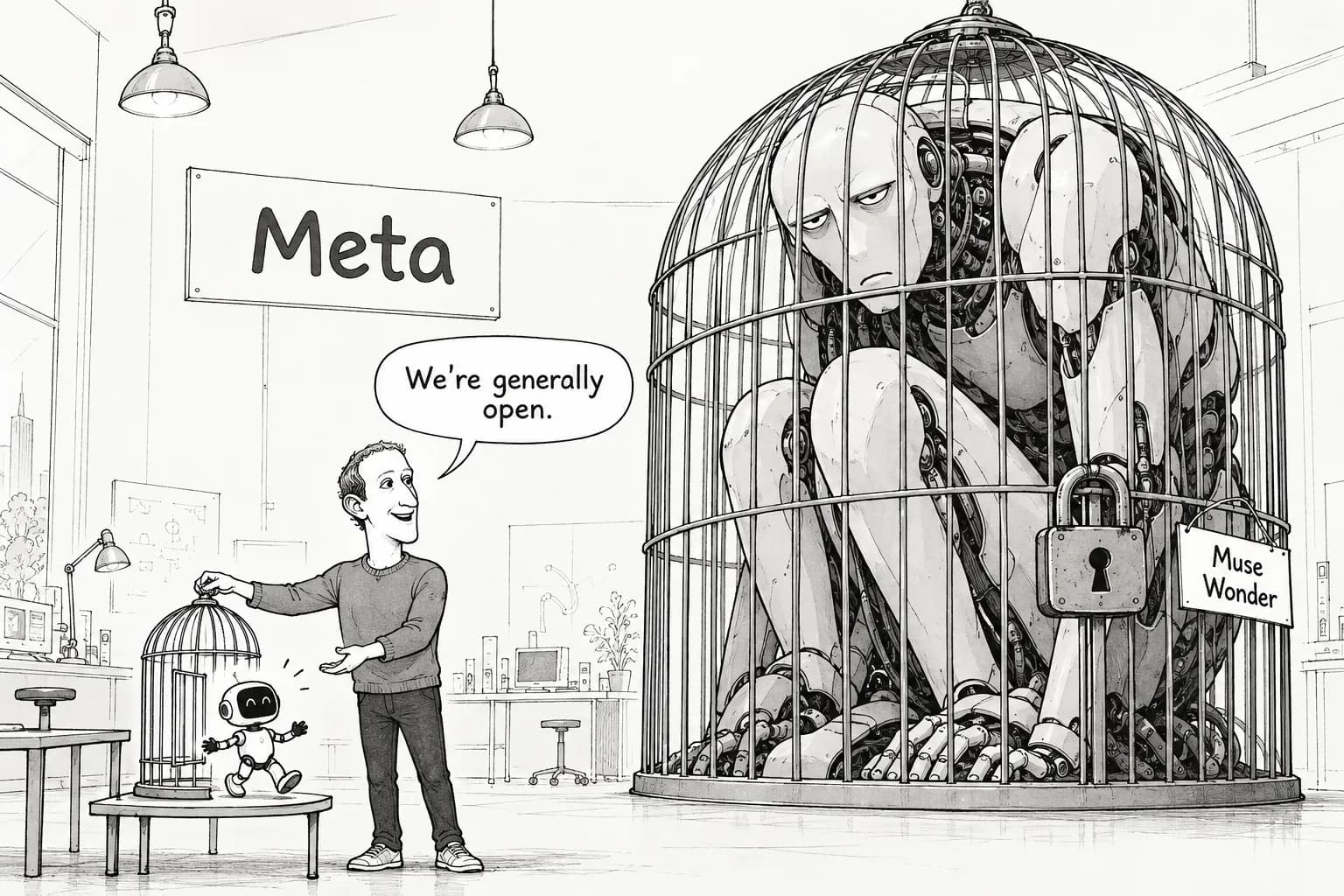
In other words, Meta says it is withholding its strongest models for safety reasons. This writer does not think that decision is wrong in itself. The problem is that five weeks earlier, the head of the same company said almost the opposite in public. The argument of this piece is this: the conflict between open and closed no longer runs between Meta on one side and OpenAI and Anthropic on the other. It runs through Meta itself. And Meta has not yet explained publicly where it draws that line, or how.
What was released, and what stays closed
First, the facts. According to the model card, Muse Spark Open uses 8 of its 256 experts, has a 1 million-token context window, and handles text, images, audio and video. It is built on the same base model as the non-public Muse Spark 1.3. The figures Meta itself published are 80.4 on OSWorld Verified, 76.4 on Terminal-Bench 2.1 and 60 on DeepSWE 1.1, which puts computer use and coding front and center.
Third-party evaluations show a clear gap with the closed models. On the Artificial Analysis Intelligence Index, Muse Spark Open (xhigh) scores 39. That makes it the top U.S. open-weight model, but only 10th among the 120 models compared. On the same index, the closed Muse Wonder scored 52 and Wonder Full 56. What Meta released is a model one tier below its best, built from the same base as a previous-generation closed model.
The license comes with conditions too. Under the custom Muse Model License, a business with more than $20 million in revenue over 12 months needs a separate agreement with Meta to offer the model as a service. Nathan Lambert of Interconnects sees the model's weakness in its terms, not its performance.
If anything will hold Muse Spark Open back, it'll be the specific license they designed for it.
The weights are out, but they are not for the strongest model, and their use is restricted. Muse Spark Open is a release limited on two fronts.
What Zuckerberg said five weeks ago
According to The Next Web, Zuckerberg spoke about the dangers of holding back advanced models on the Sources podcast, released Sept. 10, it was reported. At the core was this line:
I personally am much more worried about a small number of labs or people having control.
Zuckerberg's worry was that powerful models would pile up in the hands of a few organizations. His remark pointed toward opening stronger models more widely. It is the classic open-source argument: concentration of power in a few labs is a bigger danger than misuse of models.
Wang's Oct. 15 explanation points the other way. The strongest models are exactly the ones to keep closed, and the reason is safety. That is almost impossible to tell apart from the reasoning of OpenAI and Anthropic, which Meta has long criticized. Meta kept Wonder closed on Oct. 12, about a month after Zuckerberg's remarks. Three days later, it opened only the weaker model.
The line runs inside Meta, not between companies
Until now, the debate over open versus closed has been framed as a fight between companies, with Meta and Chinese developers on the open side and OpenAI and Anthropic on the closed side. Muse Spark Open breaks that picture. Within a single company, Meta has split its models in two by capability. The top tier is closed and the lower tier is open.
The arrangement itself is not new. Google keeps Gemini closed while opening Gemma, and Microsoft and NVIDIA split their models the same way. What is new is that Meta has adopted the split openly, citing safety. The company that carried the open-weight banner has admitted it will stay closed at the top of the capability range. That changes the question. It is no longer whether to open or close. It is at what level of capability the line is drawn, and who decides where it goes, and how.
The strongest counterargument: a staged release is the responsible approach
The counterargument is strong. First, opening models in order from least to most capable is sound safety thinking. Weights cannot be recalled once released. On this view, it is only natural to be more careful the more a model's capabilities could be misused. Meta also describes additional safety measures in the model card.
This open weights version has additional safety post-training to make it more robust against misuse as a standalone model without system guardrails.
Second, some argue that judging risk by whether weights are open or closed is too crude to begin with. In a joint document on Oct. 19, Microsoft and NVIDIA reportedly wrote:
Weight openness alone does not determine an AI system's risk
From this position, Meta's two-track approach looks pragmatic. Risk depends on how a model is deployed and controlled, not just on whether it is open. If so, the argument goes, it is reasonable to change the form of release according to a model's capability.
This writer accepts the broad thrust of that argument and does not intend to call staged release hypocrisy. The problem is that Meta has not shown how it decided on the stages.
The questions are where the line sits, and on what basis
If you draw a line on safety grounds, you have to show the safety case behind it. For Muse Spark Open, though, Meta only says the model "met" the thresholds of its own Superintelligence Scaling Framework and that a full evaluation report is "coming soon." The safety report for Muse Wonder, the model Meta kept closed on safety grounds, has still not appeared more than a week after release. Secondary sources report that Meta has not ruled out that Wonder Full could reach high biological and chemical thresholds without mitigations, but this cannot be confirmed from Meta's own documents.
A comparison makes the gap clear. Reflection AI released the weights of Beam under Apache 2.0 the next day, Oct. 16, and published a technical safety report the same day. The No. 2 U.S. open-weight developer put out its evidence on release day. Meta, which kept its top model closed for safety reasons, has not yet published its evidence for either the model it opened or the one it kept closed.
The "small number of labs" in control that Zuckerberg feared in September does not come only from closing models. It also comes from deciding what to open and what to close by internal criteria that outsiders cannot check. Meta now stands on the side that holds those criteria.
Conclusion: accept the two tracks, not the lack of explanation
Muse Spark Open has clearly raised the bar for U.S. open-weight models, and that deserves credit. Even so, the lesson of this release is not that Meta has left the open camp. It is that the border between open and closed has moved from between companies to a step partway up one company's capability ladder.
If so, what matters is not Meta's stance but where the line sits. Which capabilities crossed which thresholds to justify closing Wonder? What evaluation showed that Spark Open was safe to open? How does Meta square all this with what its CEO said five weeks ago? If safety is the reason, the explanation should start with safety. The Muse Wonder safety report will be Meta's first chance to show why it drew this line.
Editorial cartoon
Sources
- https://huggingface.co/meta-models/Muse-Spark-Open-816B-A42B
- https://thenextweb.com/news/meta-muse-spark-open-weights-eu
- https://thenextweb.com/news/zuckerberg-muse-sources-interview-labs-holding-back-ai-models
- https://www.interconnects.ai/p/meta-shakes-up-the-frontiers-open
- https://www.unite.ai/metas-816b-parameter-muse-spark-open-weights-are-now-public/
- https://officechai.com/ai/muse-spark-open-benchmarks/
- https://www.helpnetsecurity.com/2026/10/19/open-weight-ai-model-risks-microsoft-nvidia/