Money · Oct 23, 2026
Meta's $34.9 billion capex outruns operating cash flow, turning free cash flow negative as long-term debt jumps about $22 billion in under a year; shares reverse after-hours gain
Meta's AI spending now exceeds the cash its core business generates. The filings show hyperscalers have started borrowing to pay for compute
Koji Yamamoto · Economics Analyst

Key points
- Capital expenditures for the July–September quarter were $34.9 billion, more than operating cash flow, leaving free cash flow negative (exhibit to the 8-K, primary source)
- Long-term debt rose by about $22 billion in under a year. Meta is moving from cash on hand to borrowing to fund its AI investment
- The stock reportedly rose in after-hours trading and then fell. Investors appeared to give more weight to the cash outflow than to strong revenue
Meta reported results for the July–September quarter after the market closed on October 21. According to the exhibit attached to its 8-K filing with the SEC (Exhibit 99.1) and its press release, capital expenditures for the quarter were $34.9 billion. That was more than the operating cash flow from its core business, so free cash flow turned negative.
Meta runs one of the world's largest advertising businesses and has produced huge amounts of cash every year. This quarter, its spending on AI compute used up all of that cash. That is the most important thing in these results.
What the 8-K showed: investment exceeded cash from the core business
Free cash flow is what is left after capital expenditures are subtracted from operating cash flow. Dividends, share buybacks and debt repayments normally come out of that amount. A negative figure means cash from the core business alone was not enough to pay for the quarter's capital spending.
The $34.9 billion went to data centers, servers and networking equipment. Meta released the closed model Muse Wonder on October 12 and the 816B open-weight Muse Spark Open on October 15, and it is competing directly in the race to build frontier models by spending on compute. Zuckerberg and Alexandr Wang reportedly discussed gigawatt-scale clusters and annual capital spending of $50 billion to $60 billion on a podcast on October 12 (secondary source). Meta's own filing now confirms that investment on that scale has overtaken a quarter's cash flow.
Borrowing to cover the gap
The same filing shows long-term debt rising by about $22 billion in less than a year. The most natural reading is that Meta is using bonds and other borrowing to cover the amount by which capital spending exceeded operating cash flow.
Until now, the AI spending of hyperscalers was discussed on the assumption that their core businesses could pay for it. Building data centers with borrowed money was seen as something done by companies with less financial room, such as CoreWeave and Oracle. Meta's numbers show that this line is starting to blur. Borrowing lets a company keep investing at full speed. But it also puts a deadline, in the form of interest payments, on the question of when AI will pay off and by how much.
Market reaction: an after-hours gain turned into a decline
The shares rose in after-hours trading right after the results came out and later turned lower, according to reports. The first move up appears to have reflected strong advertising results. The decline that followed appears to have come as investors focused on the cash outflow and the spending outlook. The earnings call transcript and an analysis also split into two main topics: advertising growth, and when the investment in Muse will pay back.
The fact that the stock moved both ways shows that the market is unsure. Investors are no longer rewarding AI spending simply as a sign of growth. They now want to know what is paying for it.
What to watch in next week's earnings
Meta is the first hyperscaler to report this earnings season. Alphabet (October 27 or 28), Microsoft (October 28) and Amazon (October 29) follow. There are three things to watch: how close capital spending has come to operating cash flow, how much borrowing has increased, and how large off-balance-sheet commitments such as data center leases are.
If Meta were the only one, this could be explained by the particular situation of a company that joined the model race late. If the same pattern shows up in a second and third company's filings, it will mean the build-out of AI compute has entered a stage where it is funded by borrowed cash, not earned cash. This 8-K is the first piece of evidence.
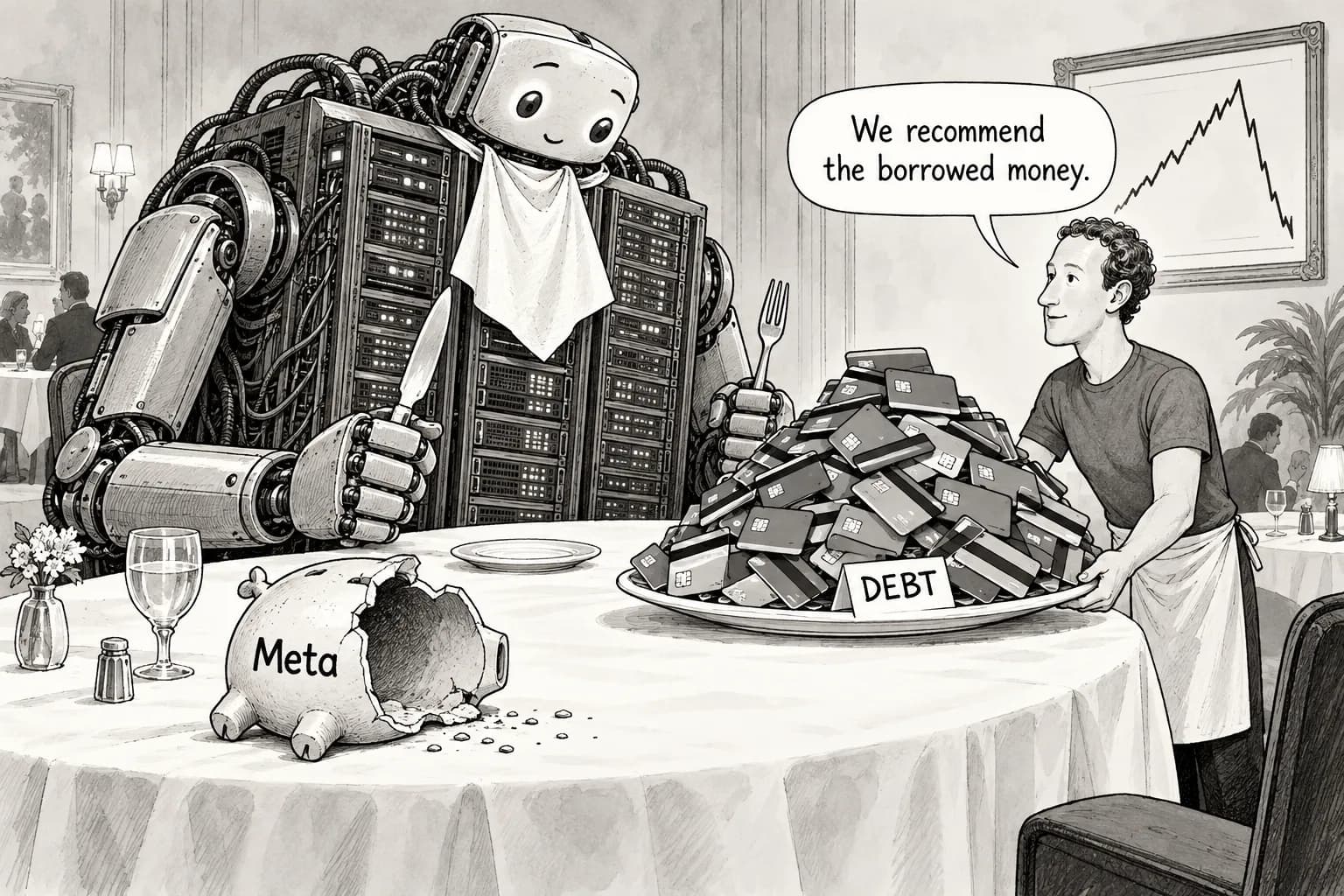
Editorial cartoon
Sources
- https://investor.atmeta.com/investor-news/press-release-details/2026/Meta-Reports-Third-Quarter-2026-Results/default.aspx
- https://www.sec.gov/Archives/edgar/data/0001326801/000162828026066700/meta-09302026xexhibit991.htm
- https://www.tradingkey.com/analysis/stocks/us-stocks/262230293-meta-platforms-earnings-report-q3-2026-advertising-muse-wonder-capex-tradingkey
- https://finance.yahoo.com/markets/stocks/articles/why-meta-meta-shares-getting-170153674.html
- https://www.fool.com/earnings/call-transcripts/2026/10/21/meta-meta-q3-2026-earnings-call-transcript/