Money · Oct 13, 2026
KOSPI falls 3.65%, SK hynix −4.5% and Samsung −4.4% as CXMT's new DRAM design fuels talk of a memory peak
Foreign investors reportedly sold right after record earnings, citing China's catch-up. In the middle of a boom, the market has started pricing in what comes next
Koji Yamamoto · Economics Analyst

Key points
- KOSPI −3.65%, SK hynix −4.5%, Samsung −4.4%, according to reports (Investing.com, TradingKey, Seoul Economic Daily)
- The selling was reportedly triggered by news that China's CXMT has made progress on DRAM with a 4F² structure. Strong earnings no longer held up the shares
- Foreign selling reportedly drove the decline, and Korea's two memory makers are said to be lagging the global chip-stock rally. The market has started pricing in both a peak in the boom and China's catch-up at the same time
South Korea's two memory makers came under heavy selling. According to reports, the KOSPI (Korea Composite Stock Price Index) fell 3.65%, while SK hynix dropped 4.5% and Samsung Electronics fell 4.4%. The losses in these two companies, which carry large weights in the index by market value, reportedly dragged the index lower (Investing.com, TradingKey).
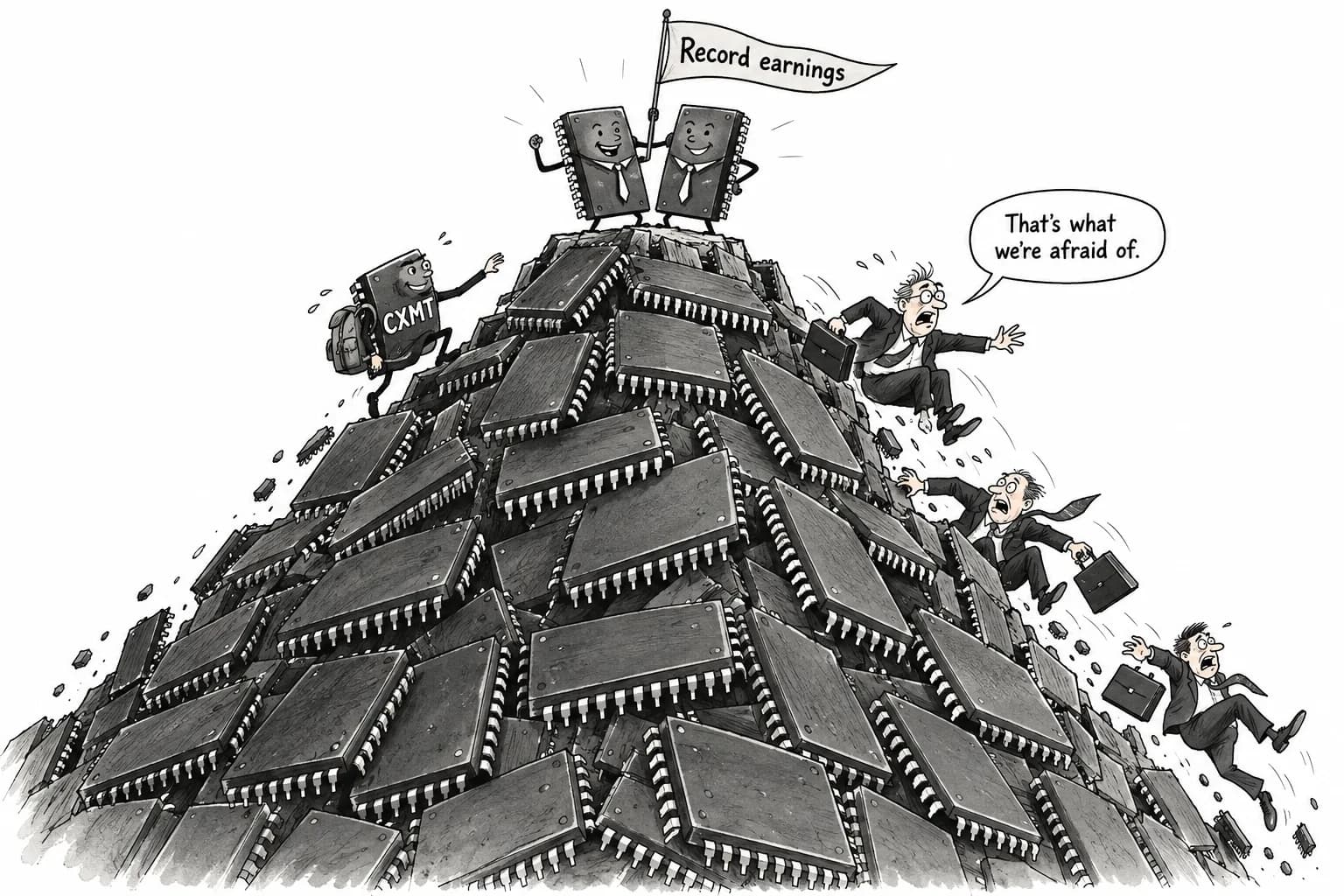
The timing stands out. The selloff reportedly came right after Samsung posted record earnings, which means the shares were sold when business was at its best. One reading is that the market is looking past current profits to two questions: how long this boom can last, and who is catching up.
Note that this article is based on reports. We were unable to read the full text of any of the three sources directly, and we have not verified the specific figures in Samsung's earnings, the size of foreign net selling, or the details of CXMT's announcement. The only figures cited are the percentage moves in the headline; everything else is presented as a summary of what was reported.
CXMT's 4F² DRAM reportedly sparked the selloff
According to reports, the selling was triggered by news that Chinese DRAM maker CXMT (ChangXin Memory Technologies) has made progress on DRAM using a structure known as 4F².
4F² describes the area taken up by a single DRAM memory cell. F is the minimum feature size of the manufacturing process, and most DRAM in mass production today is 6F². If a maker can reach 4F² using techniques such as vertically oriented transistors (vertical channels), it can pack more cells into the same area at the same process dimensions. Samsung and SK hynix have also been researching the structure as a candidate for future generations.
Chinese manufacturers have difficulty obtaining the most advanced lithography equipment because of U.S. export controls. If they cannot catch up head-on through shrinking features, one alternative is to raise density by changing the cell structure. The market appears to have taken CXMT's 4F² work as a way to narrow the gap with its Korean rivals by that indirect route. Reports do not make clear what stage the progress has reached (research, prototyping or preparation for mass production). Judging by the share-price reaction, however, the mere fact that the direction has become clear weighed more heavily than the details of the stage.
Strong earnings offered no support: pricing in a peak
Samsung's record results came as demand from AI data centers drove up prices for both HBM (high-bandwidth memory) and conventional DRAM. Ordinarily, that would support the stock.
The shares were sold anyway because memory is a classic cyclical industry. When prices rise, companies step up investment, supply catches up, and prices eventually fall. Record profits can also be a sign that the cycle is near its peak. When news of new supply from China lands on top of that, investors tend to price in the second half of the cycle early. This decline appears to be a case where record earnings followed by the CXMT news brought peak-cycle concerns to the surface all at once.
Foreign selling, and being left behind by the global chip rally
Seoul Economic Daily (Seoul Economic Daily, October 12) reported that Samsung and SK hynix are being left behind in the global chip-stock rally. Foreign selling is said to have led the decline.
The pattern of U.S. and Taiwanese chip stocks being bought on AI investment while Korea's two memory makers fall behind is significant. If the selling reflected doubts about AI demand itself, chip stocks as a whole should have fallen. That only Korean memory is being sold suggests the concern lies not with demand but with the memory price cycle and competition from Chinese rivals. Foreign investors have expressed these two concerns by pulling money out of Korean stocks.
What to watch next
Whether the peak thesis is right will be tested by the numbers ahead. In the near term, ASML's earnings (October 14) will show equipment orders from memory makers — in other words, how fast supply is growing. TSMC's earnings (October 15) will show whether AI demand is still rising. For CXMT, the key question is whether the timing and yields of 4F² mass production emerge from the company itself or from equipment makers' materials, rather than from press reports.
What can be said for now is that the market has begun to weigh future prices and China's catch-up more heavily than record profits. Much of the data remains unverified. Even so, the fact that selling heavy enough to push the index down more than 3% came right after strong earnings is being taken as evidence that views on the memory boom are starting to shift.
Editorial cartoon
Sources
- https://www.investing.com/news/stock-market-news/asia-stocks-mixed-as-oil-retreats-earnings-season-gathers-pace-4943026
- https://www.tradingkey.com/analysis/stocks/more/262210977-japan-south-korea-stocks-kospi-sk-hynix-samsung-tradingkey
- https://en.sedaily.com/finance/2026/10/12/samsung-sk-hynix-left-behind-in-global-chip-rally