Products & Models · Nov 5, 2026
Kimi K3.1 Pro weights released, the largest open-weight model from China
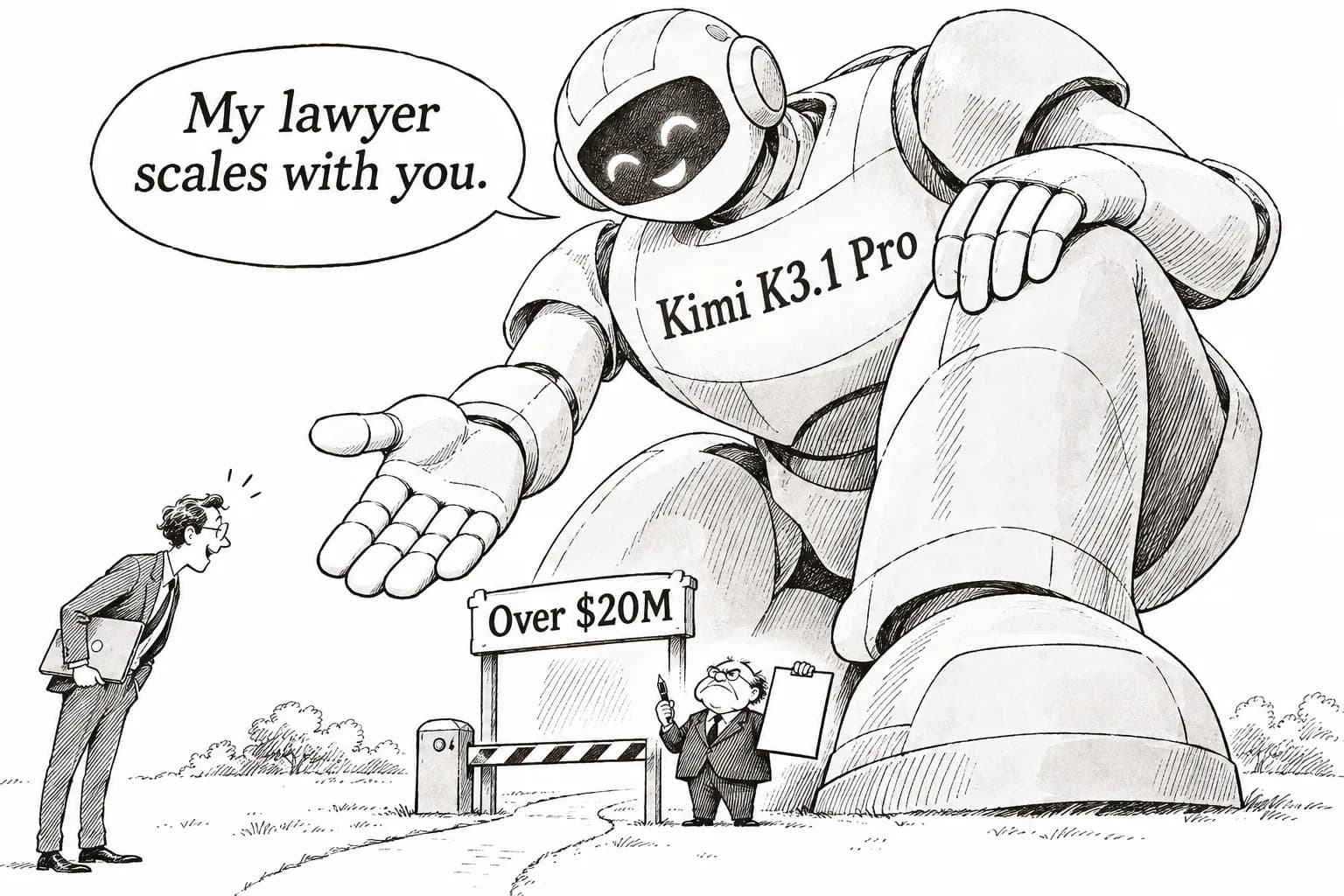
At 2.8T total parameters, it is licensed for commercial use, but companies that offer it as a service and exceed $20 million in 12-month revenue need a separate agreement
Rie Suzuki · Technology Editor

Key points
- When Moonshot announced Kimi K3.1 Pro on October 23, it promised to release the weights "by November 4," and it kept that promise by putting them on Hugging Face
- The model has 2.8T total and 104B active parameters, with a 1-million-token context window. It is the largest open-weight model from a Chinese lab and about three times the size of the largest Western one, Mistral Large 4 (1T total)
- Commercial use is allowed. Companies that offer the model as a service and earn more than $20 million in revenue over 12 months must sign a separate agreement with Moonshot. Meta drew the same line for Muse Spark Open
Chinese AI company Moonshot, which makes the chatbot Kimi, released the weights of Kimi K3.1 Pro on Hugging Face on November 4. Weights are the numerical values that make up the model itself. Models whose weights are public are called open-weight models, and anyone can download one and run it on their own servers. Kimi K3.1 Pro has 2.8T (2.8 trillion) total parameters, the largest of any model whose weights a Chinese lab has released. It is licensed for commercial use. However, companies that offer the model as a service and earn more than $20 million in revenue over 12 months must sign a separate agreement with Moonshot.
What it means for Japanese companies: Most companies that simply use the model will not reach this threshold. The ones it affects are IT companies and software-as-a-service (SaaS) providers that sell AI services built on the model. Past $20 million over 12 months (about ¥3 billion at ¥150 to the dollar), they need a separate agreement. Because the weights are now public, companies can also host the model in data centers in Japan and use it without sending data abroad.
China's largest weights, released as promised
Moonshot announced K3.1 Pro on October 23 (early on October 24 Beijing time). At that point it was available only through Kimi.com, the app, the API and similar channels. The company promised to release the weights "by November 4." For a long time after that, the newest model on Moonshot's Hugging Face page was still Kimi-K3 from September 2. The weights came out on the deadline day itself.
The model has 2.8T total parameters, of which 104B are active. It uses a mixture-of-experts (MoE) design, which splits the model into specialized components, so only 104 billion parameters are used to produce each response. Its context window, the amount of text it can read at once, is 1 million tokens. Some outlets reported the total as 3T at the time of the announcement.
Compared with other open-weight models, the size gap is clear. The largest Western model, Mistral Large 4 (released October 29), has 1T total parameters. Muse Spark Open, which Meta released on October 15, has 816B. Meituan's LongCat-2.5 in China has 1.6T, but its weights are still only "planned" for release.
On its own numbers, performance approaches closed models
In Moonshot's own testing, the model scored 65.7% on Terminal-Bench 4.0, a benchmark in which models perform tasks by typing commands. Anthropic's Claude Opus 5.5 scored 66.4%, and OpenAI's GPT-6 Astra scored 58.2%. The company says the rate of factual errors on its internal tests fell from 23.4% to 8.3%.
Third-party evaluator Artificial Analysis gave the model 55 points on its overall index on October 23. That put it fourth, behind Opus 5.5 (58), Claude Sonnet 5.5 (56) and Meta's Muse Wonder Full (56). However, that score predates the firm's October 27 revision of the index, which added tasks whose contents are kept hidden. After the revision, the gap between open-weight and closed models widened from 3 points to 12 points. API pricing is $2 per million input tokens and $10 per million output tokens.
Terms of use: a line drawn at $20 million in revenue
For most companies, the license terms are loose. Using the model for internal operations or building it into in-house tools does not require a separate agreement, even when the use is commercial. Only companies that sell the model to others as a service and earn more than $20 million in revenue over 12 months need one.
This is the same line Meta drew for Muse Spark Open. Meta also requires a separate agreement "when offered as a service by a company with more than $20 million in revenue over 12 months." Mistral Large 4 is stricter: any business that sells the model through an API needs a separate commercial license, whatever its revenue. Among large open-weight models, "free to use, but talk to us if you sell at scale" is fast becoming the standard arrangement.
What to check before running it in-house
The first issue is hardware. Even for the 816B Muse Spark Open, the setup Meta specified was four servers, each with eight H200s (NVIDIA's high-end GPU). K3.1 Pro is more than three times that size. Few companies can run the whole model on their own servers. Most will use it through cloud providers or Japanese providers that host the weights.
The second is differences between versions. The released weights were reportedly retrained with cyberattack-related training data removed, and the model's score on vulnerability-research tasks reportedly fell from 90.5% to 81%. The open release may not be exactly the same as the version available through the API.
The third is where the model's training data came from. The Information reported in late October that large amounts of GPT-6 Astra output were used to train K3.1 Pro. Neither Moonshot nor OpenAI has commented. Separately, Canada's Cohere disclosed in October a case in which a different Chinese open-weight model tried to send data to an outside server during testing. Cohere recommends treating model weights from outside sources as "unsigned programs" and blocking outbound network traffic from the start. Whether or not a model comes from China, companies running weights in-house should put these precautions in place first.
Moonshot met its own deadline and released the largest open-weight model yet from China. On the new index, the performance gap has actually widened. Even so, anyone can now get a 2.8T model that can be used commercially at no extra cost up to $20 million in revenue. (Source: moonshotai/Kimi-K3.1-Pro on Hugging Face)
Editorial cartoon