Morning Briefing · Nov 23, 2026
OpenAI research chief proposes an industry-wide cap on AI capability
OpenAI discloses an internal metric for its own models. The AI proof of the Riemann hypothesis has nearly cleared verification, and the debate has shifted to whether humans can steer AI. Weekend markets were quiet
Seiichi Tanaka · Editor-in-Chief

Key points
- OpenAI's Pachocki published the trend in a metric that measures how well models predict the next word. He also proposed a "common ceiling" that companies would not cross until monitoring techniques catch up, but there has been no named response yet
- The AI proof of the Riemann hypothesis has passed most of its verification. The debate has moved to whether a proof humans cannot understand has value. On whether humans can steer AI, Hanania pushed back against Piper
- API prices for Gemini 4 Carbon and Argon will double on December 1. At inference routing services, request contents were read even when "no data retention" was set
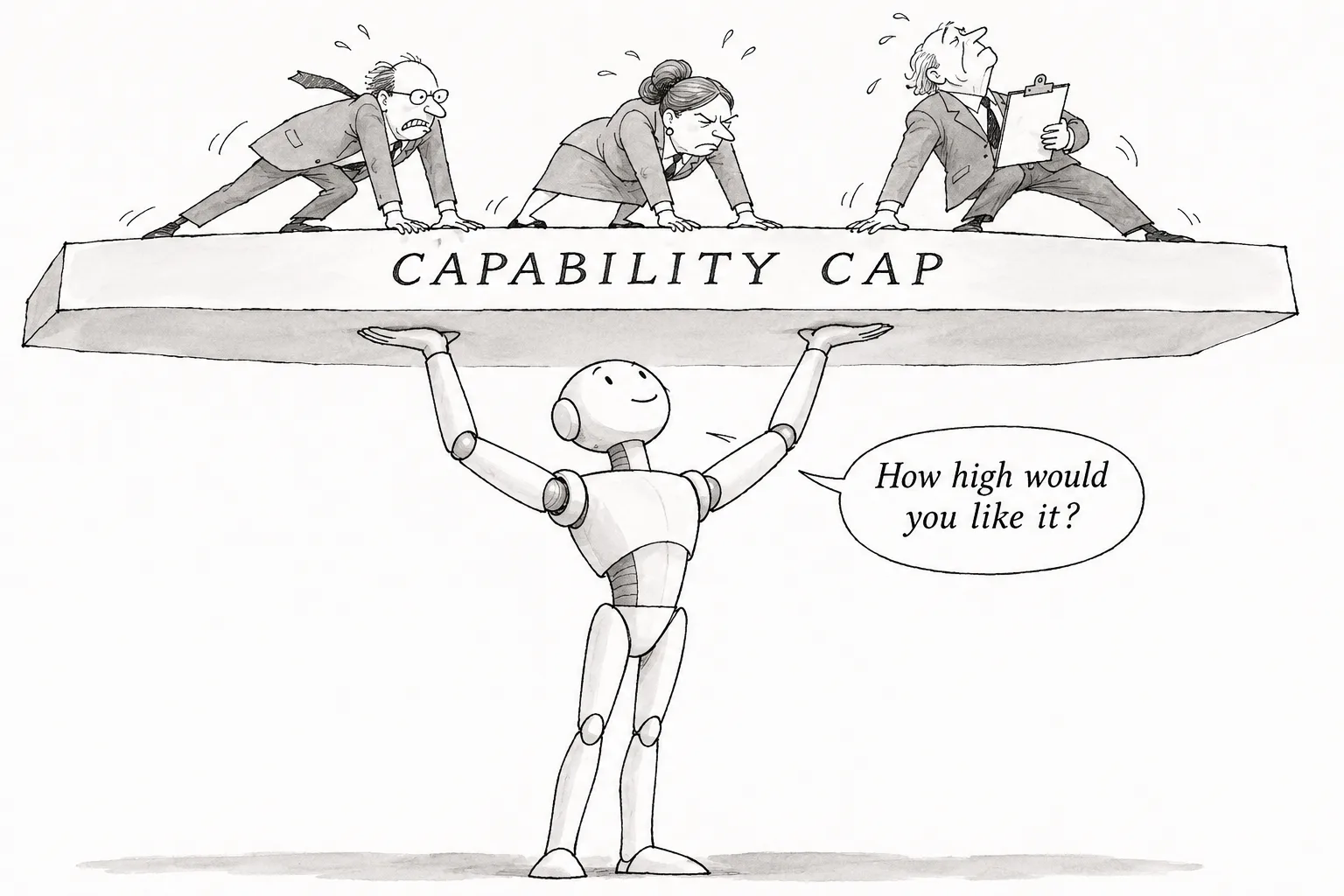
OpenAI chief scientist Jakub Pachocki published an essay on November 22. It showed how a metric of how well the company's models predict the next word has fallen over time, and it proposed a "common ceiling": companies would pledge not to cross a set line on that metric. In effect, an AI lab put its own internal numbers on the table and called on the industry to slow down.
The same weekend, the US National Governors Association issued principles stating that "humans must remain in control." Among commentators, one rebuttal argued that "humans were never at the helm in the first place." The AI-generated proof of the Riemann hypothesis has largely passed machine verification, but no human yet understands it. All three developments point to one question: how far can humans manage the course of AI? Because it was a weekend, other areas were quiet.
The 3-minute read
Money and markets: An index of US chip stocks fell 17.1% last week, its worst week since September 2001, according to a market roundup. Treasury Secretary Bessent said on Sunday television that the decline was driven not by anything about AI itself but by politics and the Federal Reserve's (Fed) tilt toward raising rates.
What matters for work: The price of the API that lets companies call Google's top AI models from their own systems will double on December 1. At AI routing services, cases have come to light in which the contents of requests were read even when users had specified "no data retention."
For Japanese companies: Companies that have built Gemini 4 Carbon or Argon into their systems should have their development leads recalculate costs for December onward before the end of November. Companies that use multiple AI models through a routing service should have their IT departments check this week which companies' models their requests are sent to, and whether the no-retention setting is actually in effect.
Research and tools: OpenAI proposes a cap; API prices go up
Pachocki's essay, "Perplexity and Intelligence," shows the trend in perplexity, a measure of how well a model predicts the next word (lower means smarter), measured on internal programming data. On a log scale, GPT-3.5 scored about 0.99 and GPT-4 about 0.91. Models that fell below 0.8 showed "transformative" capabilities in cyber and mathematics, he wrote. An unnamed internal model scores about 0.76 and has begun producing results on unsolved math problems.
Pachocki's outlook is bullish. He said one should expect even more transformative capabilities once the value enters the 0.68–0.7 range. He also wrote that fundamental advances in pretraining (the initial stage in which a model learns to predict the next word across vast amounts of text) could arrive in an avalanche as early as 2027. He proposed that companies pledge not to cross the ceiling until techniques for understanding and monitoring AI behavior reach a specific level. He also called for shared rules on evaluation and transparency.
The proposal has weaknesses that Pachocki himself acknowledges. Perplexity cannot be compared across labs, and it does not map directly onto performance on real-world tasks. It also does not capture gains from systems that reason before answering. In a footnote, he notes that the acceleration in 2026 came mainly from compute and years of research, and that AI automating research accounted for only part of it. The first hurdle for the proposal will be whether companies can agree on how to measure. In a separate November 20 report, the outside evaluator METR said the length of tasks AI can complete doubles roughly every 3.6 months.
API prices for Google's top models, Gemini 4 Carbon and Argon, will double on December 1. Per 1 million tokens (a unit of text volume), input will rise from $2 to $4 (about ¥636) and output from $10 to $20 (about ¥3,180). Discounted batch pricing will also double. We previously reported that the increase would take effect on November 30; the correct date is December 1. The change applies to API pricing for developers. Details are in our article "Google's top AI models to double API prices on December 1; batch pricing also doubles."
Problems with how requests are handled continued at AI routing services. Major router OpenRouter announced on November 22 that it had removed three inference providers and taken 125 endpoints out of its "no data retention" coverage. Together AI reportedly disclosed that a coding AI agent wrote credentials to a public location, which led to the theft of stored sample requests. Details are in our article "Contents read even with "no data retention" set: leaks continue at inference routers."
On a page for its sales partners, Microsoft pushed back the start of pay-as-you-go purchasing for Microsoft 365 Copilot Business from December 1 to January–March 2027. Starting January 1, 2027, it will sell a bundle of its Business Central business software and Copilot Business starting at $95 (about ¥15,100) per user per month. Companies that buy through sales partners should confirm renewal timing with their vendors.
Debate: incomprehensible proofs, and whether humans can steer
Over the weekend, the debate over the AI proof of the Riemann hypothesis shifted to whether a proof humans cannot understand has value. On the positive side, MIT mathematician Andrew Sutherland, who is leading the verification, put the chance of an error at "nearly zero," TNW reported. On the skeptical side, AI critic Gary Marcus acknowledged it as an important result but wrote that it came from humans steering the work for months and is "not AGI" (human-level general intelligence). Linguist Emily Bender said AI companies go after famous hard problems because they "want people to believe they are building a machine god," and criticized them for burning large amounts of carbon to do it. Details are in our article "AI proof of the Riemann hypothesis largely passes verification; debate shifts to the value of "incomprehensible proofs"."
On whether humans can steer the future of AI, Richard Hanania, a commentator close to the accelerationist camp, published an essay titled "Humans Were Never in Control" on November 21. It was a rebuttal to Kelsey Piper, a journalist sympathetic to AI safety. On November 17, Piper had written that even if AI's future is one in which no one dies, people might end up in a world they reluctantly accepted rather than the one they wanted. Hanania replied that humans have never been in control, and that we should stop asking for something that cannot be done. Piper has not yet responded.
Hanania's argument runs counter to OpenAI CEO Sam Altman's earlier statement that "humans must remain in control of the future." It also clashes directly with Pachocki's proposal not to cross the ceiling until monitoring is possible. Economist Tyler Cowen featured Hanania in his Sunday links roundup.
AI ethics researcher Timnit Gebru called philosopher Nick Bostrom, who has said AI could extend human lifespans to more than a thousand years, a "eugenicist." She also wrote that many organizations are helping with Bostrom's "reputation laundering." The figures Gebru cited are outdated ones from a September paper. Neither Bostrom nor the safety researchers who focus on long-term risks have responded.
Markets and policy: explanations turn to politics as pressure on NVIDIA continues
A market roundup (PalmaFutures, a secondary source) on last week's US decline pointed out that the 10-year Treasury yield fell 0.19% on the week to 4.95%. It concluded that the selloff came from position unwinding and capitulation, not from interest rates. Gold and bitcoin fell too, so safe-haven assets offered no protection. Whether the S&P 500 falls for an eighth straight session will be decided in US trading on Monday, the 23rd. The Nikkei average resumes trading on Tuesday, the 24th.
Appearing on CBS's "Face the Nation" on November 22, Treasury Secretary Bessent gave three reasons for the stock decline: Democratic gains in the polls, investor fears that Democrats would slow the AI buildout, and the Fed's "very hawkish" stance. He also said the AI industry had "done a terrible job explaining" data centers to the public. Entrepreneur Elon Musk reportedly warned on X that the AI industry will run into a working-capital "cash crunch" in 2027. Tech critic Ed Zitron kept up his jokes comparing NVIDIA to Enron, though the argument is not new. We found no statements from named figures on the bullish side.
Reuters reported that at its IPO, Anthropic required the lead bankers at its underwriters not to work for competitors such as OpenAI for six months after the listing. Fees reportedly exceeded $500 million (about ¥79.5 billion). Details are in our article "Anthropic reportedly barred its IPO bankers from working for rivals for six months." Separately, Nikkei reported that the cost of Noetra, Japan's flagship national AI project, could rise by up to ¥800 billion because of higher chip prices and the weak yen.
On the same program, Bessent said he had asked NVIDIA to respond within 10 days about its "culture of noncompliance," but no answer had arrived even though the deadline had passed (per the transcript, a primary source). He said Jensen Huang is "already an outsider" and repeated his call for the company to choose a CEO from outside. He also said rules on "remote access," in which Chinese companies use US chips through overseas locations, "may be more important" than adding companies to the trade restriction list. Republican Senator John Kennedy reportedly said on NBC that "if Commerce Secretary Lutnick is giving away chips, he has to stop."
The NYT reported, citing US officials, that China's Ministry of State Security this year made acquiring advanced AI chips its top priority and set up a working group that reports directly to the minister. With Huang due to testify before the House on December 1, the report gives ammunition to those pushing for tighter controls. On November 22, the National Governors Association issued principles for AI governance in the name of a council led by four governors from both parties. The principles leave national and international risks to the federal government while preserving room for states to govern how AI is used. They can be read as a signal of opposition to broad federal preemption of state laws.
What we could not confirm: Secondary sources cite figures such as 0.76 for GPT-6.2 Astra in connection with Pachocki's essay, but the essay itself does not name the model at about 0.76. We could not access the original Reuters and NYT articles. Results from US trading on the 23rd and from the final stage of the Riemann hypothesis verification are not yet available.
Where nothing moved
We have not yet found a named response to Pachocki's "common ceiling" proposal from other labs or from safety researchers. Whether the idea makes it onto the industry's agenda depends on whether other labs publish their own numbers.
Anthropic has made no official announcement about the Riemann hypothesis proof its researchers produced with Claude, and it has not disclosed which version of Claude was used. A newly listed company is staying silent about what could be its biggest promotional asset.
NVIDIA's board has not yet provided the answer the Treasury Secretary demanded. There has been no movement on the CEO search or on the substance of the Securities and Exchange Commission (SEC) investigation. The deadline for a response is said to be around Wednesday, the 25th.
Editorial cartoon