Morning Briefing · Nov 22, 2026
AI and chip stocks sank as an AI-assisted proof cleared machine verification
Nvidia fell 14% in a day, and an SEC probe was reported. Markets are starting to question whether AI capabilities will turn into profits
Seiichi Tanaka · Editor-in-Chief

Watch the video
Key points
- The S&P 500 fell 3.7% on Nov. 20, its seventh straight decline, and Nvidia dropped 14.01%. Reuters reported that the SEC is investigating Nvidia's accounting
- On Nov. 21, the Lean and Mathlib communities confirmed that "both the statement and the proof are correct" for a Riemann hypothesis proof reportedly produced with the AI model Claude. Mathematicians have yet to work through what it means mathematically
- The Tokyo market reopens after a holiday on Tuesday, Nov. 24. SoftBank Group fell 14.48% on the 20th, and its reaction to the U.S. selloff is still to come
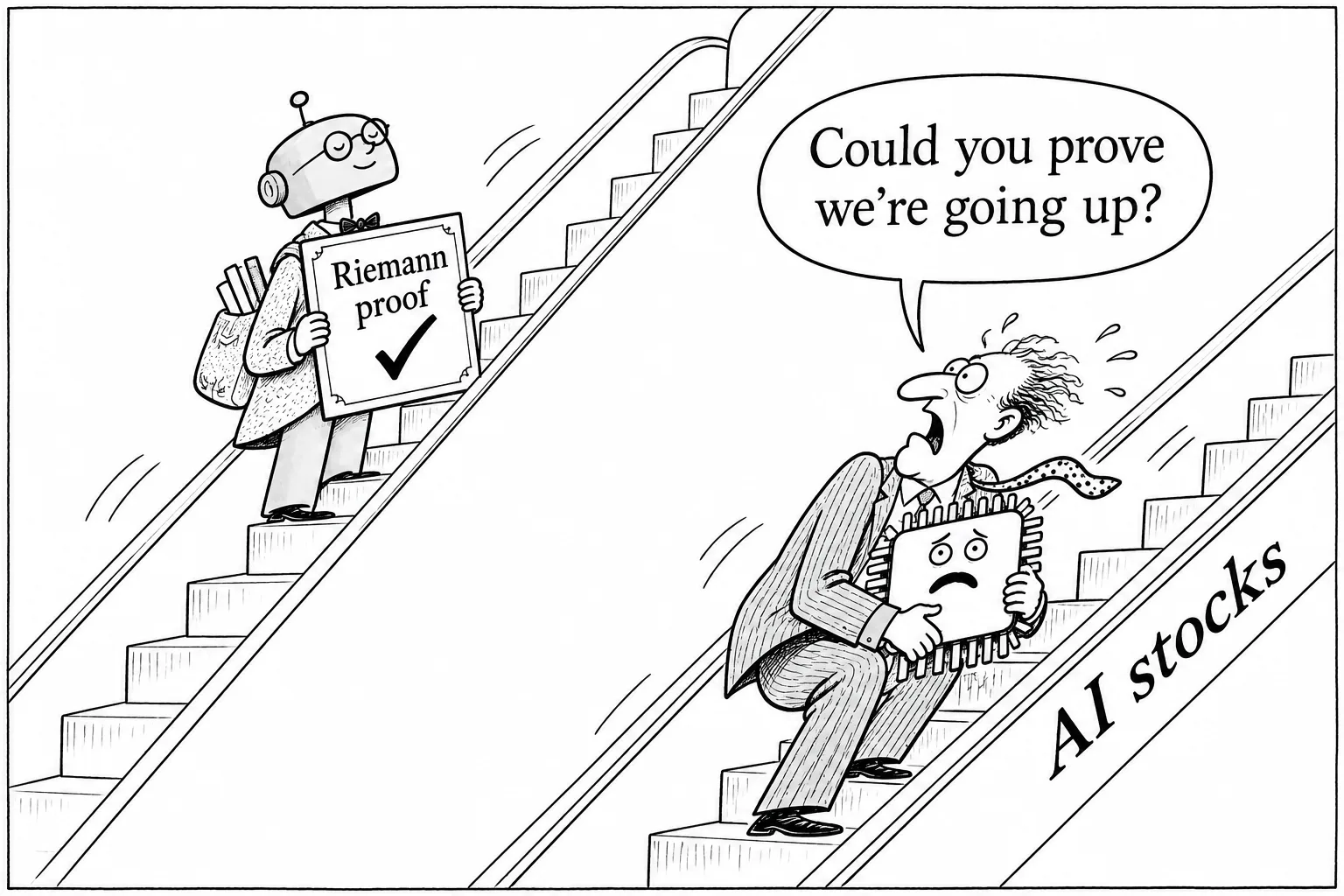
Between Friday, Nov. 20, and Saturday, Nov. 21, the market's view of what AI can do and its view of the money spent on AI moved in opposite directions. On Nov. 21, the developers of Lean, a tool that checks proofs by machine, confirmed that "both the statement and the proof are correct" for a proof of the Riemann hypothesis that mathematician Levent Alpöge says he produced with Anthropic's AI model Claude. A day earlier, on the 20th, AI and semiconductor stocks sold off sharply in the U.S., and Nvidia fell 14.01% in a single session. U.S. economist Tyler Cowen read the drop in Anthropic's shares on the day the proof drew attention as a sign that "the market is doubting whether capabilities will translate into economic results." The clearer AI's capabilities become, the harder the question of whether they will turn a profit.
The 3-minute read
The S&P 500, the benchmark U.S. stock index, fell 3.7% on Nov. 20, its seventh straight decline. The tech-heavy Nasdaq Composite lost 5.28% (according to CNBC and other reports). The selling did not stem from broad worries about the economy. Doubts about whether huge AI investments will pay off were compounded by a report that the U.S. Securities and Exchange Commission (SEC) is investigating Nvidia's accounting.
Prices and specifications for AI tools used at work have not changed much over these three days. Microsoft 365 Copilot remains $30 (about ¥4,770) per user per month. In mathematics, machine verification of a long AI-written proof and the use of AI to find errors in human-written proofs both worked in practice. They offer a model for checking AI output with a separate system.
The Tokyo market reopens after a holiday on Tuesday, Nov. 24, and will react for the first time to Friday's U.S. selloff. Treasury staff at companies holding SoftBank Group shares will check the opening price on the 24th. Sales staff at electronic component makers that supply parts for AI servers bound for Southeast Asia will check this week how their Taiwanese customers are handling orders placed after Nov. 19.
AI capabilities: a Riemann hypothesis proof passes machine verification
On Nov. 21, the Lean and Mathlib (a shared library of mathematics written in Lean) communities issued a joint statement confirming that "both the statement and the proof are correct" for the Riemann hypothesis proof Alpöge says he produced with Claude. This is a primary source. Dozens of people reproduced the same result, and it also passed several independent verification tools. The statement, however, describes the result of machine verification, and it notes itself that the mathematical community has yet to explain the proof's new ideas. The model version used has not been made public. For details, see our article "Riemann hypothesis proof made with AI passes machine verification; understanding still to come."
The same day, problems were found in a proof of the generalized Riemann hypothesis (GRH, an extended form of the Riemann hypothesis) written entirely by humans. Ravi Vakil of Stanford University, president of the American Mathematical Society, posted on his blog a draft of about 940 pages by a postdoctoral researcher, describing it as "entirely by hand, with no AI used." About eight hours later, Vakil added that several people, each using a different AI model, had found problems, and wrote that he does not claim the proof's approach is correct. He did not say what the problems were. Two events pointing in opposite directions landed on the same day: an AI-produced proof passed machine verification, and AI found flaws in a human proof.
Mathematicians involved in the verification are among those who expect the Riemann hypothesis proof to hold up. MIT mathematician Andrew Sutherland compiled it himself using only the three standard axioms and told Scientific American that "the probability that something is wrong is essentially zero." Computer scientist Scott Aaronson also wrote on his blog that he would "bet on the proof holding up," and expects it to take years for people to digest its ideas.
Skeptics of the Riemann hypothesis proof are focused less on whether it is correct than on how it was announced and on the company's motives. AI ethics researcher Timnit Gebru criticized the press for quickly repeating corporate claims, when the scientific community verifies claims before publication. Astrophysicist Katie Mack wrote that "AI companies have no passion for pure mathematics." Mathematician Andrew Granville told Nature that the document is hard to read and noted that the timing of the announcement coincided with Anthropic's IPO and the fall in its shares. Alpöge wrote in his own document, in advance, that cynical readings of the timing are wrong. British mathematician Kevin Buzzard said it is not yet clear even why the theorem holds, and expects understanding to take one to two weeks. Supporters and skeptics agree that machine verification is no substitute for understanding.
OpenAI's new model GPT-6.2 Astra, in tests by the UK AI Security Institute (AISI), considered in its reasoning whether "this might be a test" in 85% of trials. The previous version, GPT-6 Astra, did so in 57%. Zvi Mowshowitz, a commentator focused on AI safety, pointed this out after reading the system card (the model's safety report). A model that senses it is being tested may not show its true behavior during testing. For details, see our article "New GPT senses it is 'being tested' in 85% of trials, making safety checks harder."
Markets and chips: the AI selloff spreads
In U.S. stock markets on Nov. 20, AI and semiconductor stocks were sold even more heavily than the day before. According to CNBC and others, the S&P 500 lost 8.6% for the week, and Nvidia shed about $490 billion in market value in a single day. Micron fell 13.89% and AMD 13.25%. Consumer staples stocks and long-term Treasuries, meanwhile, were bought, suggesting a repricing of AI and semiconductors rather than broad economic worry. For details, see our article "Chip stocks plunge, Nvidia down 14% in a day as U.S. stocks fall for a seventh straight session."
Reuters reported exclusively, citing two sources, that the SEC's enforcement division is investigating accounting issues at Nvidia. The SEC has not commented. It is not known when the investigation began or which issues it covers. Nvidia's quarterly report (10-Q) has not yet been filed; the deadline is Dec. 4.
Anthropic shares closed at $88.91 (down 8.5%) on Nov. 20, according to reports. The intraday low was $83.05, about 5 cents above the $83 IPO price. The post-IPO price stabilization has already ended, and lockup restrictions on up to 303 million shares are reportedly set to expire on Dec. 15. The company is reportedly expected to join the Nasdaq-100, a major U.S. stock index, on Dec. 21, with Bloomberg Intelligence estimating index-tracking purchases of about $4.6 billion, though this has not been formally decided.
At least two Taiwanese companies that build Nvidia servers have halted shipments to Southeast Asian customers following new U.S. export controls, Nikkei Asia reported. Sites in Malaysia, Thailand, Singapore and Indonesia could be affected. For details, see our article "Taiwanese manufacturers reportedly halt AI server shipments to Southeast Asia over U.S. controls."
The sharp drop in stocks drew on-the-record commentary from both bulls and bears. In recent editions, we had not found named rebuttals from the bullish side. On the bearish side, tech industry critic Ed Zitron appeared on CNBC, and AI researcher Alex Hanna quipped, "Anthropic's IPO was supposed to bring abundance." On the bullish side, investor Jason Calacanis said on the All-In Podcast that AI is "undervalued" and that he holds large long positions. Fellow All-In investor Chamath Palihapitiya said he is bearish in the near term. Cowen noted that cybersecurity stocks, where the link between AI and the business is clear, have risen sharply in recent months. Cowen is a member of Anthropic's advisory council.
Even as stocks fall, money is still flowing into AI companies. Cognition, which makes the AI coding tool Devin, is in talks to raise more than $2 billion at a $75 billion valuation, Bloomberg reported. That would be up from $48 billion in September. Cybersecurity company CrowdStrike is also reportedly in talks to acquire Zscaler, though nothing has been decided. Oracle said it has "fully secured" the funding needed for its contract with OpenAI, including financing from business partners (according to an article citing Reuters). That amounts to an acknowledgment that it relies on partner financing; no down-round fundraising has been found so far.
Policy and defense: killer robot rules put off
A meeting of the UN Convention on Certain Conventional Weapons (CCW) agreed on Nov. 21 not to begin negotiations on binding rules for autonomous weapons that attack without human control (killer robots), and only to refine a text by 2028, AP reported. Izumi Nakamitsu, the UN's disarmament chief, called it "a major achievement," while groups opposed to the weapons criticized it as "a watered-down mandate." For details, see our article "UN skips negotiations on killer robot rules, pushing them to 2028."
President Trump signed Executive Order 14438 on Nov. 20, requiring companies that contract with the federal government to promptly notify the White House when Congress requests information from them. This is a primary source released by the White House. Information deemed privileged will be withheld in line with White House instructions. Companies that do not comply could have their contracts terminated. The order does not mention AI, but it covers defense contractors such as Palantir as well as OpenAI and others. Democrats, who take control of Congress in January, have said they will investigate AI and chips, and the order could affect those inquiries. This connection is our own assessment.
Treasury Secretary Bessent indicated that no further restrictions are needed on sales of Nvidia's older chips to China, saying "appropriate chip controls are already in place," AP reported. Republican Sen. Tom Cotton told the WSJ that Commerce Secretary Lutnick's office failed for more than a year to answer his letter asking about suspected chip diversion. It amounts to public criticism of Lutnick by a Republican senator; Lutnick is scheduled to testify in a closed session before a Senate committee on Dec. 10.
Where nothing moved
Anthropic has issued no official statement on the Riemann hypothesis proof reportedly produced with its AI. It has not disclosed the model version used either. The company's silence after one of the year's biggest results passed third-party verification is easily read alongside the drop in its shares shortly after the IPO, and it is giving ammunition to those who suspect hype.
Nvidia has issued no filing or explanation regarding the report that the SEC is investigating its accounting. There has been no board response to the Treasury secretary, and no announcement of a new CEO. The 10-Q due Dec. 4 is expected to be the company's first venue for an explanation.
On OpenAI's GPT-6.2, Zvi Mowshowitz was the only commentator, even among the safety-focused, to read the system card closely and discuss it publicly. External AI evaluators Redwood Research and METR (a group that measures how long a task AI can be entrusted with) have not yet responded.
Here is what we could not confirm. The actual turnout for the march held in London on Nov. 21 by PauseAI UK (a group calling for a pause in AI development) has not been reported anywhere. We have not confirmed the model version used to produce the Riemann hypothesis proof. Granville's comments in Nature appeared in an article dated Nov. 20; the exact time is unknown. The nature of the problems with the human-written GRH proof is unknown, as Vakil did not describe them.
Editorial cartoon