Morning Briefing · Nov 20, 2026
Claude maker's record IPO opens 34% higher, then loses steam by midday
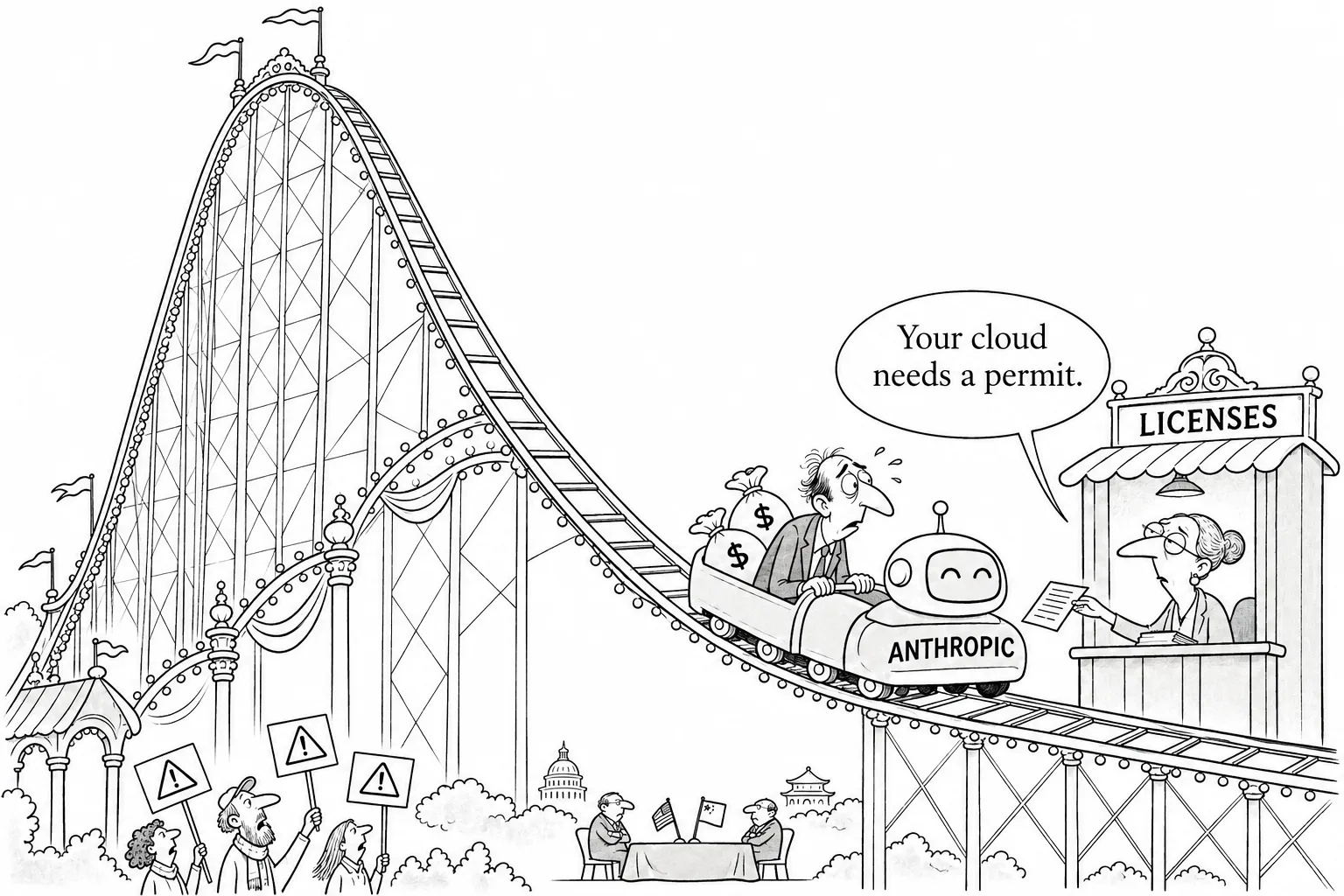
On the same day, safety advocates criticized the company en masse, and the U.S. began requiring licenses for access to AI chips through the cloud. A U.S.-China summit produced no agreement on chips or on extending the truce
Seiichi Tanaka · Editor-in-Chief
Watch the video
Key points
- Anthropic went public at $83 a share, raising about $81.3 billion, the largest IPO on record. The stock fell from its opening price of $111.50 to $95–100 by midday, and the Dow Jones Industrial Average fell about 2% intraday
- On the day of the IPO, safety advocates criticized the company en masse, saying "it is no longer a safety company," while management repeated that safety remains its top priority. Both optimists and skeptics read the listing as a sign that "superintelligence is not coming soon"
- The U.S. began requiring licenses for access to AI chips through the cloud, effective immediately. A U.S.-China summit in Shenzhen produced no agreement on chips or on extending the truce
Anthropic, the maker of Claude, listed on the U.S. Nasdaq on November 19. It sold about $81.3 billion worth of shares, the largest IPO on record. The stock opened 34% higher but had lost momentum by midday. On the same day, safety-focused researchers criticized the company en masse, saying "this company is no longer a safety company." The U.S. government began requiring licenses for Chinese companies to access AI chips through the cloud, with the rule taking effect the same day.
These events point to the same dynamic: AI companies have entered a stage where they are judged by both the stock market and politics. The more money an AI company can raise, the more exposed it becomes to shareholders and governments. Within that, how to balance "safety" against "speed" has become the center of the debate.
The 3-minute read
On money and markets, Anthropic's shares were priced at $83 each (about ¥13,280) and opened at $111.50. They later fell to around $95–100. In the broader U.S. market, the Dow Jones Industrial Average fell about 2% intraday, while a semiconductor stock index fell only 0.2%. That means the decline cannot be blamed on AI alone. For details, see "Claude maker goes public in record IPO of about $81.3 billion, opens 34% higher."
On news that matters for work, two versions of a Microsoft developer tool for AI agents contained malicious code that steals passwords and keys. Google's new AI launched at less than 40% of the price of a rival's top model. Microsoft will sell a bundle of business software and AI starting January 2027 for $95 (about ¥15,200) per user per month.
What this means for Japanese companies depends on the industry. IT departments developing AI agents in-house should check this week whether they installed the affected versions of the Microsoft tool, and if so, rotate all keys. Companies operating data centers or GPU cloud services in Southeast Asia should identify any customers headquartered in China or Macau by around February 17, 2027, the licensing deadline. For the majority of companies that fall into neither group, today's developments have no direct impact.
Tools: Google's new AI is cheap, and developer tools become an attack vector
Google DeepMind on November 18 released Gemini 4 Neon, a mid-tier AI model. It is priced at $3 (about ¥480) per million input tokens and $15 (about ¥2,400) per million output tokens. That is less than 40% of the price of the rival top model it was compared against ($8 input, $40 output), and it ranked third on Google's composite index. For companies on Google's paid AI plans, the more immediate cost impact is that discounts on older models end on November 30 (secondhand information). For details, see "Google's new model ranks third overall at less than 40% of the price of top models."
Google announced on November 19 that AI in its Gemini app for Mac can now operate the computer, TechCrunch reported. The feature is available only to paid users in the U.S. and only in English. OpenAI and Anthropic have already released similar features, so Google is catching up.
In Microsoft Agent Framework, Microsoft's toolkit for building AI agents, two Python versions contained malicious code. The code was reportedly designed to steal credentials for cloud services, GitHub and OpenAI. It is an example of the tools used to build AI agents themselves becoming an entry point for attacks. For details, see "Malicious code found in Microsoft's AI agent developer tool: two versions contained key-stealing code."
Money: a record IPO, and chipmakers' "customer support commitments"
In Anthropic's IPO, the $83 price exceeded the company's indicated range ($70–78), and the number of shares sold was increased to 980 million (company announcement). Its market capitalization at the opening price was about $2 trillion, and later about $1.78 trillion, Reuters reported. Only about 7.4% of the shares are in public circulation, leaving many buyers competing for a small float. AMD, Broadcom, Google, Microsoft, NVIDIA, TSMC and others bought a combined $26 billion worth of shares at the IPO price, CNBC reported. The buyers were all business partners that sell chips or computing power to AI companies.
Among U.S. chipmakers, financial commitments to support customers have repeatedly come under scrutiny. NVIDIA has not yet filed the quarterly report it usually releases on earnings day, saying it will do so "in the coming weeks." The maximum amount it guarantees for customers' debt and other obligations is $118 billion, according to its earnings materials. AMD shares fell about 10% intraday on November 19. The trigger was a report by Hunterbrook, known for short selling, which took issue with AMD firmware being found in products from a Chinese company that the U.S. has barred from trading, as well as more than $33 billion in loan and lease guarantees and up to 320 million shares pledged as collateral. However, short sellers stand to profit when a stock falls. AMD said the report mischaracterizes its practices.
At China's Alibaba, AI cloud revenue grew 53% in the July–September quarter. But capital expenditure rose 60%, and free cash flow turned negative. For details, see "Alibaba's AI cloud grows 53%, but capital spending pushes cash flow into the red." In Asian stock markets, SoftBank Group rose 4.55% and Kioxia gained more than 3% on expectations around NVIDIA's earnings and Anthropic's IPO.
Debate: safety criticism on IPO day, and "is superintelligence near?"
On the day of Anthropic's IPO, safety-focused researchers criticized the company en masse. Nate Soares of the research group MIRI criticized Chief Executive Officer Dario Amodei for equivocating on television and before Congress, writing that "companies like Anthropic must be stopped." Dan Hendrycks of the Center for AI Safety (CAIS) said many safety organizations did not put their names on a critical statement for fear of losing funding, and wrote that Anthropic had largely co-opted the people who were supposed to be watching it.
Others defended or praised Anthropic. An OpenAI employee known as roon praised Anthropic for building some of the best models in history. Management repeatedly emphasized safety. CEO Dario Amodei reportedly said at the listing ceremony that the company would develop AI "taking as much time as necessary" and would not bow to business or political pressure. In front of the Nasdaq, left-wing groups protested, demanding that there be no bailout if the AI bubble bursts.
On how to read the IPO, economist Tyler Cowen (on the optimistic side) and Gary Marcus, known for his criticism of AI (on the skeptical side), reached the same conclusion for opposite reasons: superintelligence is not near. Cowen wrote that a company that believed superintelligence was coming soon would choose debt over an IPO that exposes it to public scrutiny. Cowen has disclosed that he is an adviser to Anthropic. Marcus said revenue growth is already slowing under pressure from cheap Chinese models and urged people not to buy the stock.
On whether AI is already accelerating AI research on its own, OpenAI released internal data, and interpretations split between "not yet accelerating" and "accelerating." For details, see "Has AI sped up AI research? OpenAI's internal data draws split readings." On the same day, Sayash Kapoor, a Princeton University researcher who views AI as a "normal technology," criticized the safety camp for leaning too heavily, based on a small amount of low-quality data, toward views such as "a rapid takeoff within a year" or "superintelligence in 2027." Dean Ball, who worked on AI policy in the Trump administration, agreed.
Policy: U.S. chip rules take effect immediately, U.S.-China summit ends without agreement
A new rule from the Commerce Department's Bureau of Industry and Security (BIS), which handles export controls, was published in the Federal Register on November 19 and took effect that day. Data centers that rent large amounts of computing resources to companies headquartered in China and certain other countries must obtain a license within 90 days. Exports of advanced chips to Indonesia, Malaysia, Singapore, Thailand and Brazil now also require a license. The aim is to close loopholes through Southeast Asia and access through the cloud. For details, see "Chinese companies now need licenses to use AI chips via the cloud, as U.S. rule takes effect immediately."
President Trump and President Xi Jinping met at APEC (Asia-Pacific Economic Cooperation) in Shenzhen, China. The tone was positive, but no agreement emerged, according to reports. There was no decision on extending the tariff truce that expires on January 10, 2027, on controls on gallium and rare earths (materials essential to electronic components), or on a chip arrangement. The November 27 date on which the suspension of gallium and other controls ends also remained unresolved. The two leaders are expected to meet again at the G20 in Miami in December.
Differences between the U.S. and China on how to regulate AI globally also became clear. President Trump reportedly said at an APEC meeting that he opposes any form of "globalist regulation" that would constrain AI. President Xi said AI should be kept under human control and called for cooperation on safety. In the U.S., California on November 18 released a safety report that includes giving the state authority to order an emergency shutdown of AI, among other measures. However, it is a report with recommendations and is not yet law.
What we could not confirm in today's reporting: Anthropic's first-day closing price and the closing prices of U.S. stocks on November 19 were not available at the time of checking. A report that China's Moonshot AI stopped renting chips in Indonesia comes from a single source and is unconfirmed. Whether NVIDIA invested $10 billion in Anthropic is also unconfirmed.
Where nothing happened
Anthropic co-founder Jack Clark posted nothing on the day of the IPO. The latest issue of his weekly newsletter is dated November 16. His silence stands out on a day when criticism of his company poured in.
Accelerationists who argue AI development should move faster, including Marc Andreessen and David Sacks, posted nothing on the day of the IPO. They had signed on to a statement criticizing Anthropic. That means Anthropic's attackers were not limited to the safety camp.
METR and Redwood Research, research groups that externally assess AI risks, have not yet published evaluations of the safety documentation for OpenAI's latest model, GPT-6.2. Early reception from users has been poor (secondhand information). Even so, outside experts have not yet reviewed it, and the only material available for judging whether the model is safe is documentation released by the developer itself.
Editorial cartoon