Morning Briefing · Nov 16, 2026
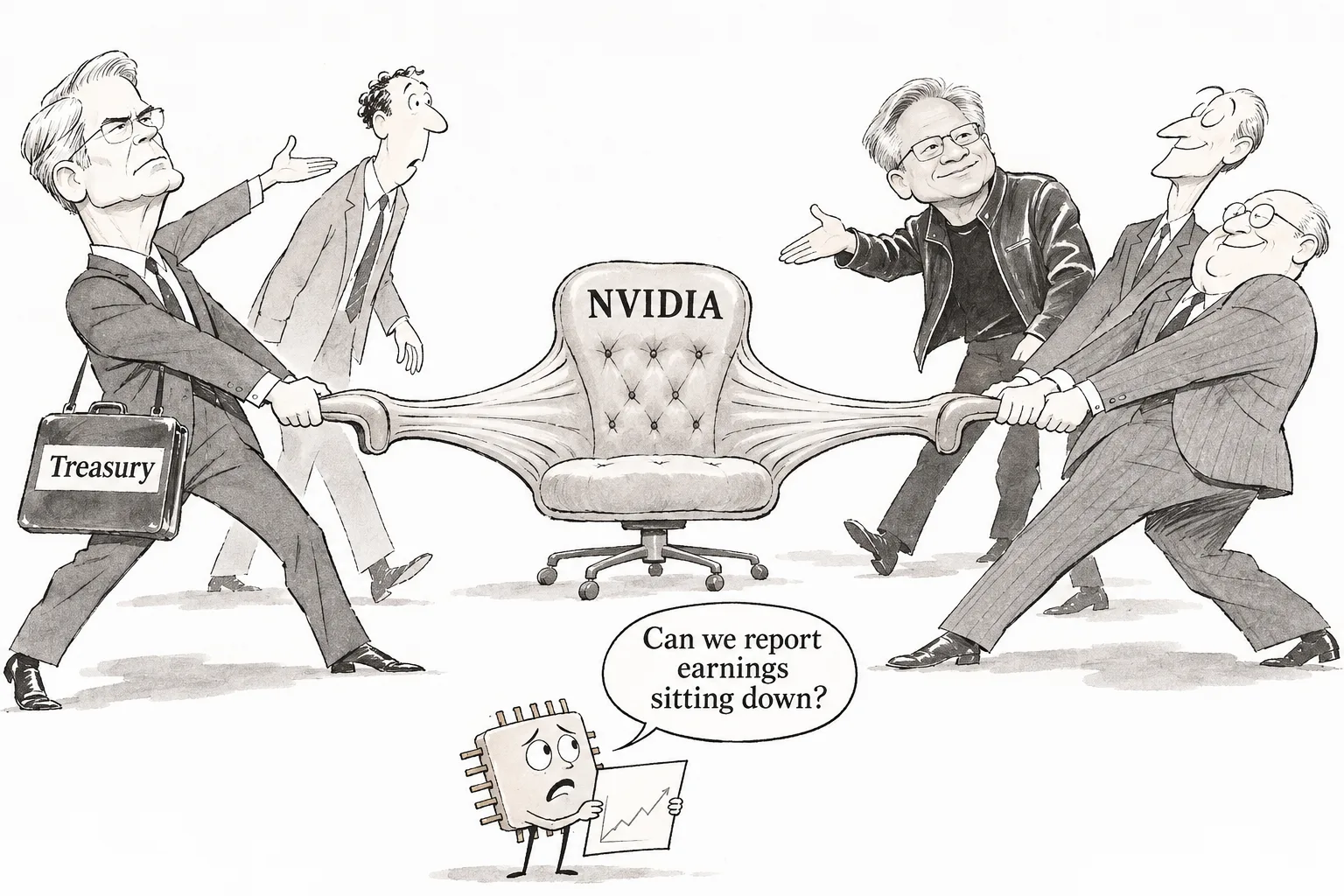
NVIDIA faces opposite demands from government and top shareholders over next CEO, with earnings due tomorrow
The Treasury secretary said the company should "choose from outside" and demanded an answer on export-control compliance within 10 days, while major shareholders want Huang back. Scrutiny has widened to the Commerce secretary, who is expected to travel to China with Trump
Seiichi Tanaka · Editor-in-Chief

Watch the video
Key points
- Treasury Secretary Bessent reportedly said NVIDIA should choose its next CEO from outside the company and demanded an answer on export-control compliance by around November 25. Major shareholders are calling for Huang's return
- Megaspeed said Alice Huang, suspected of being a spy, left in August 2025, and launched an internal investigation. The House has asked Commerce Secretary Lutnick to appear, but he is reportedly expected to travel to China with Trump this week
- NVIDIA shares posted their longest losing streak since 2012, while AMD rose about 13%. Money did not flee AI; it rotated within AI
NVIDIA's troubles have spread from congressional scrutiny to intervention by cabinet officials. Treasury Secretary Scott Bessent said on a television program on Sunday, November 15, that NVIDIA "needs to choose" its next chief executive officer (CEO) "from outside the company," and demanded that the board and outside counsel respond within 10 days (by around November 25) to questions about its culture of export-control compliance, according to reports. Meanwhile, major shareholders sent a letter to the board urging it to bring back Jensen Huang, the former CEO who resigned. The government and shareholders are pulling the company in opposite directions. Earnings are due after the U.S. market close on Tuesday, November 17 (early on the 18th, Japan time), and interim CEO Colette Kress will lead the call. Because it was the weekend, there were no new announcements from AI developers.
The 3-minute read
NVIDIA shares ended the week of November 13 at $162.85, their longest losing streak since 2012. In the same week, however, AMD rose about 13% and the Nasdaq had its best week since August. Money did not flee AI; it moved to other companies within AI (as reported by CNBC).
A White House AI working group has reportedly recommended that companies that voluntarily report AI-related incidents or vulnerabilities be shielded from regulatory liability for at least 12 months. The idea is to make early reporting more advantageous than concealment.
Companies that rent or buy NVIDIA GPUs (the chips used for AI computing) through data centers or cloud services in Malaysia, Indonesia and Singapore should have their IT and procurement staff confirm the supply outlook with their vendors this month, because the U.S. Commerce Department is reportedly drafting a rule requiring licenses for exports to the three countries. Finance staff at companies holding semiconductor-related stocks should be prepared for large share-price moves around the earnings release early on the 18th, Japan time (the options market implies a move of about ±10.8%).
NVIDIA: Government says "choose from outside," major shareholders say "bring Huang back"
According to reports, Bessent questioned whether NVIDIA had "inflated" its revenue and profit through "illegal" sales to China, and asked the board and outside counsel to answer for its culture of export-control compliance. He also said some of its Singaporean customers were "obvious" shell companies serving Chinese interests. On the other side, major shareholders Altimeter (Brad Gerstner) and Atreides (Gavin Baker) asked the board to consider Huang's possible return. Elon Musk also signed a petition backing Huang. Its organizers say it has passed 100,000 signatures, but that figure is their own count. The earnings call will be a forum for answering these questions as well as for the business outlook. For details, see our article "NVIDIA earnings: government and major shareholders make opposite demands over next CEO."
Megaspeed, the Southeast Asian data center company at the center of the affair, issued a statement on November 15 saying that Alice Huang, who is suspected of being a Chinese spy, resigned on August 30, 2025, and holds no position at the company (a company statement reported by CNBC). It said it had hired outside counsel to begin an internal investigation and that reports about the company were "not supported by verifiable evidence." Megaspeed also said its systems are designed to comply with applicable laws, including U.S. export controls. However, a May 2025 report by short seller Culper Research quoted an employee as saying she is "still our boss," which contradicts the statement. The WSJ has reported that Megaspeed arranged about $12 billion (about ¥1.9 trillion) worth of NVIDIA chips on behalf of Chinese companies between March 2024 and June 2025. How many were actually delivered is not known.
Scrutiny has also turned to Commerce Secretary Howard Lutnick. Rep. Jim Himes, the top Democrat on the House Intelligence Committee, said on a CBS program that Lutnick had been "a wall within the government" when it came to stopping chips from flowing to China. The committee, jointly with its Republican chairman, has asked Lutnick to appear. Semafor, meanwhile, reported that Lutnick is expected to travel to China with President Trump this week. Bessent wants Megaspeed placed on the Entity List (a list of entities that U.S. companies need a license to do business with), but that decision rests with the Commerce Department. The White House has said it has "full confidence" in Lutnick. For details, see our article "Chip leaks to China: scrutiny turns to the Commerce secretary as the House seeks his testimony and he heads to China."
Opinion is divided on the spy allegation itself. Among those defending her, investor David Sacks wrote on X that the claim that Alice Huang is a spy is unverified and criticized the NYT for relying on anonymous sources. The Washington Post has also reported that Secretary of State Rubio rewrote a CIA report "in stronger language," which supports the view that the allegation was overstated. On the other side, security expert Dmitri Alperovitch wrote that the smuggling and the failure of compliance systems matter more than whether she is a spy, and Chris McGuire called on Lutnick to resign (both according to newsletter roundups).
Markets: Within AI, money is heading in different directions
HSBC analysts reportedly downgraded NVIDIA from "buy" to "neutral" and cut their price target from about $370 to $170. They said about 11% of revenue over the past six quarters is exposed to tightening export controls. Dan Ives of Yorkville also cut his target from $300 to $225, saying that with Democrats in control of Congress, 10–20% of planned data centers may not get built. An exchange-traded fund (ETF) of emerging cloud companies that rent out AI computing is down 39% since its launch in August.
Anthropic's IPO has drawn orders for about six times the shares on offer, Reuters reported (citing Israel's Calcalist). It had previously been reported as "several times" oversubscribed. Banks are said to be considering raising the valuation, which Yahoo puts at $1.3 trillion to $1.45 trillion (about ¥208 trillion to ¥232 trillion). Anthropic has not responded. The shares are expected to be priced on Wednesday, November 18, and to begin trading on Thursday, November 19.
Earnings filings from AI computer maker Cerebras (a primary source) show an order backlog of $26.1 billion (about ¥4.2 trillion), much of it from its contract with OpenAI. The filings also say that if OpenAI terminates the contract, Cerebras could be required to immediately repay $1 billion in borrowings. The numbers show how heavily AI infrastructure companies depend on a small number of customers.
Outside the AI developers, an AT&T executive said nearly 500 workflows handed over to AI are now running. In buildings that already have fiber, the time needed to provision dedicated internet lines has been cut in half. The company's threshold of handing tasks over fully only once accuracy reaches the mid-to-high 90% range offers a reference point for companies considering adoption. For details, see our article "AT&T has nearly 500 AI-run workflows in operation, halving the time to provision dedicated internet lines." Once again, we found no examples of Japanese companies publishing their own quantified results.
Debate: Can AI speed up AI research on its own?
Opinion split over "recursive self-improvement," the idea that AI accelerates AI research, which in turn accelerates AI further. The trigger was an essay by podcast host Dwarkesh Patel, "The avalanche that hit math is coming for AI development" (November 13). Researcher Joshua Saxe called Patel's scenario of incrementally improving training methods "the clearest and most plausible path" and wrote that he has become less skeptical than before. He said, however, that two points still need checking: whether there are economic incentives to sustain it, and whether it shows up in real-world data. On the opposing side, Google DeepMind research engineer Cindy Wu wrote that defining good metrics is most of the work, and because verifying whether a change actually helped is costly, "that's where the bottleneck is."
The same weekend brought two essays arguing that "the slowest part constrains the whole." Economist Tyler Cowen quoted a passage from a paper arguing that because production is constrained by the slowest tasks, the benefits of automation will arrive only slowly. In the paper's example, a tenfold productivity gain in a task accounting for 1% of GDP raises overall output by less than 1%, but a fall to one-tenth cuts the total by 68%. The paper argues that as the AI sector grows, so does the potential for damage, and that the productivity gains are small compared with that damage, so "markets will overinvest in AI." A LessWrong post likewise argued that because of experiments and regulatory procedures, there is a ceiling on how much faster things can go even with superintelligence. The author acknowledged a point raised in the comments, however, that this constrains the economic impact, not when superintelligence arrives. Applied to a company, the point is that even if AI speeds up document preparation, the whole process will not get faster if approvals and inspections remain slow.
Views remain divided on the cause of the nationwide halt to U.S. flights. The FAA (Federal Aviation Administration) said communications were lost at several air traffic control centers. The transportation secretary pointed to aging equipment, overflowing data and a single router in southern Arkansas, and the Department of Homeland Security says there is no evidence of a cyberattack. The FAA administrator said there is no evidence that anything AI-related was the cause, and the developer of a new AI routing tool says it was not at fault. Even so, Gary Marcus, a researcher critical of AI, wrote about it as a warning against using generative AI in air traffic control, and some suspect that legacy systems were overwhelmed by data that AI has multiplied. Others, including AI researcher Nathan Lambert and mathematician Daniel Litt, said the incident should be judged against the frequency of ordinary failures and that blaming AI is premature. The FAA administrator has also said the root cause has not yet been fully explained.
Separately, Pope Leo XIV wrote on X that promises to eliminate illness and aging risk making progress the preserve of the wealthy. OpenAI researcher Joshua Achiam responded that suffering should be reduced, but not to the point of erasing essential parts of being human. Free-market advocate Adam Thierer noted that the pope himself had benefited from modern medicine when he underwent cancer surgery. For details, see our article "Pope says "limits are not defects but a condition of human greatness," trading barbs with former OpenAI researchers." On the development front, China's DeepSeek on November 13 made tools such as web search and URL reading available through its API (the interface other software uses to call it) (a primary source). It is shifting toward selling not just models but also the infrastructure for having AI carry out tasks, the same direction as OpenAI and Anthropic.
Where nothing moved
As of the 15th, there were no reports on whether former CEO Huang had complied with the House's deadline of the night of November 13 (U.S. Eastern Time). Nor have there been reports of a subpoena (an order by Congress compelling testimony). With even the Treasury secretary weighing in, the absence of any visible move by the parties themselves is itself heightening attention on the earnings call.
AI developers were quiet throughout the weekend. OpenAI's next model has not been released, and neither has xAI's Grok 4.8, which Musk said on November 10 would come out "in limited form this week." That promise appears to have been missed.
None of the external safety evaluators — METR, the UK AI Security Institute (AISI) or Apollo — has yet issued a view on Anthropic's latest models, Fable 5.2 and Mythos 5.2. Even on the eve of its IPO, no external verification has been published.
What we could not confirm: We could not read articles from the WSJ, NYT, Washington Post and CNN directly and relied on summaries. We were also unable to read the full set of individual posts on X. Japan's preliminary GDP figures for July–September had not yet been released at the time of our research (forecast: +0.1% quarter on quarter). We could not confirm whether any new filings related to Anthropic's IPO were made over the weekend, or the pricing of DeepSeek's tools.
Editorial cartoon